Reversed national insignia spoil first appearance of a fully-painted RAF Wedgetail.

2 min read

We previously reported the first sighting of the RAF’s new Wedgetail, and its 20 September first flight. That first Wedgetail AEW.Mk 1 (WT001) was subsequently ferried to Air Livery at London Southend Airport to be painted, emerging from the paint hangar on 17 October 2024, and departing Southend for Birmingham International Airport just after 1400 BST on 18 October.

The aircraft, using the callsign ‘BOEING 24’, climbed to an operational altitude over the south west of the UK before descending to shoot an approach at Exeter Airport before flying back to Birmingham at medium altitude.
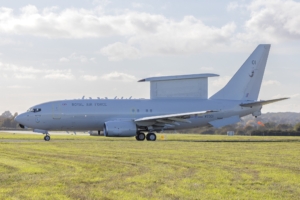
The aircraft wears full RAF markings with the historic sheathed, curved Arabian dagger or ‘Jambiya’ insignia of No.VIII Squadron, which previously operated the RAF’s E-3D Sentries, and before that the Avro Shackleton AEW.Mk 2. Delivery of the new aircraft will close a capability gap that opened up with the premature retirement of the E-3D in 2022. No.VIII’s yellow, blue and red ‘fighter bars’ flank the red and blue roundel on the rear fuselage, as they did on the Sentry and Shackleton. A small Union Flag and the legend ‘ROYAL AIR FORCE’ are applied on the upper part of the forward fuselage, and the insignia of NATO’s Airborne Early Warning & Control Force (NAEW&CF) is carried on the nose. The E-7 Wedgetail has recently been selected by NATO as its next AEW&C aircraft, so continued close co-operation is certain.

The UK’s three Wedgetails will serve with No. VIII Squadron at RAF Lossiemouth, in Scotland, where they will be co-located with the RAF’s nine Boeing P-8A Poseidon maritime patrol aircraft. Both types are military derivatives of the Boeing 737 Next Generation aircraft, and this basing will enable the RAF to take advantage of synergies between the two fleets. The Royal Air Force initially planned to procure five Wedgetail aircraft, though this was cut back to three for budgetary reasons, though five MESA radar sets were procured, because the last two were too late to cancel. Interestingly, the RoKAF has reportedly found four Wedgetails insufficient to guarantee and enduring ‘orbit’ 24/7, so the RAF fleet size does look inadequate to many observers and analysts. Budgetary pressures may mitigate against any increase in the fleet, though this is known to be an ‘aspiration’.

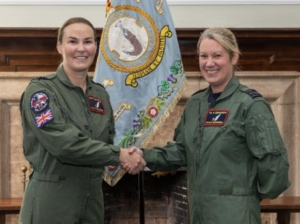
Wing Commander McDonnell, the Officer Commanding No.VIII Squadron noted that: “Seeing the first UK Wedgetail, painted, with a visual representation of No.8 Squadron’s history is an exciting moment in the journey towards operational capability for the squadron, for RAF Lossiemouth and the RAF.”