China’s all-electric COMAC CE-25A commuter aircraft emerges in new images

4 min read

New photographs appear to show a full-sized demonstrator of China’s CE-25A, an unusual 19-seat all-electric commuter aircraft designed for short- and medium-distance passenger transport.
Developed by state-owned aircraft manufacturer COMAC, the project showcases China’s ambitions to explore new approaches to electric aviation. However, questions remain over the demonstrator’s authenticity, flight status, and future role.
COMAC presents its first CE-25A demonstrator
Images circulating online appear to offer the clearest look yet at the CE-25A, an unconventional aircraft developed by the Commercial Aircraft Corporation of China (COMAC).
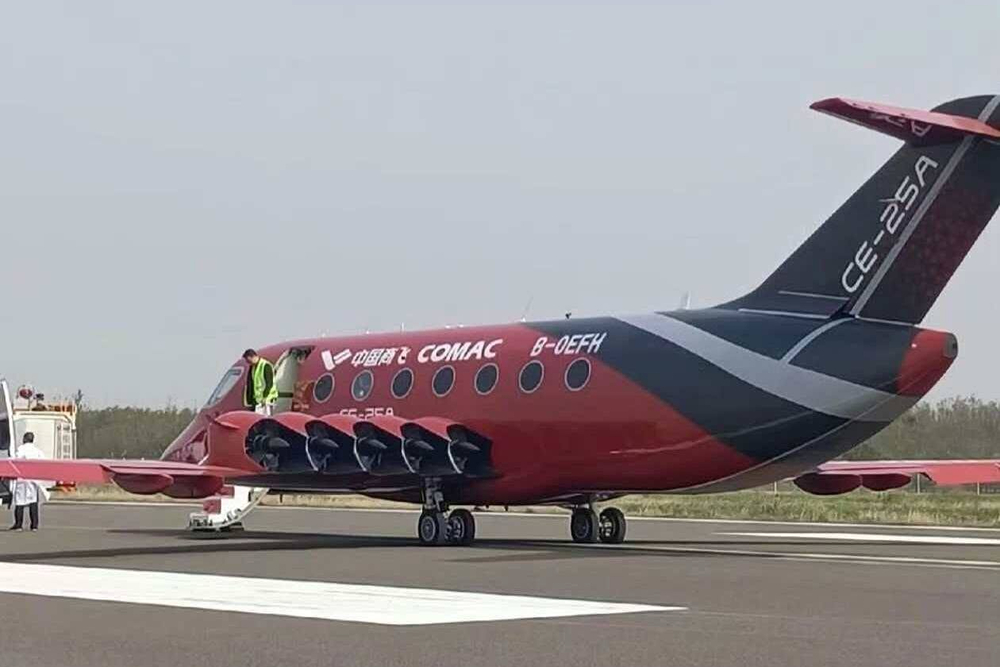
The photographs, reportedly shared by Chinese automotive blogger Han Lu on 28 October, show a red-and-black aircraft featuring COMAC and CE-25A markings.
Although the images appear plausible, their authenticity has not been conclusively established. It is also unclear whether the aircraft shown has flown or exactly how it fits into the programme’s development timeline.
What is the COMAC CE-25A?
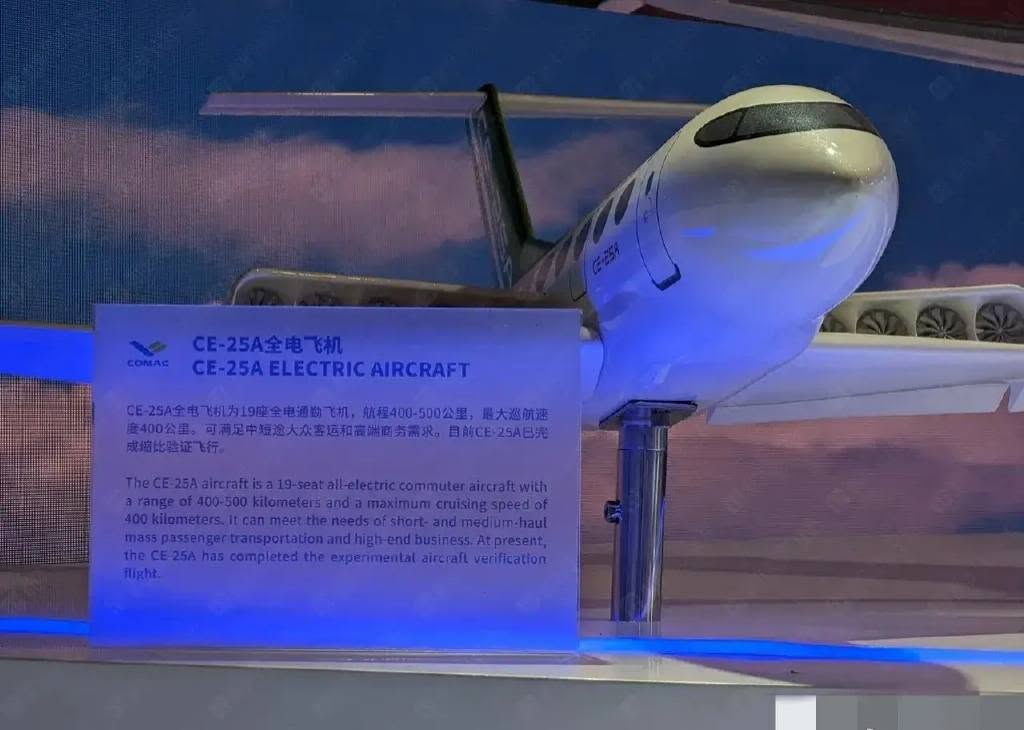
First publicly presented at the China International Import Expo in Shanghai in November 2023, the CE-25A is a proposed 19-seat, all-electric commuter aircraft intended for short- and medium-distance passenger transportation and business aviation.
The concept targets a market where smaller aircraft could connect regional destinations and provide point-to-point travel over relatively short distances. Its compact passenger capacity and proposed performance place it broadly within the regional commuter aircraft category.
According to previously published design specifications, the CE-25A is intended to achieve a cruising speed of approximately 400 kilometres per hour (248 mph) and a range of around 400 to 500 kilometres (250 to 310 miles).
These figures remain design targets rather than independently verified performance results for the aircraft shown in the photographs.
An unconventional all-electric propulsion system
The CE-25A’s most distinctive feature is its distributed electric propulsion system. Rather than using conventional turboprop engines, the aircraft is designed around 10 electrically driven ducted fans integrated into its wings.
This arrangement sets it apart from more conventional commuter aircraft, which typically rely on a smaller number of propellers driven by turbine engines.
Distributed electric propulsion offers designers new possibilities for integrating thrust generation with the aircraft’s aerodynamic design.
Depending on the configuration, multiple propulsion units could help improve aerodynamic efficiency and performance in particular flight conditions.

Electric motors can also offer mechanical simplicity compared with conventional turbine engines, potentially reducing some maintenance requirements.
Crucially, the CE-25A is described as an all-electric aircraft, meaning its intended propulsion system does not rely on conventional aviation fuel-burning engines.
However, its detailed battery configuration, energy-storage capacity, and charging requirements have not been fully established in publicly available information.
The challenges facing electric aviation
Despite the potential benefits, developing an all-electric passenger aircraft presents significant engineering challenges.
Batteries currently store considerably less energy per unit of weight than conventional aviation fuel. This places limitations on an aircraft’s range, payload and endurance, making battery technology one of the most important factors determining whether electric commuter aircraft can become commercially viable.
High-power electrical systems also require effective thermal management, while operating 10 separate propulsion units introduces additional considerations involving reliability, maintenance and flight control.
The CE-25A’s proposed range could make it suitable for relatively short regional journeys if its design targets are achieved.
Nevertheless, commercial viability would depend on demonstrated performance, passenger and baggage payload, operating costs, charging infrastructure and regulatory approval.
What happens next with the CE-25A?
The newly surfaced images raise questions about how far the CE-25A programme has progressed. COMAC previously discussed experimental aircraft verification work involving a scaled demonstrator, but the aircraft now appearing in photographs looks full-sized.
There is no clear public confirmation that the pictured aircraft has completed a flight, and its precise role in the development programme remains uncertain.
The project also reflects wider interest in electric propulsion across the aviation industry. Research programmes in Europe and the United States have explored similar technologies, although other designs have pursued different approaches, including hybrid-electric propulsion.
For COMAC, the CE-25A provides an opportunity to investigate technologies that could influence future aircraft development, including electric motors, power distribution, thermal management and the integration of multiple propulsion units.
Whether the CE-25A eventually enters commercial service remains to be seen. In the meantime, the aircraft represents an intriguing step in China’s exploration of all-electric aviation, with its 10-fan configuration offering a distinctive alternative to conventional regional aircraft designs.