Supercomputer set to take AI to the Moon aboard Astrolab rover

8 min read

A supercomputer capable of running artificial intelligence, including large language models, is preparing to travel to the Moon aboard a robotic rover later this year, in an experiment that could allow future lunar missions to analyse information and make decisions without constantly relying on controllers on Earth.
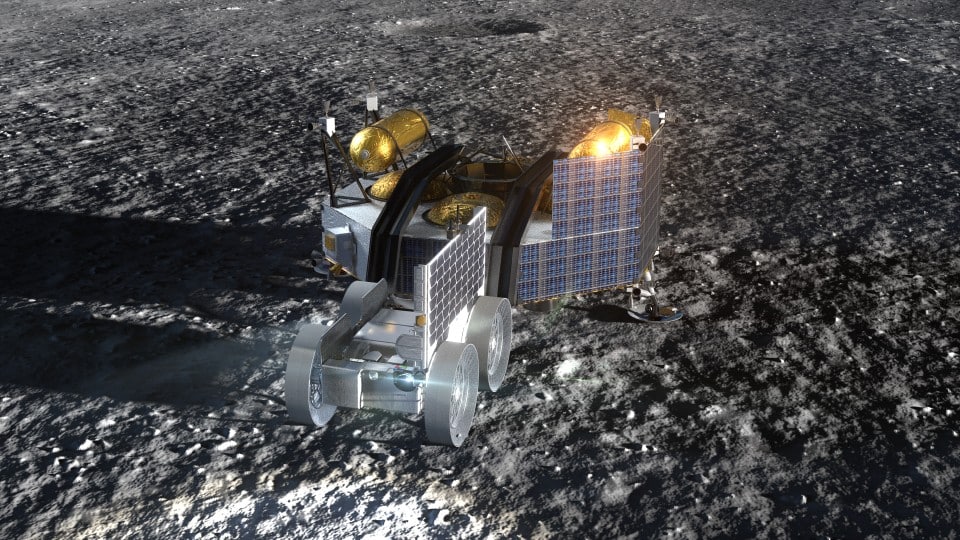
The Spaceborne Computer-4, developed by Hewlett Packard Enterprise (HPE), is one of approximately 20 scientific and technology payloads aboard Astrolab’s 480 kg FLIP lunar rover, which is being prepared for launch as early as November.
What will the FLIP lunar rover do on the Moon?
Alongside experiments involving artificial intelligence and advanced computing, the rover will carry instruments to map the lunar surface and investigate its composition.
The computer will attempt the first high-performance computing benchmarks on the lunar surface, alongside experiments involving AI-powered image analysis, navigation, document searches and cybersecurity.
The aim is to demonstrate that complex computing tasks normally performed in laboratories or data centres on Earth can be carried out directly on the Moon.
That capability could become increasingly important as NASA and commercial companies prepare for more frequent lunar missions, including operations in which robots must work for long periods without astronauts present.
HPE President and CEO Antonio Neri emphasised the importance of processing information directly on the Moon rather than relying entirely on computing facilities on Earth.
“As lunar activity accelerates, the ability to process data where it’s created will be critical to unlocking new scientific insights and supporting autonomous, sustained operations,” Neri wrote on LinkedIn.
He highlighted the company’s collaboration with NASA, the International Space Station National Laboratory, Astrolab, KIOXIA and Deloitte on the mission.
Scott Wiest, HPE’s vice president, fellow and global sales chief technologist said, “The next chapter of lunar exploration will depend on the ability to turn data into insights at the point of discovery.”
“With HPE Spaceborne Computer-4, we are bringing AI and high-performance computing to the lunar edge, helping the acceleration of scientific discovery and building the infrastructure for the next era of exploration,” Wiest added.
The mission is expected to launch in November 2026 under NASA’s Commercial Lunar Payload Services (CLPS) initiative. Its success, including the computer’s performance in the lunar environment, remains to be demonstrated.
Why take a supercomputer to the Moon?
Spacecraft traditionally collect information and transmit much of it to Earth, where engineers and scientists analyse the results and send instructions back.
That approach works, but communications take time and bandwidth is limited. The difficulty becomes greater as missions travel further from Earth.
A computer capable of processing images, identifying hazards and interpreting scientific observations directly aboard a rover could reduce the amount of information that must be transmitted.
This approach is known as edge computing: instead of sending everything to a distant data centre, information is processed close to where it is collected.
HPE’s system will combine a central processing unit, or CPU, with a graphics processing unit, or GPU. The CPU handles general computing tasks, while the GPU can perform many calculations simultaneously, making it useful for AI and image processing.
High-performance computing, or HPC, refers to using substantial computing power to solve complex problems. On FLIP, the objective is not to reproduce a large terrestrial supercomputer, but to test advanced computing workloads using a compact module designed for space.
The distinction is important. The planned lunar experiments will assess whether such technology can operate reliably under conditions that are very different from those on Earth.
AI that can read, analyse and navigate
Among the experiments planned for the mission are specialised large language models, or LLMs, the type of AI technology used in conversational systems.
On the Moon, their role will be different from answering everyday questions.
The models will be tested on tasks such as searching technical documents, interpreting information and helping researchers make sense of data collected by the rover.
HPE also plans to process images and measurements from LiDAR, a laser-based system that measures distances to surrounding objects and builds three-dimensional maps. Such information could help a rover recognise obstacles, understand the terrain and identify safer routes.
NASA will contribute two AI experiments. One, called Federated Learning for Unbounded and Intelligent Decentralization (FLUID), will demonstrate coordination between three AI models using data associated with Earth, the Moon and the International Space Station.
The other will test a specially adapted language model that can search and interpret documents stored aboard the spacecraft.
Deloitte will contribute Silent Shield, a system intended to identify unusual computer activity and potential cyber intrusions.
The experiments are demonstrations, not evidence that an AI system is ready to control future lunar missions independently.
Surviving the lunar environment
Running advanced computing equipment on the Moon presents difficulties that do not exist inside an ordinary data centre.
There is almost no atmosphere to carry away heat, temperatures vary enormously between sunlit and shaded areas, and electronics are exposed to radiation.
HPE has designed Spaceborne Computer-4 as a lightweight, self-contained unit without conventional cooling fans. It will use the rover’s thermal management system to help control its temperature.
The module includes low-power processors and solid-state storage supplied by KIOXIA. Unlike traditional hard drives, solid-state drives have no moving parts.
HPE is also using software to protect the computer against radiation-related disturbances.
As MIT Technology Review reported on 20 October, the company’s approach builds on earlier Spaceborne computers tested aboard the International Space Station. The software monitors the system for problems and can reduce processing speed and power when radiation conditions become hazardous.
HPE chief scientist and principal investigator Mark Fernandez explained the difficulty of operating equipment that cannot be repaired easily.
“In space, we don’t have the redundancy, we don’t have the repairman, we don’t have the spare parts,” he said, according to MIT Technology Review.
The company has previously flown three generations of Spaceborne computers to the ISS. The programme has demonstrated that commercially derived computing hardware can operate in space with appropriate protection.
In 2025, the ISS programme also tested Meta’s Llama 3.2 language model as part of the Space Llama initiative.
The Moon presents a tougher test because the equipment will operate outside the comparatively controlled environment of a crewed space station.
Astrolab’s rover and the Artemis connection
The computer will travel aboard FLIP, short for FLEX Lunar Innovation Platform, an approximately 480-kilogram robotic rover developed by California-based Venturi Astrolab.
FLIP is intended to carry around 20 scientific and technology payloads, including equipment for mapping the lunar surface and investigating the composition of lunar soil.
The rover uses specialised deformable wheels designed to maintain traction on uneven terrain.
It is scheduled to be delivered near the lunar south pole aboard the Griffin-1 lander, part of NASA’s CLPS programme, which purchases lunar delivery services from commercial companies.
Astrolab founder and chief executive Jaret Matthews said the rover would provide an opportunity to test technologies under actual lunar conditions.
“Our FLIP rover is designed to accommodate a variety of payloads, and this mission will demonstrate how commercial lunar mobility platforms can support technology development and scientific research.”
Astrolab also has a separate role in NASA’s Artemis lunar exploration programme.
In May 2026, NASA selected the company as one of two providers of crewed lunar rovers under its revised surface mobility plans.
The approximately $219 million task order covers development and delivery of the CLV-1 vehicle, which is intended to transport astronauts and equipment around the lunar south pole.
CLV-1 is a different vehicle from FLIP. It is designed to carry astronauts, while FLIP is an uncrewed technology and science platform.
The crewed rover draws on Astrolab’s FLEX architecture and technology developed with Venturi Space, including wheels, batteries and battery management systems.
NASA expects the newly contracted crewed vehicles to reach the Moon by 2028.
NASA is already using AI to study the Moon
The planned computing experiment comes as NASA expands the use of artificial intelligence in lunar research.
In September, NASA and IBM released a Lunar Foundation Model trained primarily on images collected by the Lunar Reconnaissance Orbiter.
The model was developed using roughly two million image tiles, including more than one million high-resolution camera images and nearly 964,000 multispectral images.
Researchers can adapt it to identify craters, investigate volcanic features and estimate where ice might remain stable near the lunar poles.
Kevin Murphy, NASA’s chief science data officer and acting chief data and AI officer, said the challenge was making decades of observations easier to use.
“We also have to make data easier for scientists to explore and use,” he said.
Unlike HPE’s proposed lunar experiment, the NASA-IBM model is designed for scientific analysis rather than specifically for operation aboard FLIP. Both developments, however, reflect growing interest in using AI to extract useful information from large quantities of space data.
From experiment to future lunar operations
The immediate objective for HPE is to establish that advanced computing can function reliably on the lunar surface.
Its planned tests include two established computing benchmarks, High Performance LINPACK and High Performance Conjugate Gradient, which measure different aspects of a computer’s ability to perform demanding calculations.
HPE will also support Astrolab’s mission control in Hawthorne, California, using its private cloud and operations software.