


NASA tests glowing paint to help design the next generation of flexible wings

5 min read
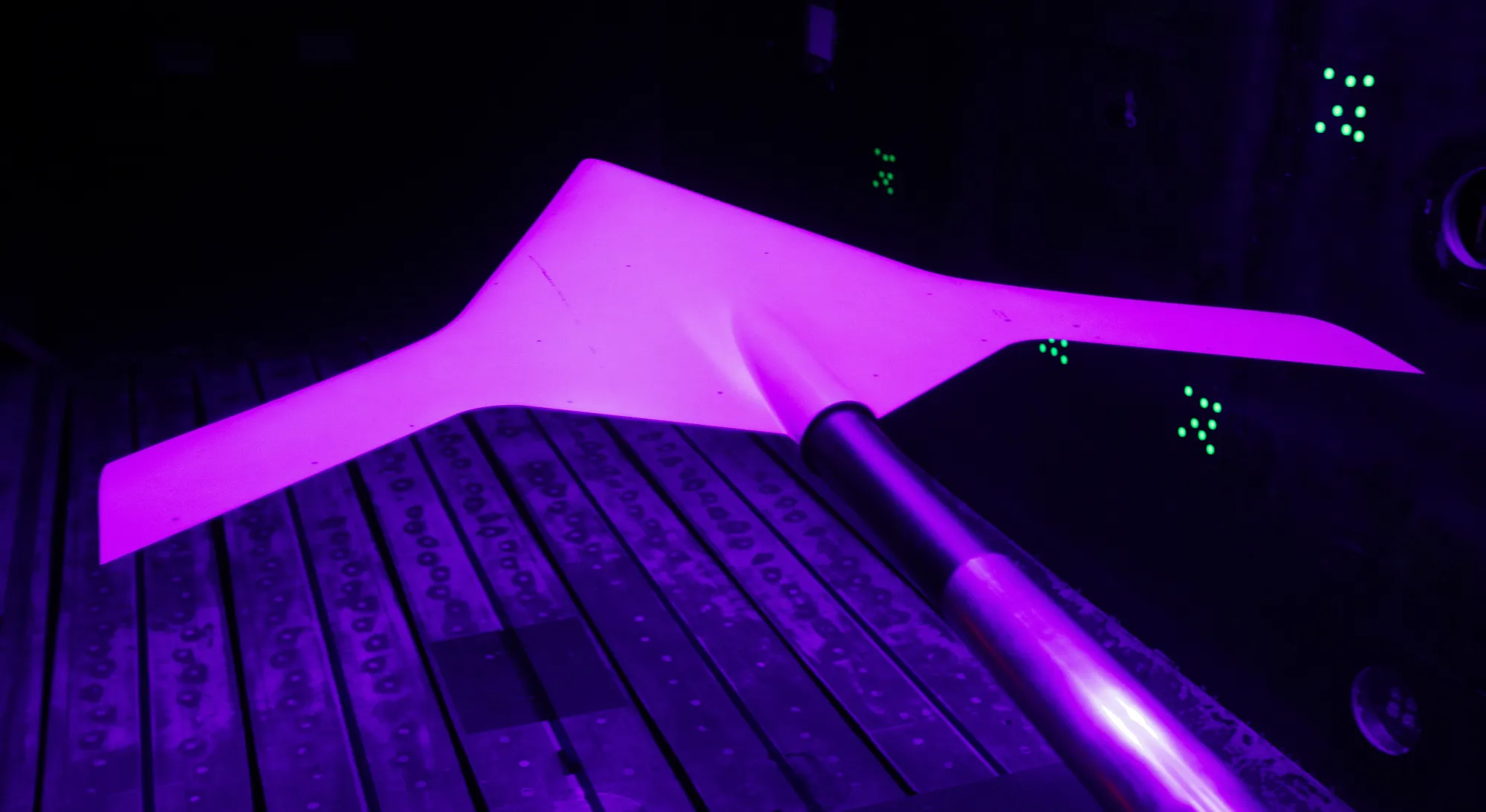
NASA has successfully tested a pressure-sensitive paint on a large, freely moving aircraft wing model for the first time in a low-oxygen wind tunnel, demonstrating a new way to measure the changing aerodynamic forces that can cause wings to bend and vibrate during flight.
The experiment, conducted at NASA’s Langley Research Center in Hampton, Virginia, used a specialised coating that glows pink-purple under ultraviolet light. High-speed cameras recorded changes in the paint’s brightness as air flowed across the wing, allowing researchers to measure how pressure varied over its surface.
NASA announced the milestone on 2 October, saying the results could support future tests of flexible wings designed to bend and adapt during flight. Such designs are being studied as a means of improving aircraft efficiency, but engineers must understand how the movement of a wing interacts with the air flowing around it.
The latest experiment builds on several years of work by NASA to improve pressure-sensitive paint technology. It also follows separate research reported by Aerospace Global News in September, when scientists at the University of Manchester developed a formulation that reduced temperature-related errors in aerodynamic measurements.
How NASA’s glowing paint measures airflow
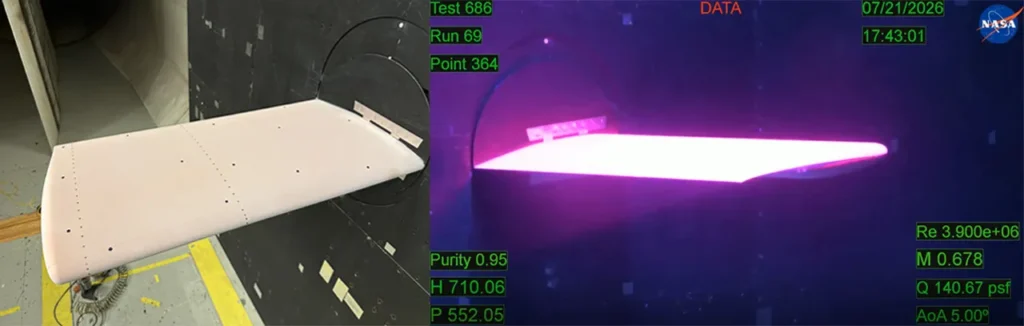
The Langley experiment used a standard research model known as the Benchmark Supercritical Wing inside NASA’s Transonic Dynamics Tunnel. The model is not a replica of a particular aircraft. Instead, it provides a common test subject that engineers can use to compare wind tunnel measurements with computer predictions.
The paint contains light-sensitive materials whose brightness changes in response to pressure. When the coated wing is illuminated, cameras capture those changes, and computer processing converts the images into measurements showing how aerodynamic pressure varies across the surface.
Traditional wind tunnel experiments often use small holes drilled into a model, connected to pressure sensors through tubes. These instruments provide accurate readings at selected points, but engineers must estimate what is happening between them.
Pressure-sensitive paint provides measurements across the coated area, revealing pressure patterns that individual sensors might miss.
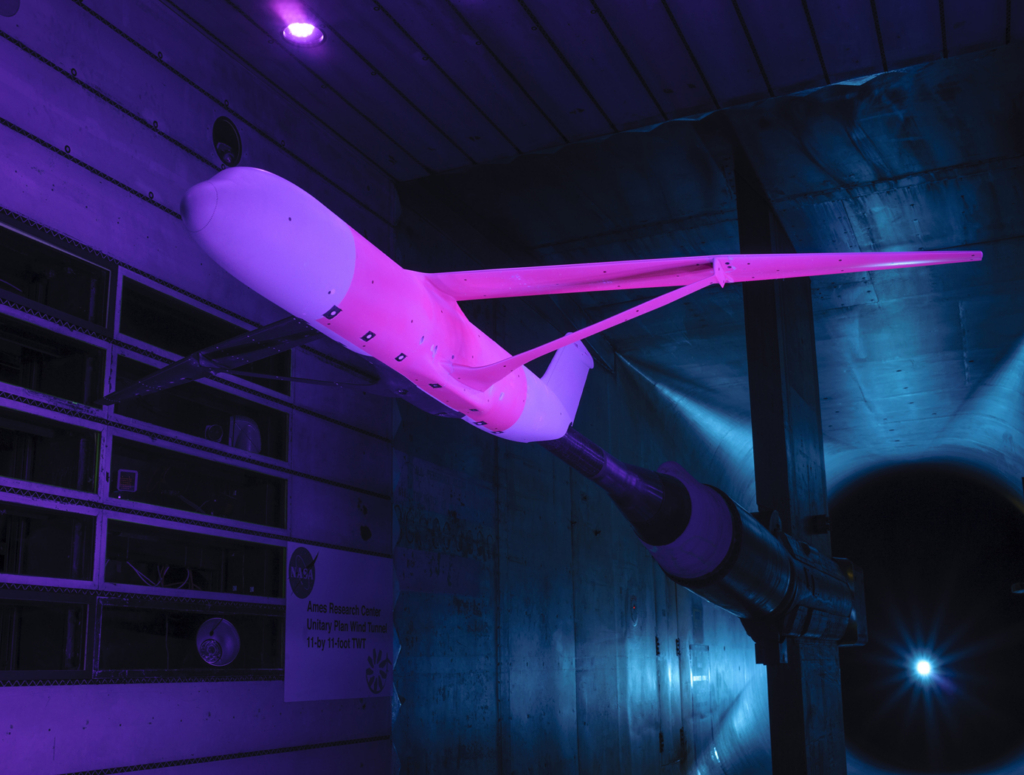
NASA has used conventional pressure-sensitive paint for more than a decade. Its newer technique, called unsteady pressure-sensitive paint, or uPSP, can also capture rapid changes in pressure caused by turbulent airflow and other disturbances.
These fluctuations are important because air does not always pass smoothly over an aircraft. Changes in airflow can produce uneven forces, vibrations and movements that affect how the structure behaves.
The latest test was particularly demanding because the wing model was free to move rather than being held completely rigid, and the experiment took place in a low-oxygen environment.
NASA said this was the first time the technique had been demonstrated under that combination of conditions on a large-scale model.
Why moving wings matter
An aircraft wing must withstand changing forces throughout a flight. As it moves through the air, pressure differences generate lift, while turbulence and other disturbances can cause the structure to flex or vibrate.
Engineers refer to the interaction between aerodynamic forces and structural movement as aeroelasticity. Understanding it is particularly important when developing lightweight wings that may bend more than those on conventional aircraft.
If aerodynamic forces and structural movement reinforce each other under certain conditions, the resulting vibrations can become dangerous. Aircraft designers therefore need reliable measurements to predict how a wing will respond across its operating conditions.
NASA’s new experiment allows researchers to collect detailed pressure information while the test model is moving. The data can then be compared with computer simulations used to predict aerodynamic loads and structural behaviour.
The agency said the demonstration would help prepare for experiments involving flexible aircraft models intended to change shape during flight.
NASA makes wind tunnel data available much faster
The latest achievement follows a major improvement in NASA’s ability to collect and process pressure-sensitive paint measurements.
In July 2025, the agency reported that advances in high-speed cameras, more sensitive coatings and supercomputing had made its measurement process approximately 10,000 times faster, while producing engineering visualisations with 1,000 times greater resolution.
NASA said some datasets could be processed in as little as 20 minutes, allowing engineers to review the results and adjust their experiments while a wind tunnel test was still underway.
Previously, analysing measurements could take days or weeks. If researchers discovered that additional information was needed, arranging another wind tunnel session could introduce further delays.
“The result of these improvements provides a data product that is immediately useful to aerodynamic engineers, structural engineers, or engineers from other disciplines,” said E. Lara Lash, an aerospace engineer at NASA’s Ames Research Center in California.
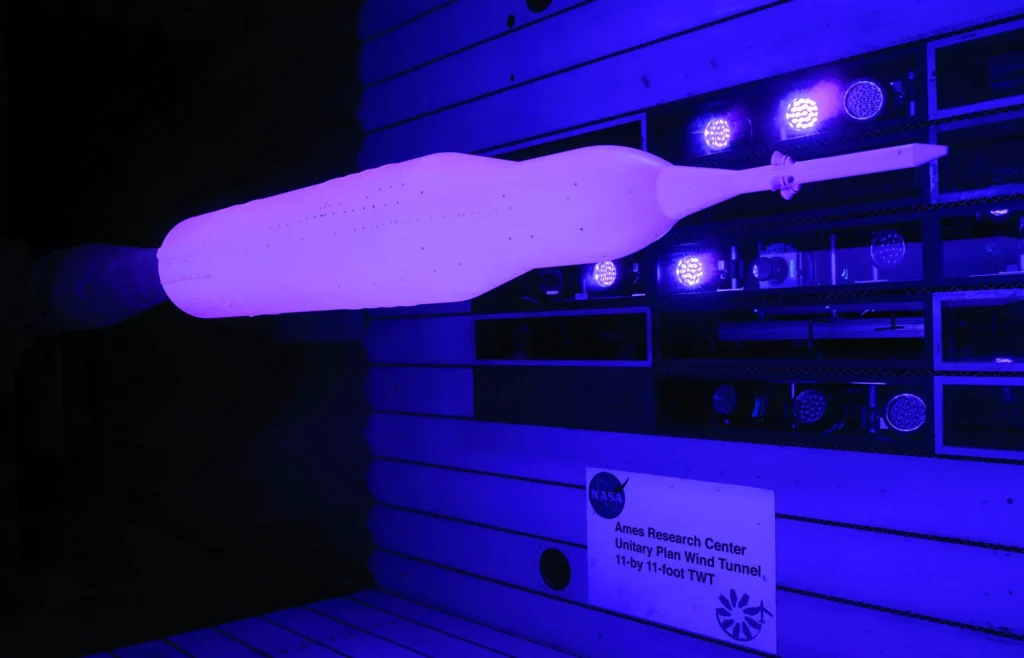
The improvements emerged from a five-year NASA research effort that began in 2019 and concluded at the end of 2024. Much of the work was carried out at Ames, where researchers connected an 11-foot transonic wind tunnel to the NASA Advanced Supercomputing Facility.
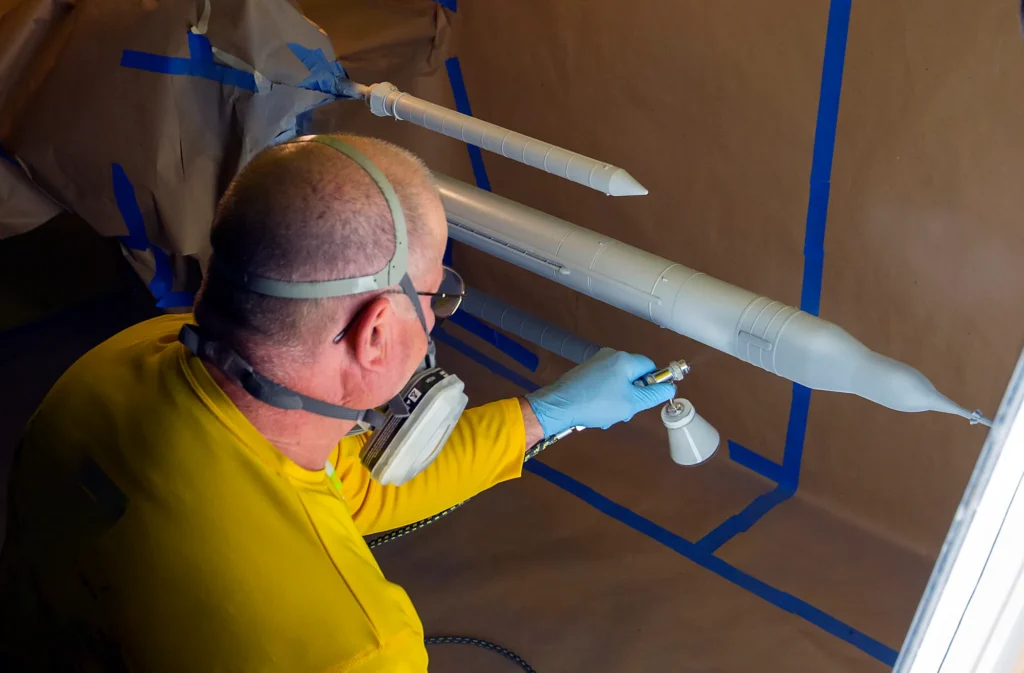
A scale model of NASA’s Space Launch System rocket was used during the development programme. The agency has also used pressure-sensitive paint in earlier tests involving aircraft wing models.
Lash said the technology could help engineers identify structural problems that might otherwise be difficult to predict.
“Aerodynamic forces can vibrate different parts of the vehicle to different degrees,” she explained. “Vibrations could damage what the vehicle is carrying or can even lead to the vehicle tearing itself apart. The data we get through this process can help us prevent that.”
From research models to future aircraft
NASA is developing the technology for use in aircraft and spacecraft testing, with the longer-term aim of making the improved capability available across its wind tunnel facilities.
The agency has also indicated that researchers from industry, universities and other government organisations could use the system.
Robert Pearce, NASA’s associate administrator for aeronautics, who recently saw a demonstration of uPSP-generated data displayed at Ames, hailed the new tool as a national asset that will be available to researchers all over the country.
“It’s a unique NASA innovation that isn’t offered anywhere else,” Pearce said. “It will help us maintain NASA’s world leadership in wind tunnel capabilities.”


