


ESA’s BepiColombo begins Mercury arrival phase after eight years in space

3 min read
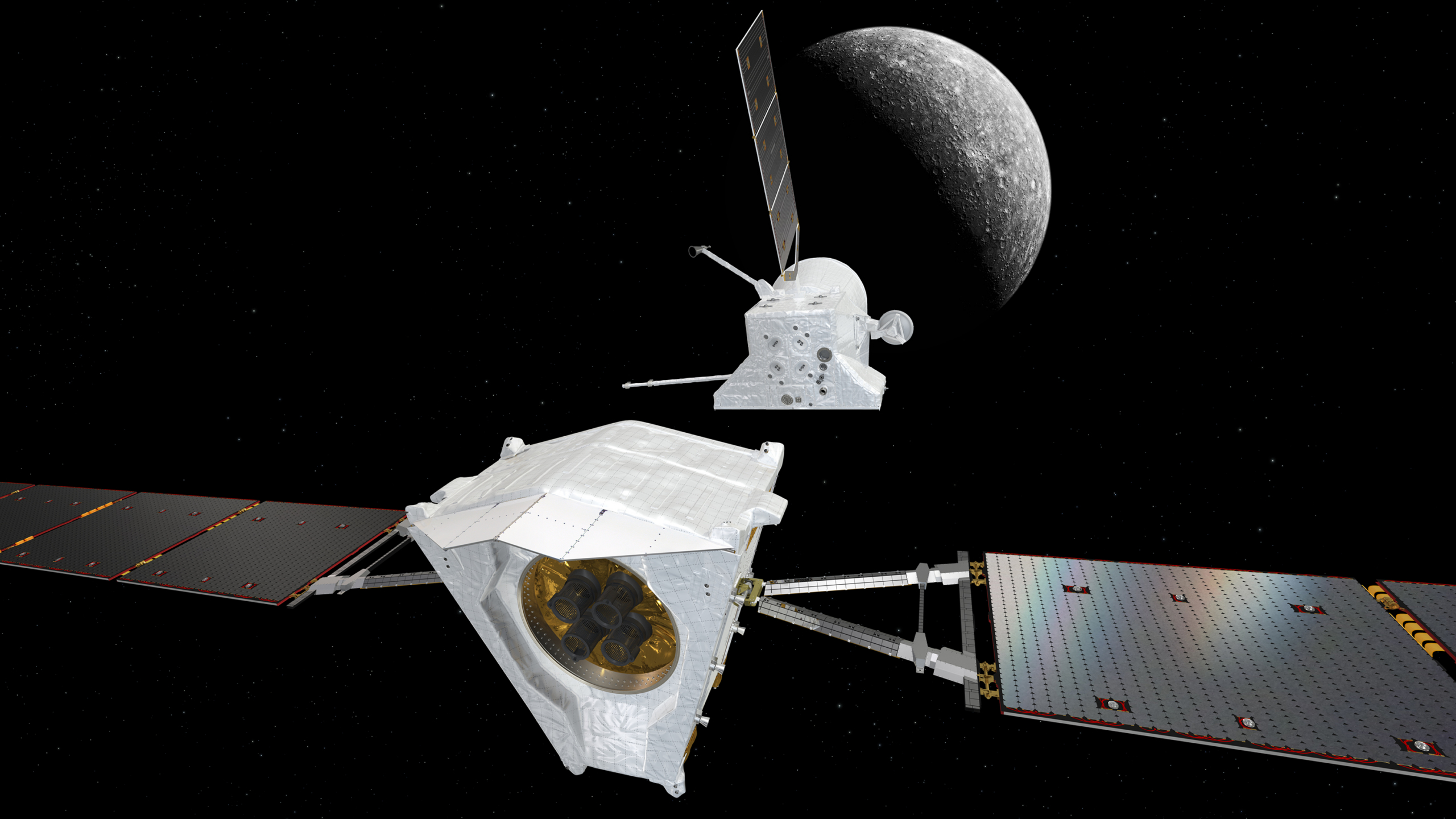
The European Space Agency (ESA) has reported that after eight years of travelling through the inner Solar System, its BepiColombo mission is now arriving at Mercury.
BepiColombo arriving at Mercury and starting to separate
The arrival phase of BepiColombo began with the separation of the Mercury Transfer Module (MTM) from the spacecraft stack yesterday. The successful separation of MTM has been confirmed, and current telemetry indicates all systems are nominal.
BepiColombo is now over 200 million kilometres from Earth. At this distance, the time lag for communication is around 11 minutes one-way, and over 22 minutes return. This makes real-time control impossible.
BepiColombo consists of two spacecraft, the European Space Agency’s Mercury Planetary Orbiter (MPO) and the JAXA Mercury Magnetospheric Orbiter (Mio). It is the first mission to orbit Mercury with two dedicated science spacecraft operating simultaneously.
Mercury Transfer Module separation confirmed! 📡 ✅
— European Space Agency (@esa) September 3, 2026
After nearly eight years in space and billions of kilometres travelled, #BepiColombo's Mercury Transfer Module has successfully separated.
Signal acquired via our Cebreros deep-space antenna confirms the spacecraft is healthy… pic.twitter.com/es5v8DqpAT
Now the two spacecraft will continue as one and enter orbit around Mercury on the 21 November 2026. The European and Japanese spacecraft will then separate from each other on the 9th or 10th of December. MPO will continue to power the spacecraft stack until Mio separates.
After that, the mission’s science phase will begin in April 2027. Currently, MPO’s solar panels are charging the spacecraft’s batteries.
The eight-year journey from Europe’s Spaceport to Mercury
ESA describes BepiColombo as “a world-class science mission led by the European Space Agency (ESA) in close collaboration with the Japan Aerospace Exploration Agency (JAXA).” The two orbiters are designed to be complementary to each other.
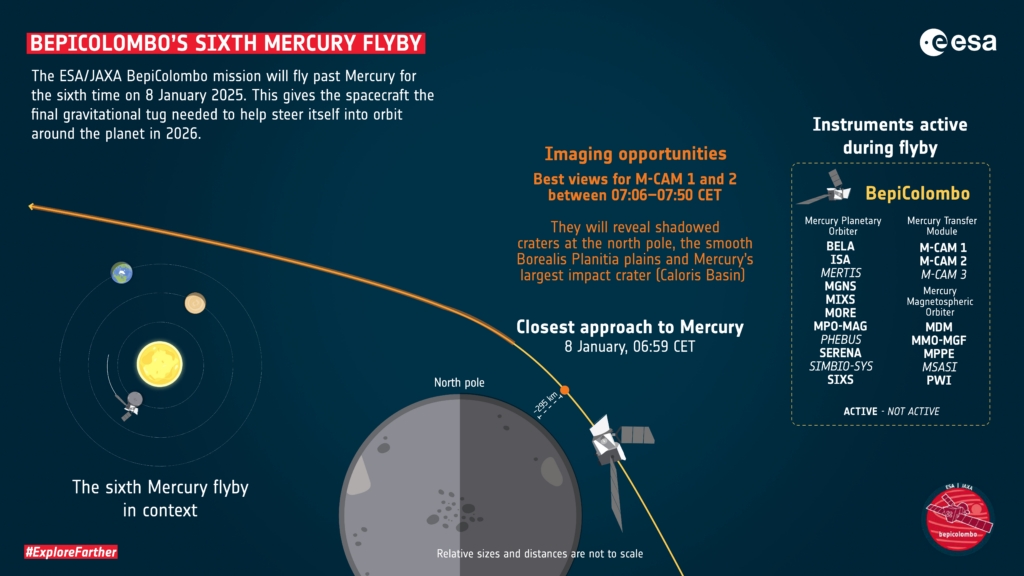
The mission launched from Earth on the 20 October 2018 on an Ariane 5 rocket from Europe’s Spaceport. Its components include the Mercury Planetary Orbiter, the Mercury Magnetospheric Orbiter, and the Mercury Transfer Module
The mission conducted Mercury flybys in October 2021, June 2022, June 2023, September 2024, December 2024, and January 2025, and will arrive at Mercury in December 2026.
The most complex mission ever to orbit Mercury
BepiColombo is the second and the most complex mission ever to orbit Mercury. Its purpose is to learn more about the history of the Solar System.
Due to the planet’s proximity to the Sun, it is harder for an orbiter to reach than the planet Saturn and is the least explored planet of the inner Solar System.
ESA says, “The mission will try to answer many perplexing questions, such as: Why is there ice in the polar craters of the scorched planet? Why does Mercury have a magnetic field? And what are the mysterious ‘hollows’ on its surface?”
While many missions, especially those focused on ice, are related to discovering life in the Solar System, this mission is not. Despite the presence of ice, Mercury is considered one of the least promising places to find life.
Instead, the focus is on geology, geophysics, and space physics to understand why Mercury is such a strange planet. Mercury is unusual because around 85% of its radius is occupied by its metallic core, and the mission hopes to find out if the core is fully or partly liquid, how thick the mantle is, and how the planet formed.
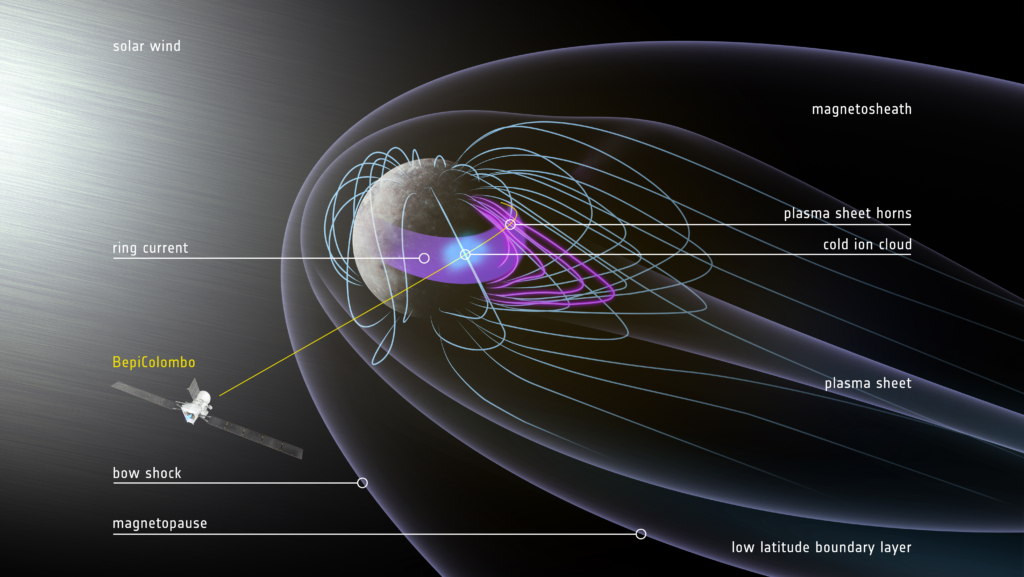
The European MPO will head for a low orbit and map Mercury itself, including the surface, gravity, interior, and exosphere. The Japanese Mio will settle into a high elliptical orbit and study the space environment around Mercury, including the magnetic field, plasma, solar wind, and dust.


