Meet EAGLE, the 50,000-passenger flying ship aiming to transform global travel

6 min read
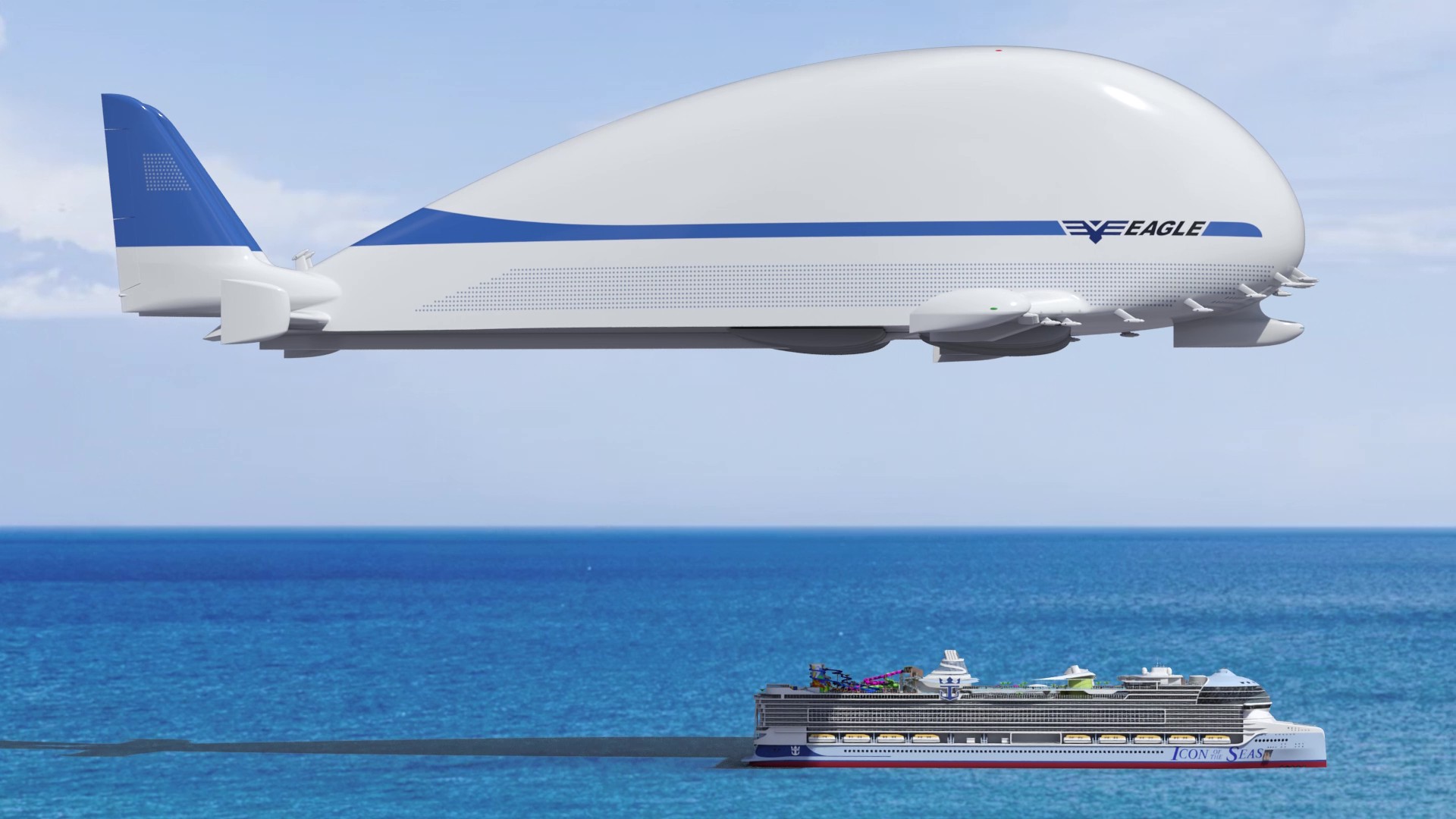
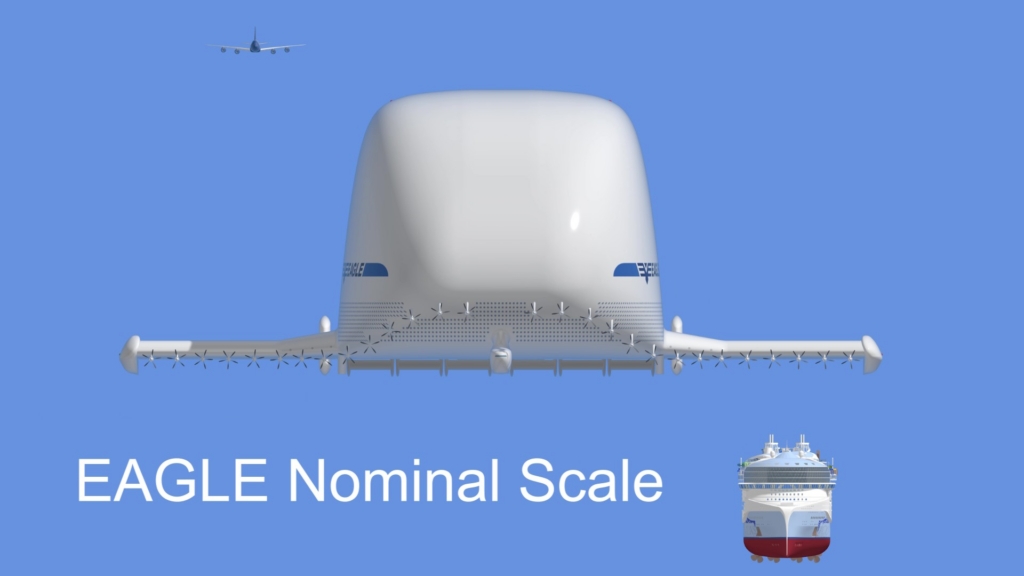
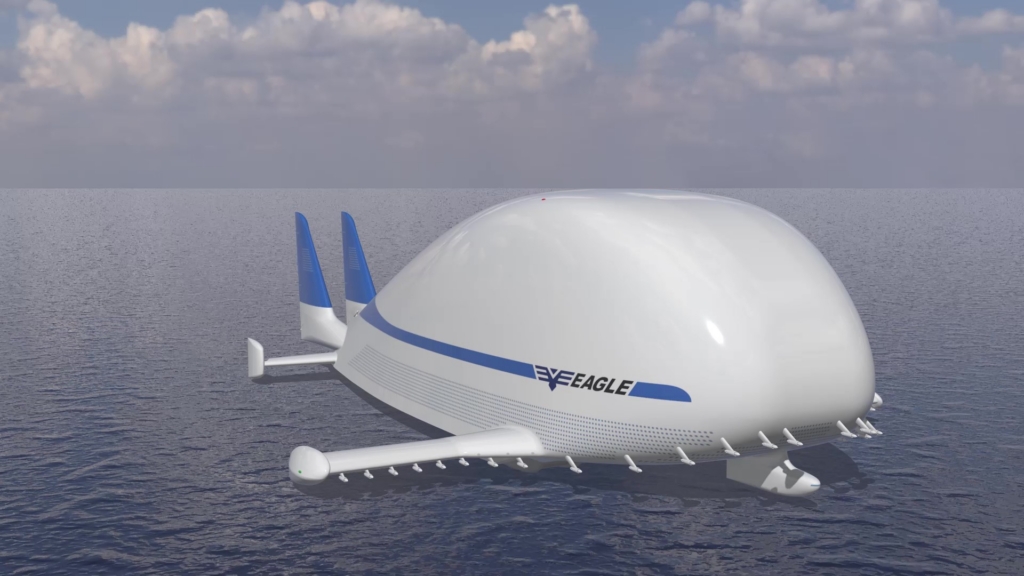
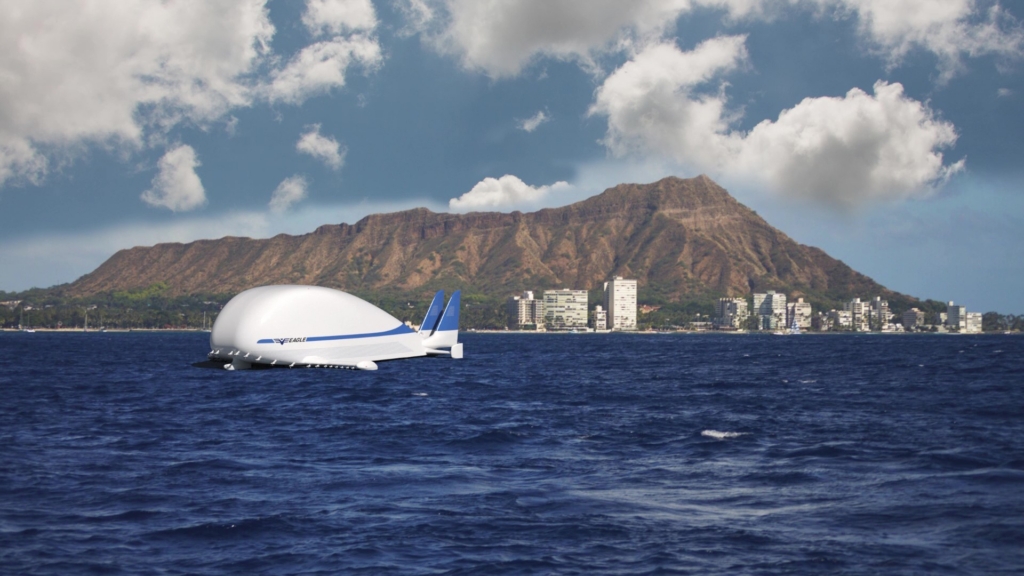
Picture a vessel, the size of seven football fields, skimming 50 feet above the ocean at 260mph.
Carrying 50,000 passengers and more than 1,000 shipping containers as it circumnavigates the globe, it would be one of the largest moving structures ever built.
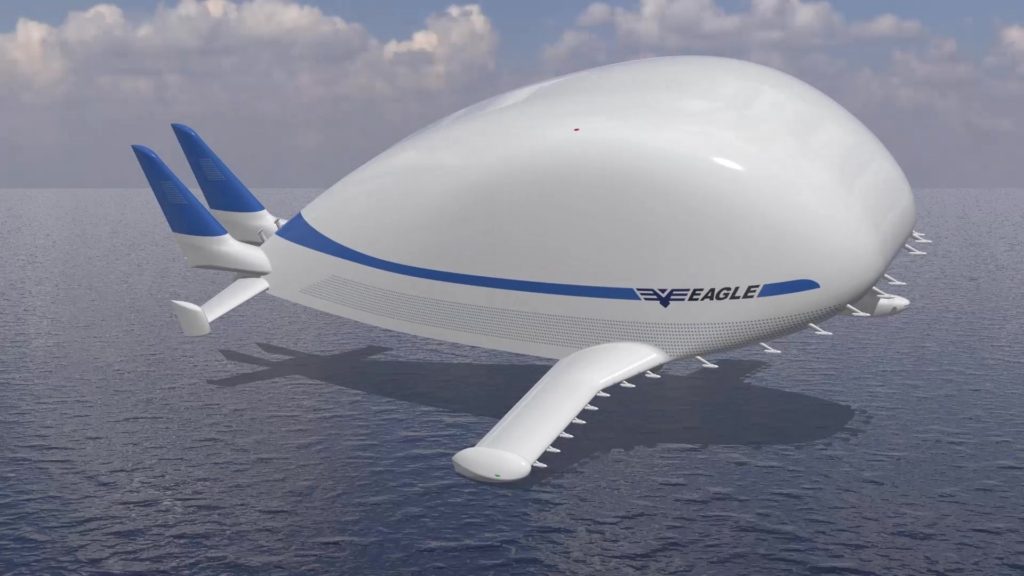
With 30 liquid-hydrogen-powered propellers, the Ecofriendly Airborne Global Luxury Ekranoplan (EAGLE) would emit no carbon dioxide and leave no contrails.
An ekranoplan, also known as a wing-in-ground-effect vehicle, flies just above the water using a cushion of air to improve efficiency.
It sounds like something out of a sci-fi film. But its inventor Dr Mithra Sankrithi believes the EAGLE could be operational by 2035.
A background with Boeing
An inventor and “disruptor”, Sankrithi earned his Princeton doctorate in 1983 with a thesis on a ground-effect vehicle, an aerodynamically levitated alternative to maglev trains. He then spent 37 years at Boeing, including as product development chief for advanced concepts, working on the 777 and 787 programmes and contributing to various undisclosed projects in the airframe manufacturer’s patent portfolio.
After retiring in 2020, Sankrithi turned to climate technology and renewable energy through a small nonprofit company he co-founded with his wife. However, he says, “the brain cells of an airplane person don’t quit thinking about airplanes.”
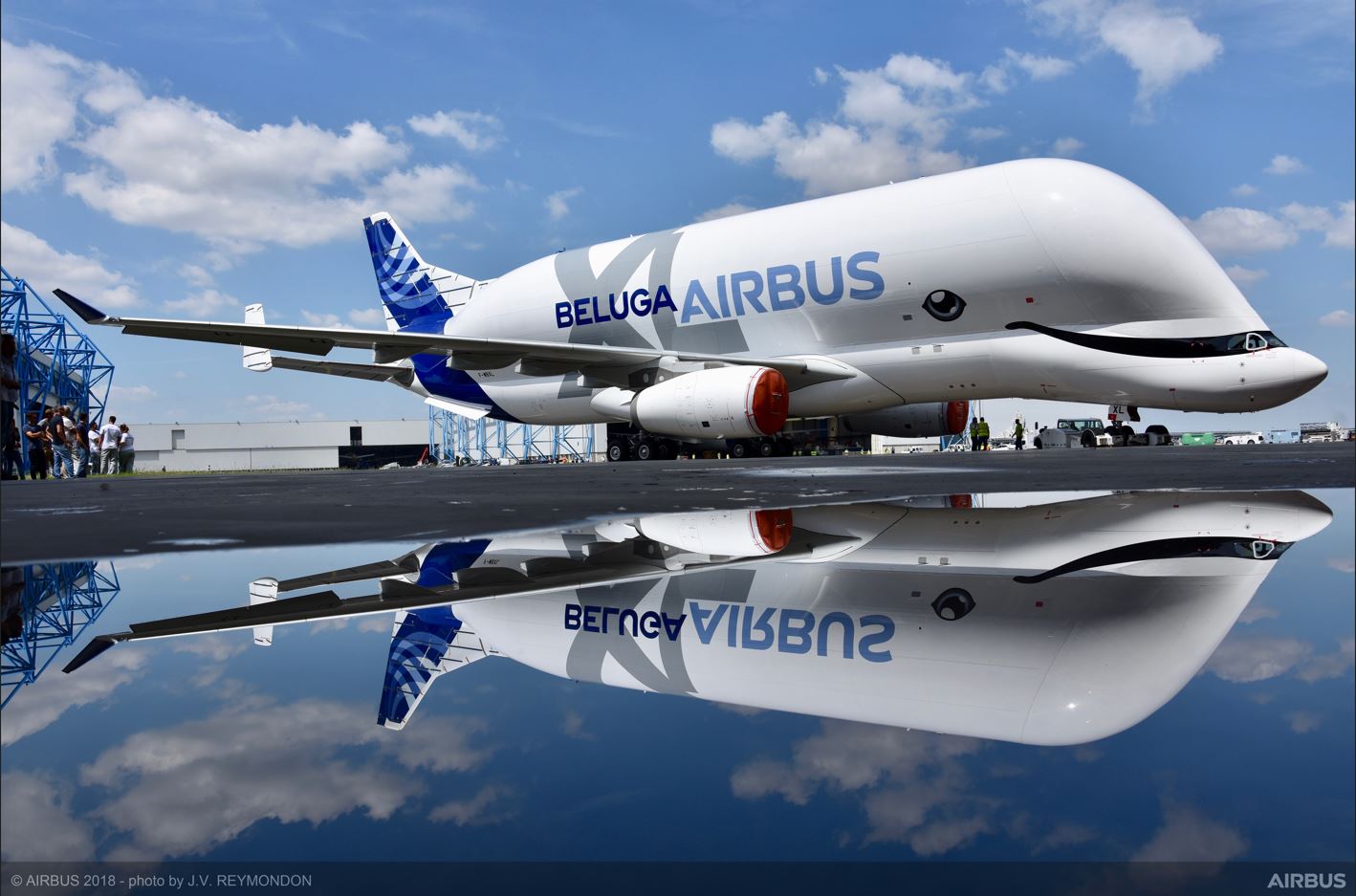
Describing both air and sea transport as brutally hard to decarbonise, Sankrithi says the EAGLE is his answer to decarbonising long-haul transport. It is a “flying ship” not totally unlike Airbus’ Beluga super transporter in looks, that uses ground effect, the cushion of extra lift a wing gets close to a surface. The technology, similar to that being developed by Regent Craft for its Viceroy Seaglider, would be certified by the International Maritime Organisation rather than aviation regulators.
Georgia Tech’s Aerospace Systems Design Lab studied the EAGLE concept for a year under Professor Dmitri Mavris, with faculty, postdocs, and students under a non-disclosure agreement. It was unveiled at the ICAS conference in Sydney, with the first patent issued just weeks ago.
How the EAGLE ekranoplan works
The Ekranoplan’s scale is the key differentiator. Sankrithi explains that ground-effect efficiency improves as a vehicle’s span grows relative to wave height, and that lifting gas (helium and hydrogen supply part of the lift) favours size too. EAGLE’s roughly 100 million pounds at maximum take-off weight is heavy for an aircraft. However, Sankrithi notes many ships weigh “substantially more”.
The operating model is another distinction. A handful of vessels would circle the globe, making 30 to 45 stops a week, with one vessel heading east and another west. Passengers and cargo would transfer via barges operating a rapid-turnaround concept borrowed from motor-racing pit stops.
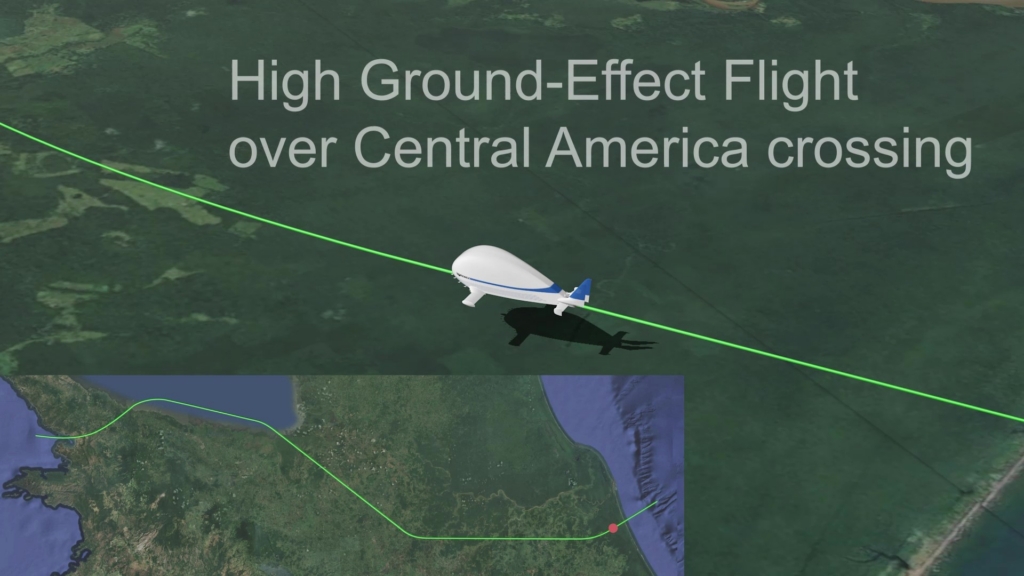
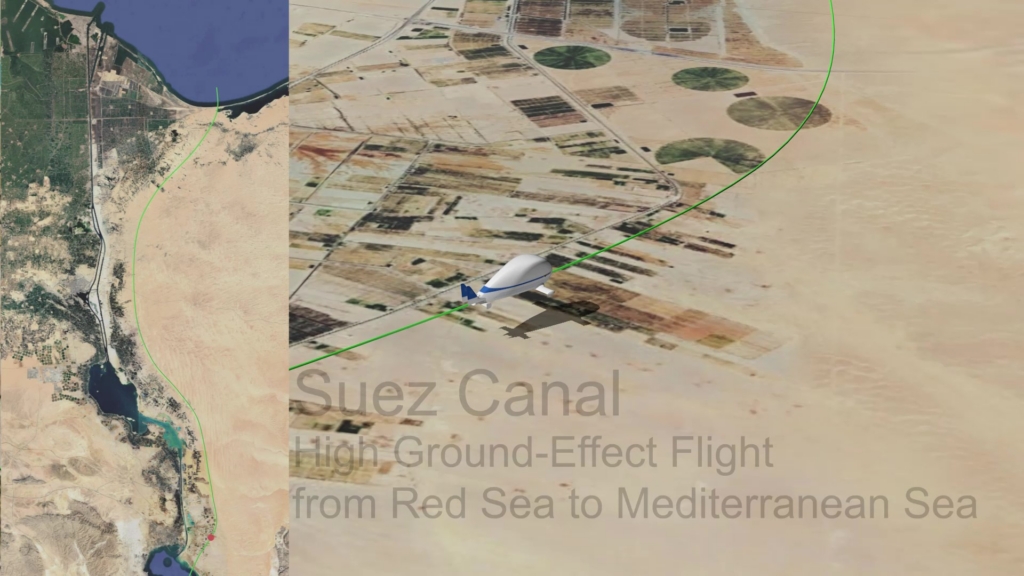
While the vessel will typically fly 50 feet above the ocean, which gives it plenty of clearance from waves, Sankrithi explains that when it has to fly parallel to somewhere like the Suez Canal and make short land crossings, it will fly at 900 feet above the surface and still be in ground effect.
Onboard, comfort is key, with Sankrithi likening the passenger experience to a mega cruise ship with entertainment and sports facilities (although not swimming pools due to the weight of water), a variety of dining options and luxurious suites for VIP passengers. Even economy passengers will have seats that convert to flat beds.
EAGLE’s headline numbers, compared with a best-in-class airliner, cruise ship, and container ship, are certainly striking.
- Emissions: Zero CO2 against 115 grammes per seat mile for an airliner.
- Energy: About 1.7 megajoules per seat mile comparable to an airliner’s 1.57
- Comfort: 145 sq. ft. of cabin per passenger, versus 12.8 on a jet, with a flatbed for every economy passenger.
- Cost: Roughly seven cents per seat-mile, against around 17 cents for an airliner, and 45 cents per tonne-mile for cargo. That’s less than half an airliner’s, but above a container ship’s two cents.
The trade-off is speed. At about half a jetliner’s pace, transatlantic journeys would take roughly twice as long, but passengers would stroll around a vessel “so steady it wouldn’t need seatbelts,” notes Sankrithi.
What the EAGLE could mean for the future of travel
If it ever enters service, EAGLE would blur the lines between airline, cruise line and container shipper, offering intercontinental travel at a fraction of today’s fares while addressing aviation’s emissions challenge. Sankrithi argues it sits where three growing markets meet: “air travel, cruising and global freight.” Ordinary travellers, he says, not just the wealthy would gain from cheaper, more environmentally friendly long-haul trips.
However, the gap between a study and a nearly 800-metre hydrogen-fuelled ship remains vast, and Sankrithi concedes much of it.
He says none of the technology is “voodoo” or “beyond the laws of science.” Most of it is already nearing technology readiness. That is true of components such as ground-effect flight, lifting gas and composites. “EAGLE is immense in scale, but it’s really the clever application of known technologies,” he asserts. Yet he acknowledges that the only comparable full-scale vehicle, the Soviet “Caspian Sea Monster”, weighed a small fraction of EAGLE and would be dwarfed by the giant vessel. Controlling something this big in rough seas, at 260mph remains unproven.
What would the supporting infrastructure look like?
Then there is the infrastructure. Liquid hydrogen would have to be available at dozens of ports worldwide, a supply chain that barely exists. There’s also the small challenge of the ports themselves needing to be big enough to harbour the EAGLE. Meanwhile, loading and offloading cargo and thousands of passengers in the rapid turnarounds Sankrithi cites would be an unprecedented logistical feat. Meanwhile, building the vessel would be the “single biggest challenge’, and would likely require a shipyard-style modular approach.
The economics also come with caveats. Demand and financial modeling are early-stage, with a business case that assumes a staggering US$15 billion development pot over ten years. Sankrithi admits work is a “foundational understanding”, and no flying prototype exists, not even a subscale remote-controlled model.
And while Sankrithi says the EAGLE could enter service as early as 2035, even he admits that date is “sporty and will require deep pocket funders”.
For a vehicle with no prototype, no committed funding and a novel regulatory path, an entry into service of less than a decade is certainly punchy.
Will the EAGLE ever fly?
Is EAGLE a pipedream? Not quite, but not yet much more. It is an inspired, disruptive concept with decarbonising long-haul travel at its core from a credible engineer and innovator. Early studies have found no fatal flaw, which is not the same as proving there is none. The physics of EAGLE are plausible.
But the distance between concept and reality is measured in billions of dollars, a hydrogen economy, and regulatory firsts. A subscale demonstrator would be the first real test. For now, the EAGLE is still some way from landing, but it does raise the question of how radically we should be rethinking long-haul travel, and therefore deserves attention.
Sign up for our newsletter and get our latest content in your inbox.




More from


October 11, 20263 min read