Blue Shark becomes official name of China’s new carrier-based J-35 fighter

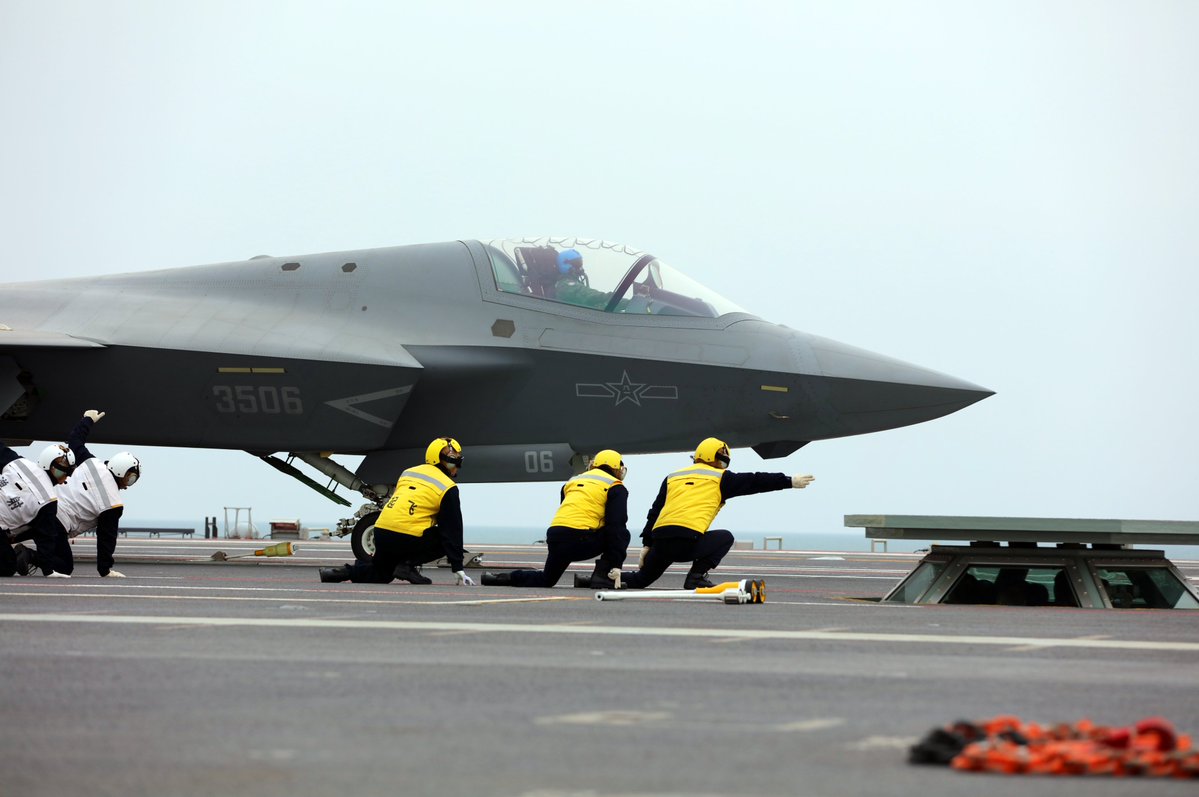
China’s Shenyang Aircraft Corporation (a subsidiary of the state-run AVIC) has officially announced its newest fighter jet for the People’s Liberation Army Navy Air Force (PLANAF) is called the J-35 Blue Shark. The name confirms four years of teasing.
AVIC officially calls J-35 the Blue Shark
China’s newest in-service fighter jet, the carrier-based Shenyang J-35, has officially been named the J-35 Blue Shark (“Lán Shā” or 蓝鲨). While the J-35 may bear the same number designation as its F-35 counterpart, it seems its name will not be similar to “Lightning II.”

The announcement came via a post by Shenyang Aircraft Corporation on the Chinese social network, Weibo. The post is not easily openly accessible, as Chinese state-affiliated corporate Weibo/WeChat posts on sensitive military topics are often not fully public or get limited visibility outside China.
However, the Weibo account lyman2003 did reference the Weibo announcement and became widely shared online and quoted by Army Recognition.

The post reads (in English), “Shenyang Aircraft (Shenfei) WeChat public account has publicly revealed the official nickname of the J-35 carrier-based fighter — Blue Shark.”
Get the latest aerospace defence news here on AGN.
Confirming an existing nickname for the J-35
The J-35 has been unofficially called the Blue Shark for four years. lyman2003 also stated, “Actually, we already knew about it back in 2022 (see picture 2 and picture 3), this time it’s the official public reveal.”
Just translated:
— @Rupprecht_A (@RupprechtDeino) November 21, 2024
„J-35 is nicknamed "Blue Shark"
J-35A nicknamed "Yaolong"“ https://t.co/4MywSf6IbG
The name follows the PLANAF’s convention. The service’s J-15 is called the Flying Shark, while the electronic warfare J-15D is termed the Electric Shark.
According to a 2024 post by the OSINT account, @Rupprecht_A, which monitors the PLAAF and PLANAF, only the naval J-35 variant is called the Blue Shark.
Army Recognition noted the name has been floating around since 2022 and wrote, “first visible reference to “Blue Shark” occurred through a unit patch at Zhuhai 2024 rather than through formal announcement channels, indicating a phased disclosure approach.”
The land-based J-35A variant was reported to be nicknamed “Yaolong,” translating to something like “Radiant Dragon.” Army Recognition provided a slightly different version of the name as “Yunlong” or “Cloud Dragon.”

China’s PLAAF land-based fighters are typically named after dragons (“long”), while PLANAF’s fighter jets are named after sharks (“shā”).
China’s 5th-generation carrier fighter jet
China is currently working to build the world’s second-largest fleet of aircraft carriers. The Type 003 Fujian was recently commissioned into service, bringing the fleet to three. This includes the Type 001 Liaoning, mostly used as a training ship.

Satellite imagery shows China has started construction on its fourth aircraft carrier, which is widely speculated to be its first nuclear-powered carrier.
Currently, these ships operate the naval J-15 fighter jet. The J-15 is a Chinese fighter ultimately derived from the Soviet Su-27 Flanker series. But China wants a more advanced stealthy or low-observable fighter for its future carrier fleet.
Chengdu and Shenyang both competed for the PLAAF’s requirement for a 5th-generation air superiority fighter. Chengdu won with its design going on to become the J-20 Mighty Dragon.
Shanyang then took its FC-31 design and produced a naval variant for the PLANAF. There is reporting that while China doesn’t export the J-20, it may be open to exporting variants of the J-35.
The J-35 was officially unveiled in November 2024, and in 2025, the aircraft was seen in serial production and operating on China’s aircraft carriers.
Featured Image: Chinese Navy