What is the fastest helicopter in the world? From the record-breaking Lynx to the V-280 Valor

5 min read
Helicopters are not usually associated with outright speed. Yet some rotorcraft have pushed beyond 400km/h in the pursuit of greater range, agility and performance.
Determining the world’s fastest helicopter is not always straightforward. Some figures represent official speed records, while others refer to maximum level-flight performance or cruise speeds. Compound helicopters and tiltrotors blur the line between helicopter and aeroplane.
For the purposes of our comparison, we’ve grouped rotorcraft into three categories:
- conventional helicopters
- compound helicopters
- tiltrotors
Speed figures may be based on official records, demonstrated flight-test performance or manufacturer specifications where relevant.
Here are the fastest rotorcraft ever built, and where they sit in the race for speed.
The world’s fastest conventional helicopters
Conventional helicopters essentially get all of their lift from the main rotor and use the tail rotor to counter the torque of the main rotor. These are what most people will consider true “helicopters.”
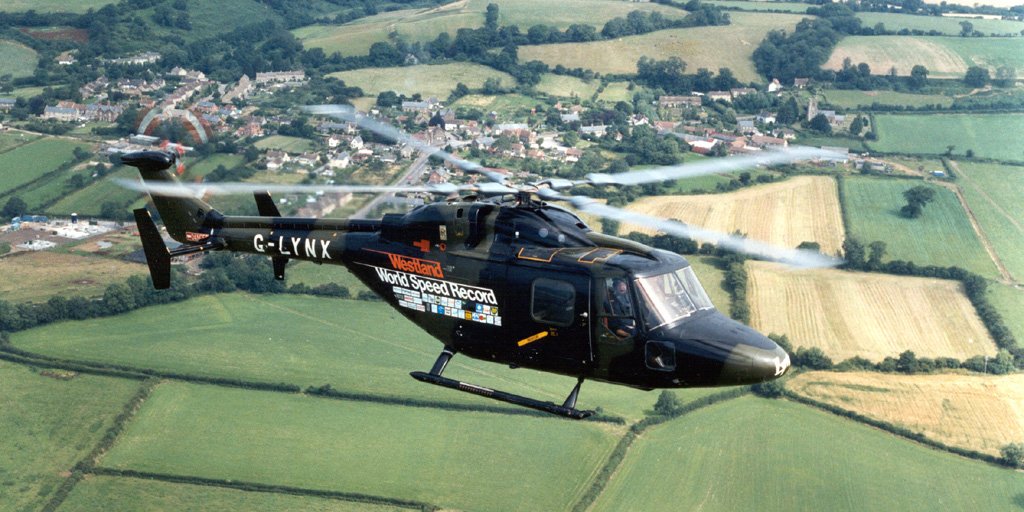
Leonardo claims to have built the world’s fastest conventional helicopter, the Westland Lynx G-LYNX. This helicopter flew at 400.87 km/h (216 knots).

Leonardo writes, “In the evening of 11 August 1986, a Westland Lynx flew a 15 km course across the Somerset Levels. The aircraft achieved an average speed of 400.87 km/h (249.10 mph), which made it the world’s fastest helicopter. The crew comprised Trevor Egginton, the pilot, and Derek Clews, the Flight Test Engineer.”
Writing in 2026, the Royal Aeronautics Society claims that the record for the “absolute world helicopter speed” remains unbroken.
The Mi-24/Mi-35 family is often cited as the fastest conventional attack helicopter, with reported maximum speeds of around 335 km/h (181 knots), depending on the variant and source.
These figures should not be confused with normal cruise speeds: they represent maximum level-flight performance, and published figures vary by variant and source.
The Boeing CH-47F Chinook is also among the fastest conventional helicopters, despite being a heavy-lift transport rather than an attack helicopter.
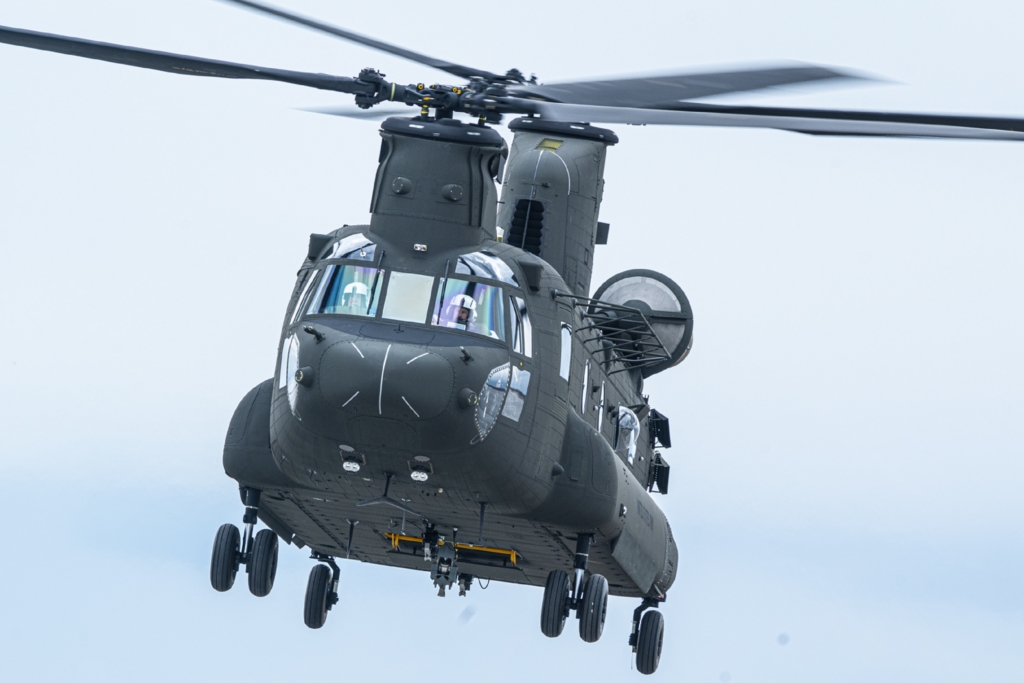
Published figures vary by source, with speeds around 302–315 km/h (163–170 knots) commonly cited. This makes the Chinook particularly notable for its size and payload capability and gives it a place among the fastest heavy-lift helicopters.
Other conventional helicopters with exceptionally fast speeds include the NHIndustries NH90 twin-rotor at 300 km/h (162 knots) max cruise and the Leonardo AW101 Merlin three-engine copter at 277 km/h (150 knots).
The world’s fastest compound helicopters
Compound helicopters are helicopters that add other sources of propulsion to help relieve the main rotor at high speed. These are often wings for lift and a pusher propeller for forward thrust. The Sikorsky X2 family uses coaxial counter-rotating rotors.
However, compound helicopters have not become as popular as conventional helicopters, and most of the fastest examples were demonstrators and cancelled programmes.
| Select fast helicopters/tiltrotors | Category | Maximum level-flight speed | Cruise speed | Speed type |
| Westland Lynx G-LYNX | Conventional | 400.87 km/h (216 kt) | — | Demonstrated record speed |
| Mil Mi-24/Mi-35 | Conventional | ~335 km/h (181 kt) | ~270 km/h (146 kt) | Published maximum |
| Eurocopter X3 | Compound | 472 km/h (255 kt) | — | Demonstrated level flight |
| Lockheed AH-56 Cheyenne | Compound | ~393 km/h (212 kt) | ~361 km/h (195 kt) | Published/design performance |
| Bell V-280 Valor / MV-75 | Tiltrotor | 519 km/h (280 kt) | — | Demonstrated test speed |
| Bell-Boeing V-22 Osprey | Tiltrotor | — | ~509 km/h (275 kt) | Published maximum |
The fastest compound helicopter to have demonstrated high-speed level flight is the Eurocopter X3, which combined coaxial counter-rotating rotors with a wing and two lateral pusher propellers. The demonstrator reached 255 knots (472 km/h) in level flight.
It also achieved a higher speed of 263 knots (487 km/h) during a dive. However, the level-flight figure is the more useful measurement when comparing it with other helicopters because it avoids giving the X3 an advantage from trading altitude for airspeed.
In 2013, Aviation Week reported, “Eurocopter is claiming to have beaten Sikorsky’s X2 unofficial speed record by reaching 263 kt. in a dive with its X3 high-speed demonstrator. During trials in early June, Eurocopter test pilots flying at the Istres test base near Marseille, France, also achieved 255 kt. in level flight.”
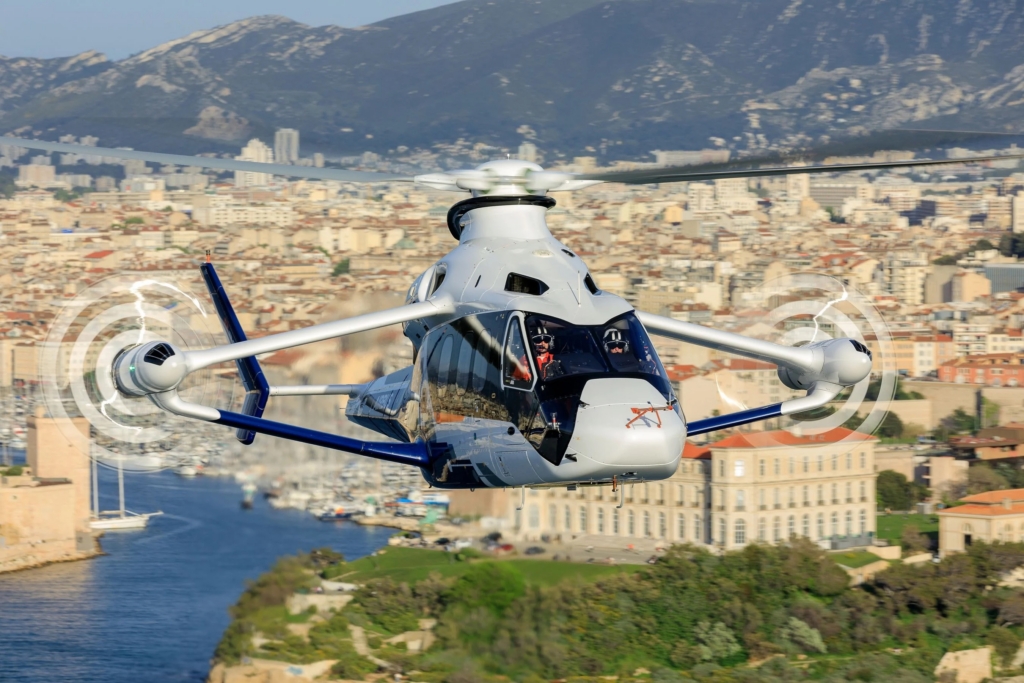
Among current compound programmes, one of the most notable is the Airbus RACER (Rapid and Cost-Effective Rotorcraft). The RACER is an experimental high-speed compound helicopter development from the Eurocopter X3. It was unveiled in 2017 and first flew in 2024.
Airbus says it is “optimised for a cruise speed of more than 400 km/h [216 knots]” and “targets a fuel consumption reduction of around 25%, compared to current generation helicopters in the same maximum take-off weight category.” It is able to reach greater speeds in dashes.
The world’s fastest tiltrotors
The arrival of tiltrotors has further blurred the line between helicopters and conventional aircraft.
Tiltrotors come with large rotors/proprotors that rotate from a helicopter-like vertical position into an aeroplane-like horizontal position. In other words, when tiltrotors reach their maximum speeds, they are essentially turboprop airplanes.
Currently, relatively few tiltrotors have flown. The most famous is arguably the Bell-Boeing V-22 Osprey, which is operated by the US Marine Corps, US Navy, and US Air Force, as well as Japan’s armed forces.
The V-22 is generally considered the fastest operational tiltrotor, with a published maximum speed of around 509 km/h (275 knots).

The US Army’s future MV-75, based on the Bell V-280 Valor, remains in development. The V-280 demonstrated a speed of 519 km/h (280 knots) during its flight-test programme.
However, this is a demonstrated test speed rather than a directly comparable operational maximum-speed specification for the V-22.
Meanwhile, in Europe, the Leonardo AW609 has a speed of 500 km/h or 270 knots. China has produced a tiltrotor bearing a strong resemblance to the AW609, although it’s unclear what its maximum speed is.
So what is the fastest helicopter in the world?
The Westland Lynx G-LYNX remains the holder of the official helicopter speed record at 400.87km/h.
However, experimental compound rotorcraft such as the Eurocopter X3 and tiltrotors including the Bell V-280 Valor have demonstrated even higher speeds, depending on how broadly you define a helicopter.
Sign up for our newsletter and get our latest content in your inbox.


More from


October 13, 202612 min read