Launch customer: Bristow secures first delivery slot for Electra’s uSTOL EL9 aircraft

5 min read

Bristow Group is positioning itself at the sharp end of advanced air mobility as it becomes the launch customer for Electra’s EL9 ultra-short take-off and landing (uSTOL) aircraft, while continuing to hedge its bets across multiple next-generation aviation platforms.
The Houston-based operator has signed a binding pre-delivery payment agreement with Electra, converting a long-standing letter of intent into firm delivery slots for five aircraft, including the first EL9 to come off the production line. The deal also includes options for a further 45 aircraft on the same commercial terms, subject to certification.
For an industry where many advanced air mobility announcements remain aspirational, the structure of the agreement matters. PDPs are standard practice in commercial aviation and signal genuine intent to take aircraft into service, rather than simply reserve a place in a queue.
By securing delivery slot one, Bristow Group is placing itself in a position to shape early operational concepts, regulatory engagement and customer use cases.
What is the Electra EL9 uSTOL aircraft?
The Electra EL9 is a nine-passenger hybrid-electric fixed-wing aircraft designed to operate from spaces more commonly associated with sports pitches than runways.
Rather than relying on vertical lift, the EL9 achieves its performance through ultra-short take-off and landing capability of around 150 feet, enabled by a combination of distributed electric propulsion and blown-lift aerodynamics.

Eight electric motors are mounted along the leading edge of the wing, accelerating airflow over large flaps during take-off and landing. This dramatically increases lift at very low airspeeds, delaying stall to extreme angles and allowing the aircraft to lift off and touch down in a fraction of the distance required by conventional fixed-wing designs.
Cruise power is provided by a turbine generator within a hybrid-electric architecture, with onboard batteries recharged in flight. That configuration avoids the energy and infrastructure penalties of hovering flight, while delivering far greater range, payload and dispatch flexibility than fully electric eVTOL aircraft.
| Electra EL9 uSTOL specifications | |
|---|---|
| Category | Take-off/landing distance |
| Aircraft type | Hybrid-electric ultra-short take-off and landing (uSTOL) fixed-wing |
| Seating capacity | 9 passengers (plus pilot) |
| Payload capacity | Up to 3,000 lb (1,360 kg) |
| Take-off / landing distance | ~150 ft (46 m) |
| Cruise speed | ~175 knots |
| Mission range | ~330 nautical miles with full passenger load |
| Ferry range | Up to ~1,100 nautical miles with IFR reserves |
| First flight target | 2027 |
| Entry into service target | 2029 |
Electra markets this approach as “Direct Aviation”, a concept aimed at bypassing congested hubs and enabling point-to-point services between communities, resorts, corporate sites and regional centres. By combining fixed-wing efficiency with helicopter-like access, the EL9 is positioned as a lower-noise, lower-cost alternative to rotorcraft, without the need for vertiports or bespoke ground infrastructure.
In performance terms, the aircraft is designed to cruise at around 175 knots, carry up to 3,000 lb of payload, and fly 330 nautical miles with a full passenger load, extending to a ferry range of roughly 1,100 nautical miles with IFR reserves.
Bristow’s growing AAM portfolio
The Electra agreement is not a one-off bet; it is the latest addition to a deliberately diversified advanced air mobility (AAM) portfolio that Bristow has been building for several years.
Rather than anchoring its future on a single aircraft category, Bristow has spread its exposure across multiple platforms and mission sets, with a clear emphasis on practical, near-term operations and on being ready to move quickly once certification gates are cleared.
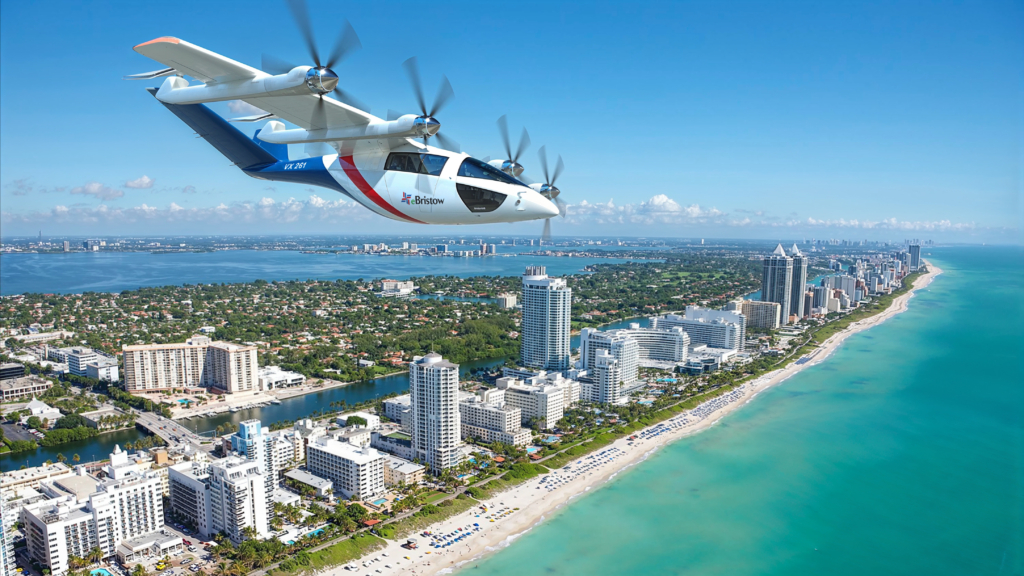
Alongside Electra, the company has partnerships with Vertical Aerospace, where it has committed to up to 50 eVTOL aircraft with options for more, and Eve Air Mobility, with an earlier agreement covering up to 100 aircraft.
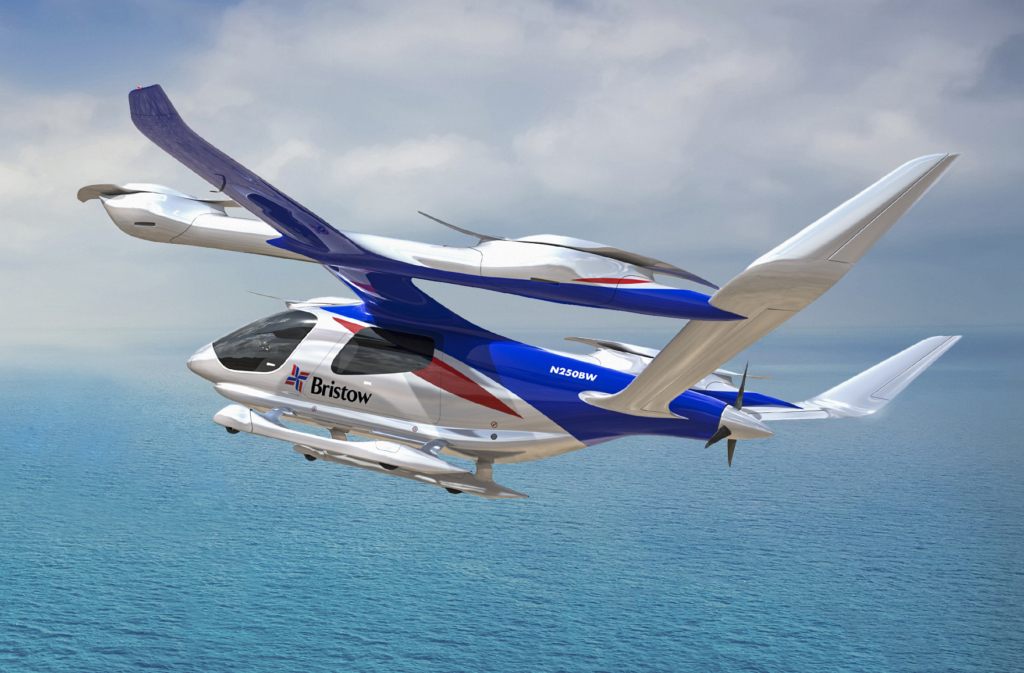
Bristow has also put firmer shape around its plans through its agreement with BETA Technologies, placing a firm order for five ALIA-250 eVTOL aircraft with an option to purchase a further 50. The ALIA is aimed at regional missions, with a stated range of up to 250 nautical miles and a payload and cabin size that suits both time-sensitive cargo and small groups.
Cargo is a prominent thread running through the wider strategy. Bristow has secured early delivery positions for the Elroy Air Chaparral cargo platform, which it has framed around logistics, healthcare, and energy applications where speed and reliability drive the business case.
Bristow is assembling a portfolio that covers multiple propulsion approaches and route structures, with Electra’s ultra-short fixed-wing concept complementing eVTOL bets rather than competing with them. If one programme slips, another may mature first, and if different markets demand different capabilities, Bristow has positioned itself to offer more than one answer.
Electra targets first flights of EL9 uSTOL in 2027
Beyond the headline performance claims, the EL9 has now entered a more consequential phase of development. In late 2025, Electra submitted its application to the US Federal Aviation Administration for Part 23 type certification, the established regulatory pathway for fixed-wing aircraft with up to 19 passengers.
The filing included a Project Specific Certification Plan and detailed aircraft specifications, reflecting several years of structured engagement with the FAA on how the aircraft will demonstrate compliance.
Electra says wind-tunnel testing carried out in 2025 has already confirmed that the EL9’s unconventional blown-lift configuration meets Part 23 stall margin and safety requirements, an important milestone for an aircraft operating at such low take-off and landing speeds.

Flight testing is planned to begin in 2027, with certification and entry into service targeted for 2029. That timeline is supported by a $115 million Series B funding round closed in 2025, led by Prysm Capital and backed by strategic investors including Lockheed Martin Ventures, Honeywell and Safran, with the proceeds earmarked specifically for pre-production and certification activity.
Commercial interest has continued to build alongside technical progress. Electra says it has secured more than 2,200 pre-orders from over 60 customers worldwide, spanning airlines, helicopter operators and mobility providers. Launch operators plan to use the EL9 to open routes constrained by runway length, noise limits or infrastructure availability, rather than competing head-on with conventional regional aircraft.
The programme also has a clear dual-use dimension. Electra has increasingly pitched the EL9 to defence customers as a platform suited to austere logistics, dispersed operations and Agile Combat Employment concepts. Early development work has been supported by US military research programmes, reinforcing the aircraft’s positioning as both a commercial and government asset.
The EL9 is rapidly moving beyond an advanced air mobility concept into a certifiable aircraft programme with funding, regulatory alignment and a defined path to first flight, placing it among the more mature next-generation AAM platforms.
Featured image: Bristow Group
Sign up for our newsletter and get our latest content in your inbox.


More from


October 17, 20264 min read