


US airlines are giving more space to premium passengers – here’s why

9 min read
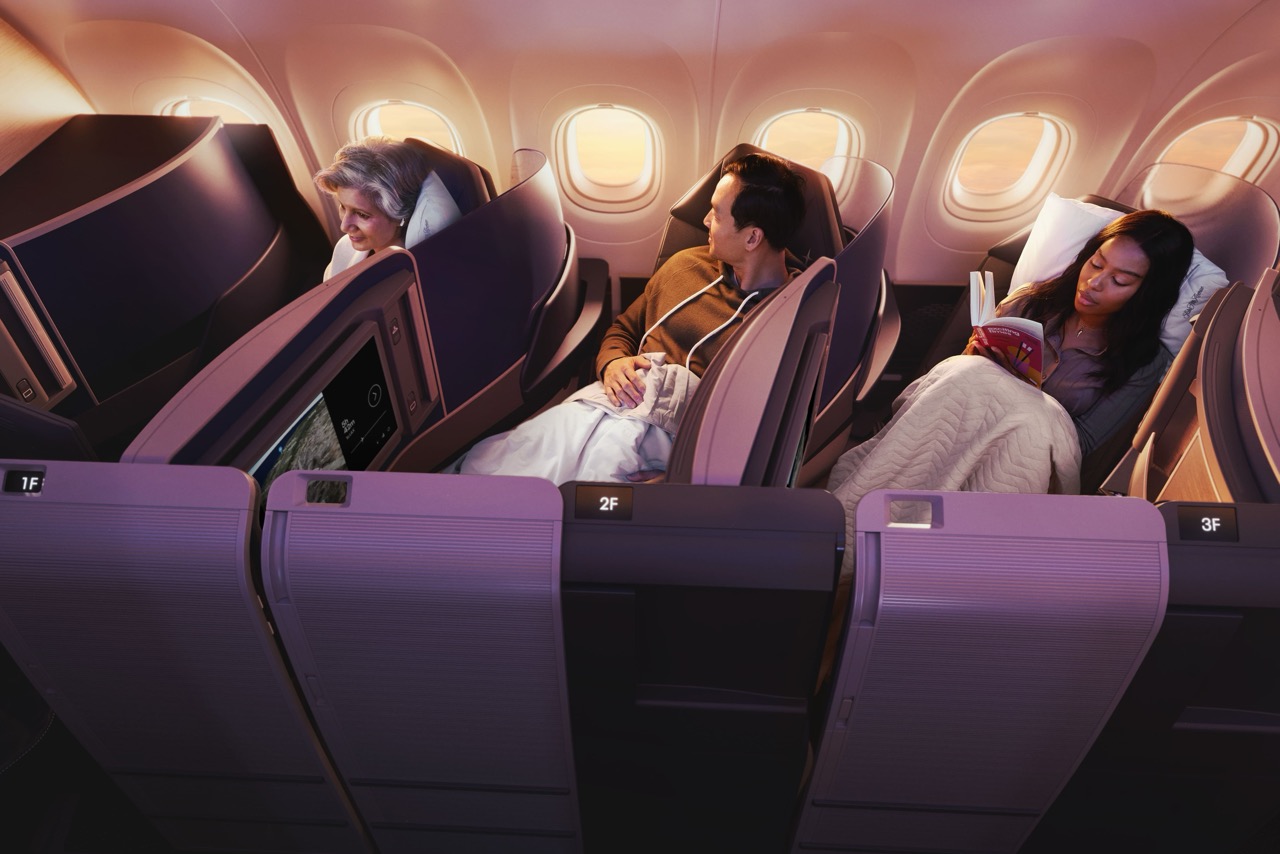
US airlines are fighting for space, but not in the way passengers might expect.
Rather than squeezing in more seats, carriers are increasingly ripping out economy rows and replacing them with business class suites, premium economy recliners and extra-legroom seating as they chase higher-spending travellers.
The scale of the shift became particularly clear this week. On September 1, JetBlue unveiled its new domestic first-class product, BlueFirst. The following day, American Airlines revealed a heavily premium-configured Boeing 777-300ER with 144 upgraded seats. Hours later, Southwest Airlines announced plans for its first-ever airport lounges.
The announcements come from airlines with very different histories and business models, but point in the same direction. US carriers increasingly believe that passengers willing to pay more for space, comfort and an improved passenger experience offer one of the best opportunities for revenue growth.
That means more suites at the front of long-haul aircraft, more first-class rows on domestic jets, larger extra-legroom sections and billions of dollars being spent on lounges, entertainment, WiFi and other elements of the premium journey.
It may also mean that the traditional economy cabin occupies a progressively smaller share of the aircraft’s valuable real estate.
How American Airlines is expanding premium seating on the Boeing 777
The newly retrofitted American Airlines Boeing 777-300ER has 70 Flagship Suite business-class seats with privacy doors, 44 Premium Economy seats and 30 Main Cabin Extra seats, giving passengers 144 seats that American categorises as premium or extra-legroom.
The airline says that gives the aircraft more business and premium economy seats than any aircraft operated by a US carrier.
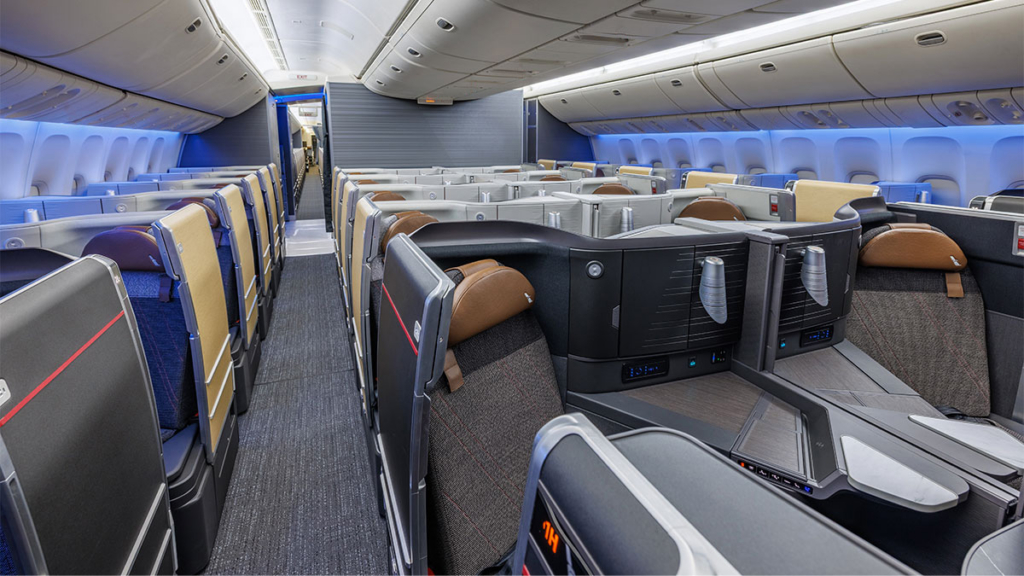
Still, American is not bringing back its ultra-exclusive international first class on this aircraft. The eight-seat Flagship First cabin disappears as American concentrates instead on a much larger business-class cabin. Flagship First will no longer be sold on the 777-300ER for travel from November 19.
The business class product has evolved to the point where it is virtually indistinguishable from first class, except for airlines that offer private luxury suites. American’s fully-equipped business-class suites can appeal to both corporate travellers and wealthy leisure passengers.
American is making similar changes elsewhere.
The airline announced in August that premium seating represents around 25% of seats on its narrowbody departures today. It plans to increase that to approximately 40% through aircraft deliveries and cabin retrofits.
Its Airbus A319 and A320 aircraft are gaining additional first-class seats, while future Boeing 737 MAX 10s will have 24 First Class seats. American also expects the number of lie-flat seats on its international aircraft to increase by more than 50% by the end of the decade.
JetBlue expands its premium travel offering with BlueFirst
JetBlue‘s September 1 BlueFirst announcement shows the premium push has moved beyond the three big US network carriers.
The airline has made its mark by offering the Mint cabin, with fully lie-flat seats. Its new BlueFirst product will introduce a domestic first class to routes that do not offer JetBlue’s Mint cabin.
The seats will be arranged two abreast on either side of the aisle and provide up to seven inches more legroom than JetBlue’s standard Main seats. They will also have 13.3-inch entertainment screens, Bluetooth connectivity, power outlets and upgraded food, drinks and amenities.
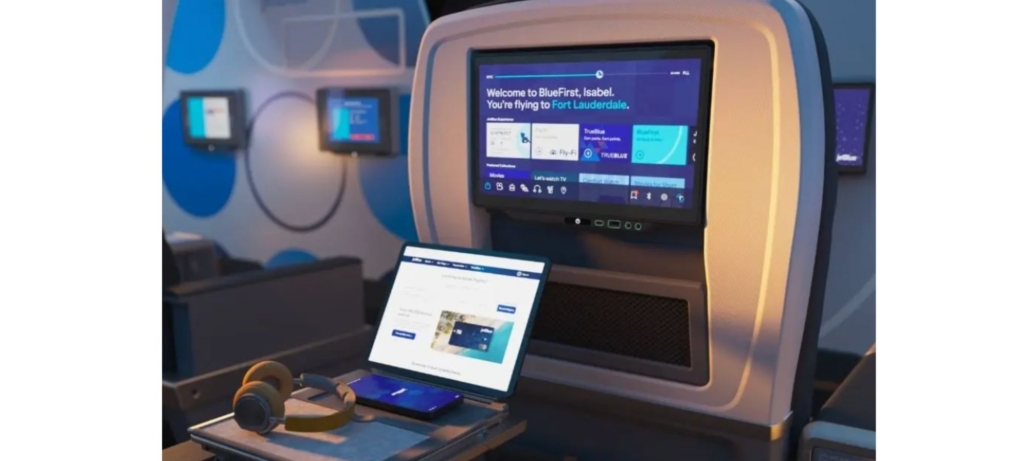
“Customers are increasingly looking for more premium experiences,” JetBlue chief executive Joanna Geraghty said when announcing the product.
BlueFirst will sit above JetBlue’s EvenMore extra-legroom product and below Mint, giving the airline several price points at which it can sell additional space.
Segmentation is becoming increasingly important. Airlines no longer have to persuade passengers to jump from a basic economy ticket to a multi-thousand-dollar business-class seat. Instead, they are attracted to incremental upgrades at several points along the cabin.
Why Delta is betting on premium cabins and revenue
Pushing the concept further, Delta Air Lines is dedicating half its Airbus A350-1000 capacity to premium seating.
Delta says the aircraft, due to enter service in early 2027, will have a 50% premium seat mix across Delta One, Premium Select and Delta Comfort.
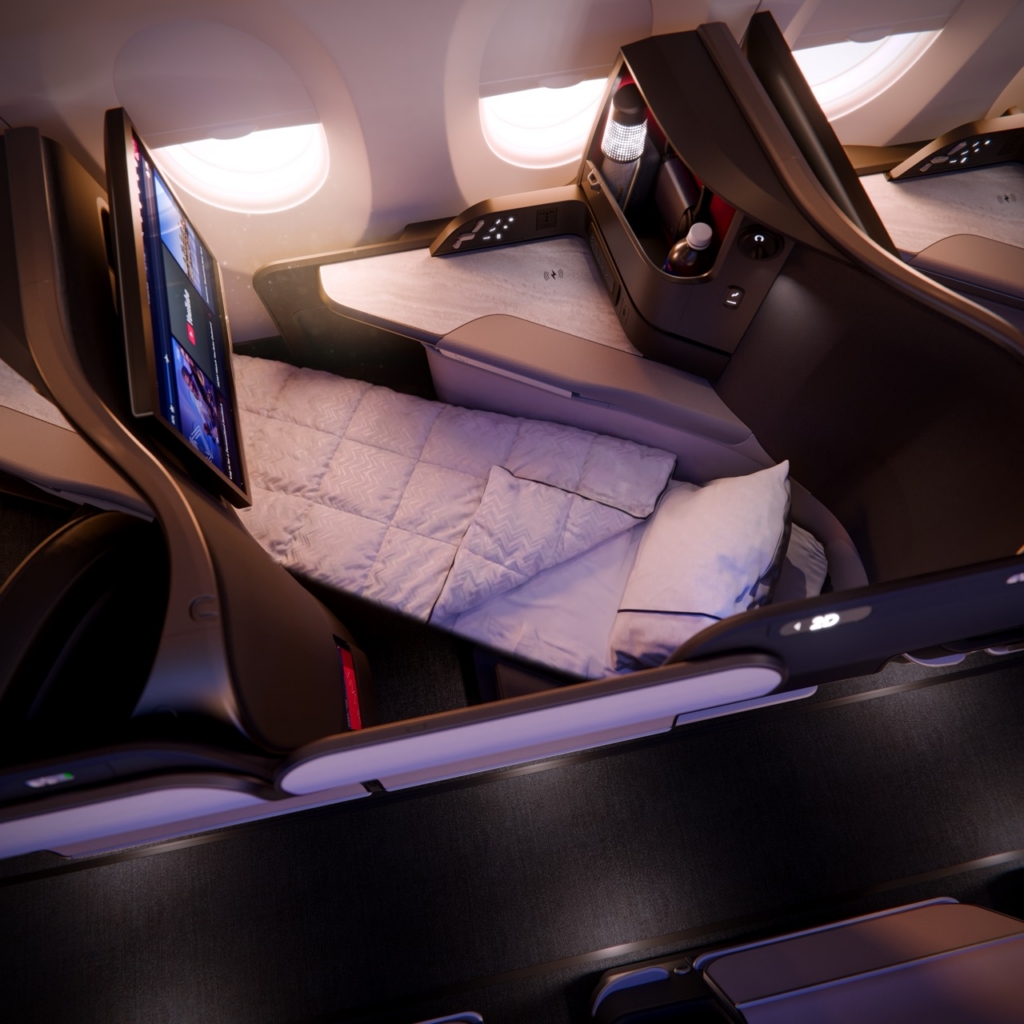
The airline is also investing more than $1 billion in its A350-1000 interiors and upgrades to its Airbus A330-200 and A330-300 fleets, including additional Delta One suites with privacy doors.
According to Delta’s second-quarter 2026 results, premium ticket revenue reached $6.92 billion, slightly exceeding the $6.85 billion generated by Main Cabin tickets.
Premium ticket revenue increased 17% from a year earlier, compared with 8% growth for Main Cabin. Delta also said premium corporate sales increased by more than 25%.
That performance helps explain why airlines are prepared to dedicate substantially more aircraft floor area to seats carrying fewer passengers.
A business-class suite might occupy several times the space of an economy seat. However, if the fare premium is sufficiently large, the revenue generated from that section of floor can still be considerably greater.
United turns the A321XLR into a premium narrowbody
Though it is not alone in doing so, United Airlines is bringing premium cabin features to its single-aisle aircraft. United describes its Airbus A321XLR as its “most premium narrowbody aeroplane.”
The aircraft has 32 premium seats—16 more than the Boeing 757s it replaces—including 20 lie-flat Polaris seats and 12 Premium Plus seats.
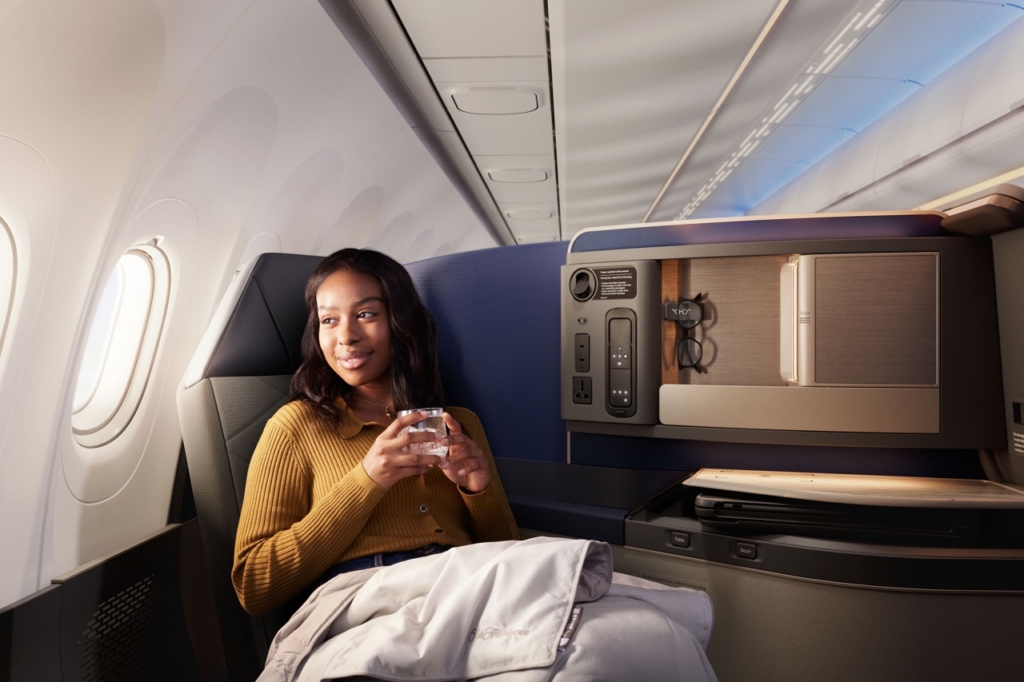
There is then an Economy Plus section offering additional legroom before passengers reach standard economy. United has even developed an Economy Plus row for the A321XLR that leaves the middle seat open, replacing it with a shared table to provide the window and aisle passengers with additional personal space.
United says it has increased the number of premium seats per North American departure by 40% since 2021.
The A321XLR will serve comparatively thin long-haul routes where a widebody might be too large. Airlines can therefore apply premium-heavy economics to smaller international city pairs, offering a passenger experience comparable to that of widebody aircraft operating higher-demand routes.
Why Southwest is entering the airport lounge market
Perhaps the most symbolic indication of the change comes from Southwest Airlines.
The carrier built its reputation around a simple, egalitarian model without assigned seats, first class or airport lounges. That model has changed substantially, including the introduction of assigned seating and extra-legroom products.
It is now entering the airport lounge business.
Southwest announced on September 2 that its first lounges will open in Austin, Baltimore, Honolulu and Nashville beginning in late 2027 in partnership with Chase. At least seven more lounges are planned over the following years.
Access will be linked partly to a new premium Rapid Rewards credit card issued by Chase.
It proves the premium competition is not confined to in-flight experiences. Airlines are also competing for high-value customers through branded credit cards, loyalty status, priority treatment, lounges and onboard products.
Why premium passengers have become airlines’ most valuable passengers
Higher-income leisure travellers have demonstrated a willingness to spend heavily on travel and experiences, while corporate travel remains valuable to the large network airlines.
The traditional distinction between business and leisure passengers has also blurred as travellers pay out of pocket for premium cabins or combine business trips with leisure travel.
Premium seating gives airlines more opportunities to segment customers by willingness to pay.

A modern aircraft may offer basic economy, standard economy, preferred seats, extra-legroom economy, premium economy, business class and in some cases, first class. Each step forward on the aircraft creates another opportunity to collect additional revenue on each flight.
Premium customers are also closely tied to profitable airline loyalty programmes and branded credit cards.
Lounges, upgrades and priority benefits encourage passengers to accumulate miles and spend on co-branded cards. Those partnerships have become major revenue generators for US airlines, giving carriers another reason to invest in experiences that make elite status and premium cards attractive.
Delta’s loyalty and related revenue increased by 19% in the second quarter, while American Express remuneration reached $2.4 billion, up 16%.
Can airlines add too many premium seats?
There is always a risk that market conditions will reset. Premium demand has been exceptionally strong, and airlines are adding substantial capacity to meet that demand.
American, Delta and United are all increasing premium seat numbers, while JetBlue, Southwest, Frontier and Allegiant are moving further into parts of the premium market they previously avoided under their low-cost models. If economic conditions weaken, discretionary leisure travellers and self-funded business travellers may be reluctant to pay hundreds or thousands of dollars to fly.
If demand turns, airlines could face the same capacity problem in premium cabins that has historically affected economy: too many seats chasing too few passengers can force fares down.
There is the added risk of return on investment. Premium seating products are significantly more expensive than classic economy seats, in both unit and development costs. The average aircraft seat is expected to have a service life of at least a decade before it requires replacement. That gives airlines time to earn multiples over the original expense of developing the seat. But that formula depends on passenger uptake throughout the product’s lifecycle. If premium seat load factors drop, the expenses of soft products like premium meals, beverages, and amenities, and the high cost of dedicated cabin staff add up, cutting into the profit margin.
For now, the numbers favour expansion. Delta’s 17% premium revenue growth backs it. And the scale of global fleet investments in premium suggest carriers believe the market shift is structural rather than temporary.
While the history of commercial aviation proves that no market trend lasts forever—and change can come suddenly—this one might last long enough for perpetually margin-squeezed airlines to finally benefit.
Why economy class is losing space on modern airliners
Economy will still be where most passengers sit on the plane. Airlines still need large numbers of lower-fare travellers to fill aircraft and support their networks.
But standard economy is only one part of a much more fragmented cabin.
Some of the floor space that might once have accommodated additional economy rows is instead being devoted to suites, premium economy recliners and extra-legroom seats.
Extra-legroom products such as American Main Cabin Extra, Delta Comfort and United Economy Plus are still economy-class seats. What is shrinking most clearly is the proportion reserved for the lowest-priced standard economy product.
At the same time, airlines are investing in better entertainment, faster WiFi, power and larger overhead bins throughout the aircraft. Passengers in the back are also benefiting from many of these improvements.
For decades, US airlines largely competed by fitting more seats into aircraft while finding ways to lower fares. The current premium boom changes the cabin calculus.
The most valuable area of an aircraft is no longer the one carrying the greatest number of passengers. It is the one carrying the passengers willing to pay the most.


