


Embraer’s Phenom 300EV secures triple certification with Garmin Emergency Autoland

4 min read

Embraer’s Phenom 300EV has received certification from aviation authorities in Brazil, the US and Europe, clearing the way for deliveries of the upgraded light jet – fitted with emergency autoland – from 2028.
The aircraft has secured certification from Brazil’s Agência Nacional de Aviação Civil (ANAC), the US Federal Aviation Administration (FAA) and the European Union Aviation Safety Agency (EASA).
Phenom 300EV becomes first light jet certified with Garmin Emergency Autoland
The achievement also makes the Phenom 300EV the first light jet certified with Garmin Emergency Autoland, according to Embraer.
The system is designed to take control of the aircraft and land it automatically if the pilot becomes incapacitated, providing a potentially life-saving backup on an aircraft that can be operated by a single pilot.

The Phenom 300EV was unveiled in July as an extensively updated version of Embraer’s Phenom 300, which Embraer says has been the world’s best-selling light jet for 14 consecutive years.
Embraer has increased the aircraft’s range to 2,055 nautical miles (3,806km) – up from 1,971 nautical miles for the Phenom 300 – with four passengers and NBAA IFR reserves, while also increasing its payload capability.
The aircraft is equipped with a Multi-Purpose Electronic Controller (MEC), developed by Embraer to enable electronically controlled functions including autobrake and rudder-by-wire. The manufacturer says the system is intended to improve handling, reduce pilot workload and simplify maintenance.
Further enhancements include runway and taxi situational awareness based on Garmin’s 3D Taxiway Routing and Runway Occupancy Awareness (ROA), synthetic vision guidance systems (SVGS), Future Air Navigation System (FANS) 1/A, required navigation performance authorisation required 0.3, and inertial reference system (IRS).

The cabin has also been upgraded with Gogo Galileo connectivity, using its low-Earth-orbit satellite network.
Starlink will be available separately as an aftermarket installation through a Supplemental Type Certificate.

How does Emergency Autoland work?
Garmin Emergency Autoland is designed for a very specific scenario in which the pilot or pilots are no longer able to fly the aircraft (the Phenom 300EV can be operated by a single or multicrew flight deck). .
Unlike a conventional autopilot, which follows instructions set by a pilot, Emergency Autoland can select a destination, navigate to it, conduct the approach and land the aircraft without human intervention.
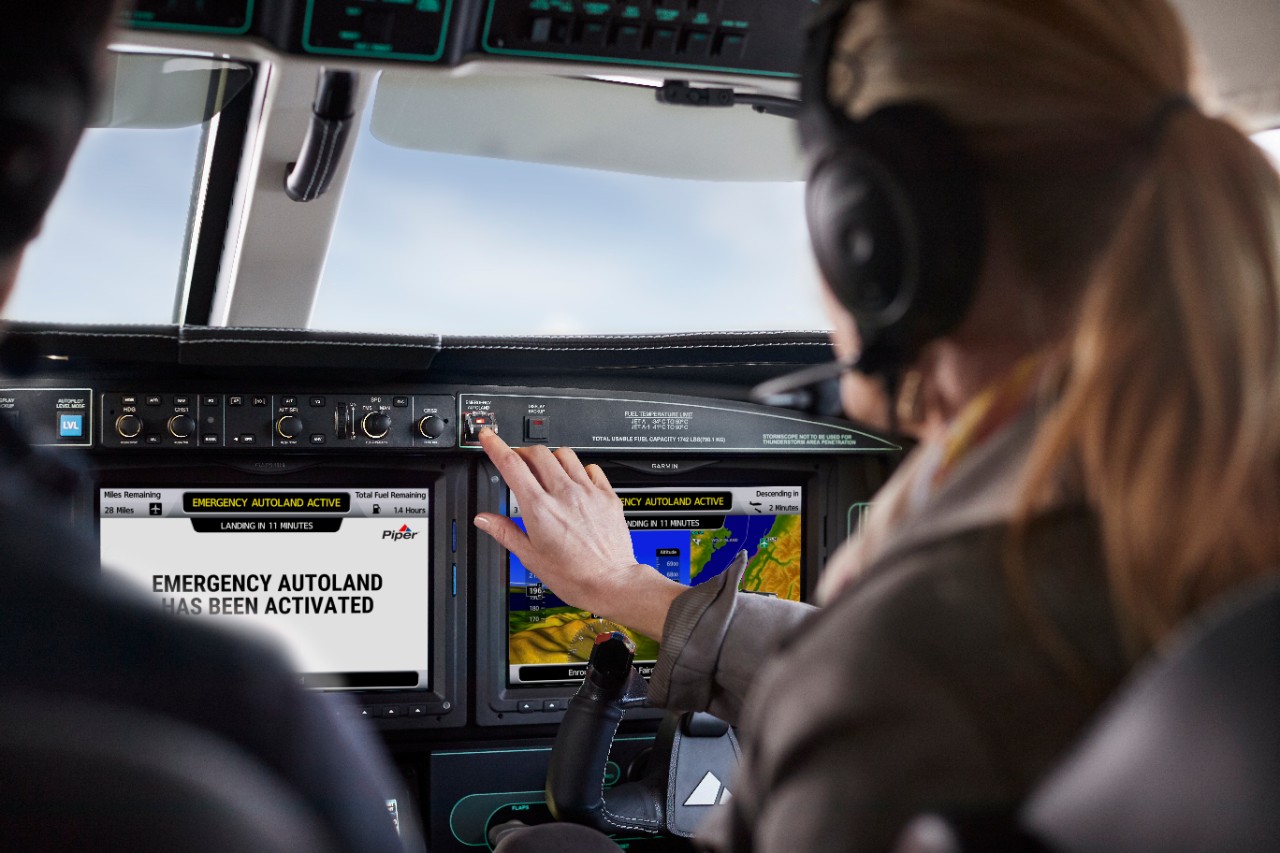
It can be activated manually by a pilot or passenger using a dedicated button. Depending on the aircraft’s configuration, it can also activate automatically if the system detects circumstances indicating that the pilot may no longer be able to operate the aircraft.
Once activated, the system assesses potential airports and selects a suitable destination based on factors including runway length and surface, distance, fuel remaining, weather, terrain and the availability of an appropriate GPS approach with lateral and vertical guidance.
It will also take account of aircraft-specific limitations such as runway width, gradient and crosswind conditions.
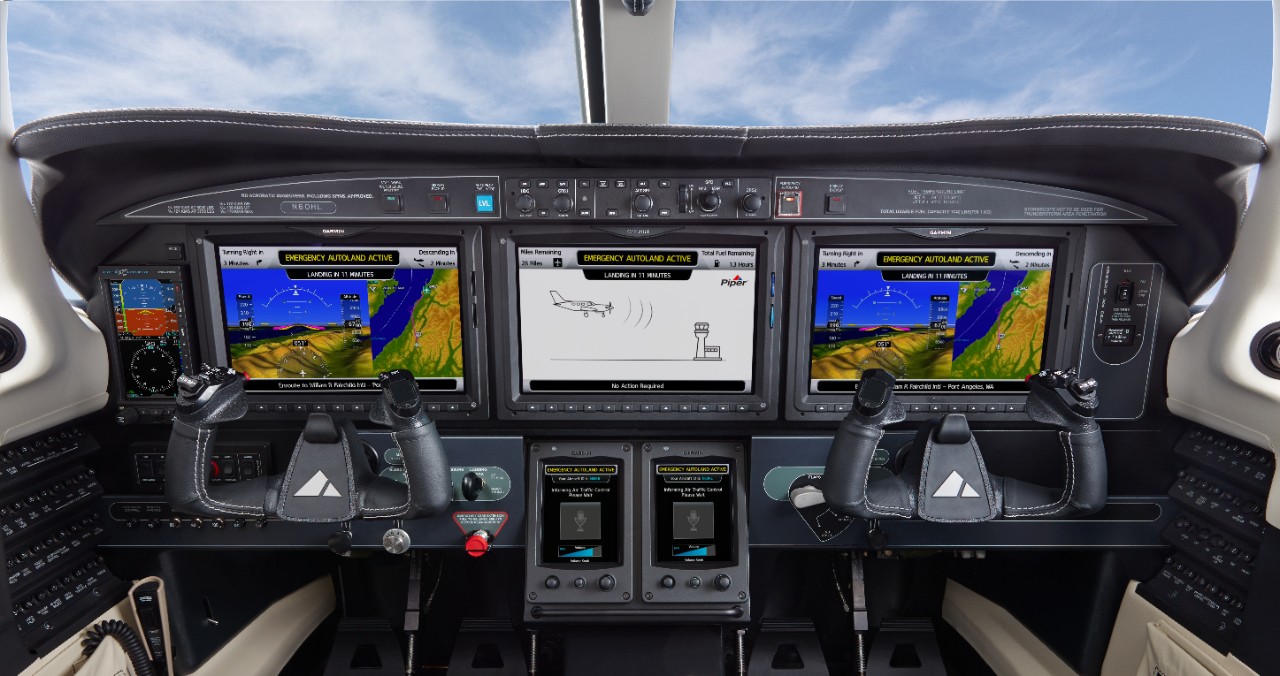
It then calculates a route to the selected runway while avoiding terrain and significant weather. The system uses the aircraft’s autopilot and autothrottle to manage the flight path, speed and altitude, while the aircraft configures itself for the approach.
During the emergency, Autoland also communicates with air traffic control, announcing the aircraft’s intentions and providing information to people on board. Once established on the approach, it flies the aircraft to the runway, lands it, applies the brakes and brings it to a stop.
Garmin says Emergency Autoland is designed specifically for emergency use and cannot perform an automatic take-off.

What happens after landing?
Emergency Autoland does not simply stop once the aircraft touches down.
After landing, the system tracks the runway centreline and applies automatic braking before bringing the aircraft to a complete stop, and shutting down the engine.
It then broadcasts a message over the appropriate radio frequencies warning other aircraft that the aircraft is disabled on the runway.
This is particularly important for a business jet such as the Phenom 300EV, which can be flown by a single pilot.

If that pilot becomes incapacitated, passengers may have little or no ability to operate a conventional flight deck.
In December 2025, the Emergency Autoland was used for the first time in a real world emergency, when a Beech B200 Super King Air experienced a “rapid, uncommanded loss of pressurisation”.
While the two pilots remained conscious during the incident, the aircraft automatically initiated a descent, although the pilots were still in control of the aircraft.

Which aircraft have the technology installed?
Piper Aircraft received the first FAA Type Certification of Garmin Autoland on the G3000 equipped M600/SLS in May 2020, and subsequently received EASA certification in April 2021.
In, July 2020 Daher completed the first EASA certification and the second FAA certification of Autoland on the G3000 equipped TBM 940.
Cirrus Aircraft certified the first jet aircraft with Autoland in August 2020, the Vision Jet equipped with Perspective Touch+.
The technology is now available on more than a dozen aircraft – those equipped with the G1000 NXI AND G3000. They include the King Air 200 and King Air 300 series aircraft, and the HondaJet Elite II.


