BermudAir eyes additional AOCs as it plots 20-aircraft Caribbean expansion

BermudAir says 70% of its routes face no nonstop competition as it explores additional operating certificates and prepares for major Caribbean expansion.

BermudAir E190F
Image: Embraer

BermudAir could add further air operator certificates (AOCs) as it expands its network, with the Caribbean-focused airline targeting a fleet of 20 aircraft by 2030.

BermudAir plots ‘steep’ growth trajectory with fleet expansion plans

Speaking at Routes World 2026 in Frankfurt, John Pepper, chief commercial officer at BermudAir, said the carrier’s growth profile over the next few years was “quite steep”, as it seeks to capitalise on demand for premium leisure destinations across the Caribbean from the US east coast.

“Some of the growth profile over the next couple of years is quite steep,” Pepper said, outlining plans to increase the fleet to double figures in 2027, before reaching 20 by the end of the decade.

The airline, which began operations in 2023, believes its model of operating in underserved markets and where direct competition is limited will differentiate it from the larger players in the region. Pepper said about 70% of its network currently comprised routes without existing non-stop competition.

Carrier considers additional AOCs

BermudAir holds a Bermuda AOC, but since Bermuda is a United Kingdom Overseas Territory and is regulated by the UK Department for Transport, the airline has rights in accordance with a British AOC including to operate to the UK. 

Pepper raised this as a future prospect, though no formal plans are in place. 

“We could fly to London in the summer if we wanted, or anywhere in the Caribbean that’s a British overseas territory,” he said. “That’s Bermuda, Turks and Caicos, Cayman Islands, Anguilla, and British Virgin Islands, and we’re making use of freedom rights in the US-UK Air Service Agreement to really be more expansive.”

BermudAir fifth-freedom flights include services from Bermuda via the US to destinations in Central America, such as Guatemala and Belize.

BermudAir Embraer E190F
Image: Embraer

“At some point as we scale, we may end up ultimately adding additional AOCs or [another mechanism] where we wet least lease our own aircraft, or something like that.”

BermudAir intends to continue operating under its existing name, although Pepper indicated that the airline’s branding was under discussion as it expands beyond Bermuda. 

With services from destinations including Anguilla and Turks and Caicos, the name may become less suitable for a carrier that has a growing regional network.

“That’s something we struggle a lot with internally,” he acknowledged. “I think for now, BermudAir is going to be the brand. I don’t think you’ll see another ‘AnguillaAir’ or ‘BelizeAir’ or anything along those lines.” 

BermudAir launched AnguillAir, recognising services from the sister British Overseas Territory, last year. However, it remains a seasonal sub-brand operated by BermudAir for flights between the US Northeast and Anguilla only.

Bermudair A220 rendering from Airbus
Photo: Airbus

BermudAir targets 20 aircraft by 2030

Fleet growth will be supported by the introduction of the Airbus A220. The airline has an order for 10 A220-300 aircraft.

BermudAir currently operates Embraer E190s. Pepper said the airline expected to have eight aircraft by the end of this year, rising to 11 in 2027.

The longer-term plan is to reach 20 aircraft by 2030, with further expansion possible across the Caribbean and Central America. 

Potential markets include destinations in the eastern and western Caribbean, as well as the Bahamas and southern Caribbean islands.

Rather than entering a new destination with a single route, the airline wants to establish several US connections and gradually build its presence, he said. 
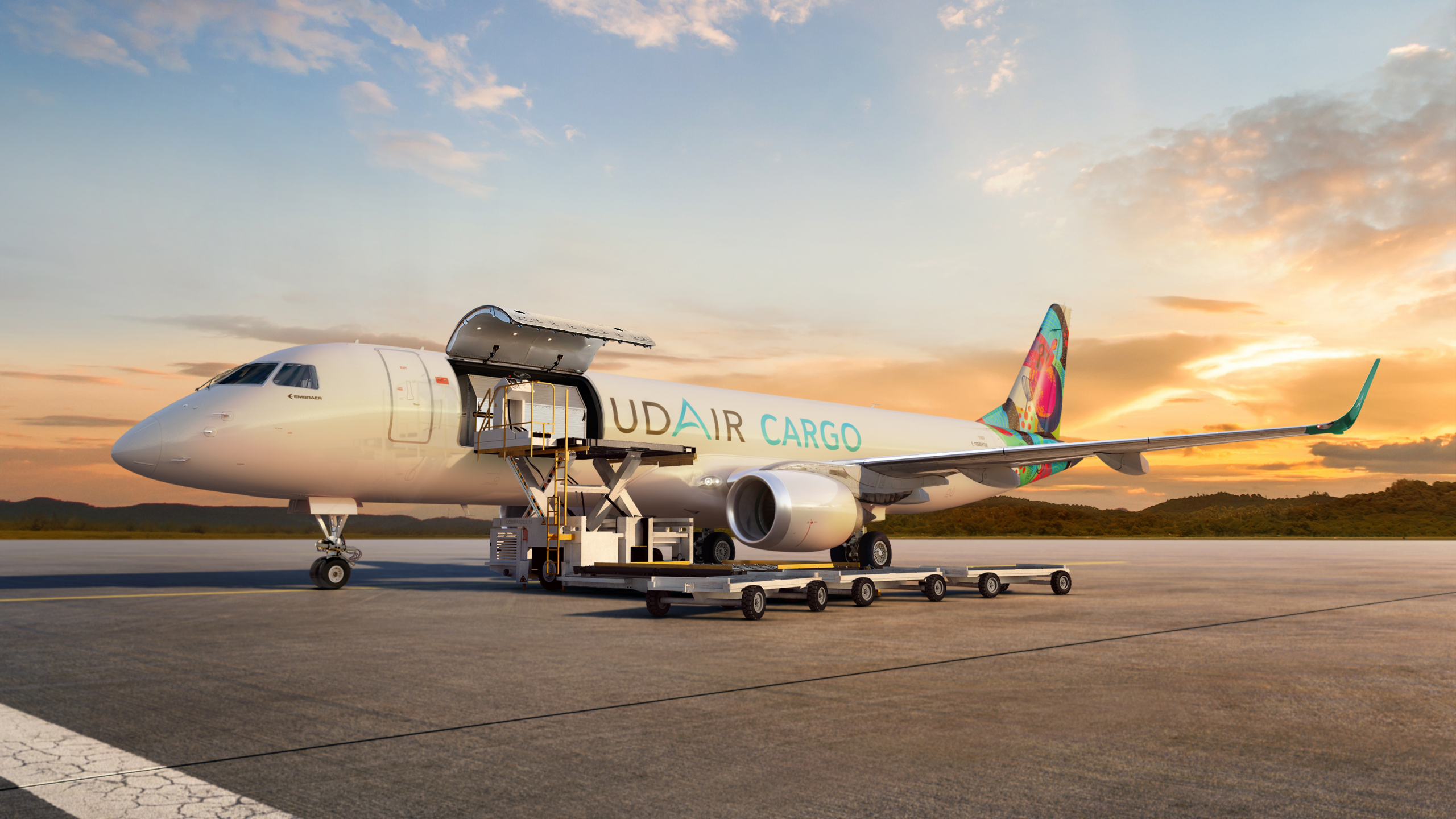
Bermuda-based carrier BermudAir is set to become the first operator of Embraer’s E190F freighter in the Americas, marking the next step in the development of the Brazilian manufacturer’s passenger-to-freighter conversion programme. The airline will operate an E190F leased from US-based lessor Regional One, becoming only the second airline worldwide to put the type into service. BermudAir to become the first E190F operator in the Americas The announcement, made by Embraer and Regional One on 16 September, is said to represent a significant milestone for BermudAir as it expands beyond passenger flying into air cargo. The airline currently operates two E175s and two E190s, serving ten destinations across the Caribbean, the United States and Canada. The E190F will allow BermudAir to use its existing regional network for express cargo, e-commerce shipments and other time-sensitive freight. For BermudAir, the move is closely aligned with the geography of its network. The airline connects Bermuda and Caribbean markets with North American destinations, where smaller volumes of high-value or time-sensitive cargo can require frequent services rather than the capacity of a large widebody freighter. BermudAir founder and CEO Adam Scott described cargo as a natural extension of the airline's existing operation. The company intends to use the aircraft for express freight, local business requirements, e-commerce and other time-sensitive shipments across the islands and North American markets it serves. The E190F therefore gives BermudAir an additional source of network utility without requiring it to build an entirely separate aircraft type around a conventional cargo fleet. Its existing experience with E190 passenger operations also provides commonality with the converted freighter platform. For the wider Caribbean market, the aircraft could provide a right-sized alternative to both belly cargo on passenger aircraft and larger dedicated freighters. Its combination of main-deck loading, container capability, range and relatively modest capacity is aimed at precisely the shipments that need speed and frequency but do not necessarily require a Boeing 737- or 757-sized freighter. Since the launch of the E-Freighter program, Regional One has placed five firm orders for the E190F. Two converted aircraft have already been delivered and have entered successfully into service. What is the E190F? The E190F is a passenger-to-freighter conversion of Embraer’s popular E190 regional jet. Rather than being designed as a conventional large cargo aircraft, it occupies a middle ground between large turboprop freighters and larger narrowbody freighters. The conversion adds a large main-deck cargo door, a reinforced main deck and a rigid 9G barrier, while the aircraft can use both its main deck and lower-deck cargo space. Embraer says the aircraft can accommodate up to nine pallets and containers. Its headline cargo figures are substantial for an aircraft of its size. The E190F offers up to 13.5 tonnes of structural payload and approximately 103 cubic metres of cargo volume when its main and lower decks are considered. Embraer says this represents around 40% more volume capacity than large cargo turboprops, while providing approximately three times their range. The aircraft also has a fully loaded range of up to 2,590 nautical miles (4,797 km), giving operators the ability to connect regional and medium-haul markets without moving up to a substantially larger freighter. Operating economics are another central part of the E190F proposition. Embraer says the E-Freighter offers up to 30% lower operating costs than larger narrowbody freighters, while providing the range and capacity needed for express and e-commerce distribution. The manufacturer has positioned the aircraft as a way of serving secondary and tertiary markets with high-frequency services rather than concentrating cargo through major hubs. That makes the aircraft particularly relevant to island and regional markets. An operator does not necessarily need to fill a much larger narrowbody freighter to make a route viable, while the E190F's jet performance provides a substantial range advantage over turboprop cargo aircraft. BermudAir becomes the world’s second-only E190F operator BermudAir will be the second E190F operator worldwide. The only other operator currently flying the type is Bridges Air Cargo, based in Malta. Bridges became the launch operator of the E190F programme, with its first converted aircraft entering commercial service in March 2026 on a flight from Cologne, Germany, to Larnaca, Cyprus, carrying time-sensitive express material. Bridges subsequently introduced a second E190F in June 2026. Both converted aircraft are operated by Bridges, making it the only E190F operator before BermudAir's aircraft enters service. The E190F programme was launched to respond to changing freight patterns, particularly the growth of e-commerce and demand for faster, more decentralised delivery networks. Regional One has placed five firm orders for E190F conversions, with two aircraft already delivered and in service. BermudAir's arrival therefore gives Embraer's E-Freighter programme its first foothold in the Americas and adds a distinctly regional application to a concept already being tested in Europe, the Middle East and Africa. With its useful payload, cargo volume and range when fully loaded, the E190F is designed to occupy a niche between turboprops and larger freighters. For BermudAir, that niche could prove particularly relevant. The aircraft is small enough for regional demand, but capable enough to move time-sensitive cargo between Bermuda, the Caribbean and mainland North America at jet speed. Bermudair E190F
Image: Embraer

“What we’re really looking for is to go into a destination where we can at least start with three or four nonstop routes to the US that don’t have that competition,” he said.

Pepper added the Caribbean offered greater growth potential than more saturated markets in Europe and the US, where airlines largely compete for existing passengers rather than tap unmet demand. 

In contrast, BermudAir is seeing strong results in underserved destinations, with bookings for the coming winter season “ahead of expectations”, reinforcing the carrier’s confidence in the region’s potential for expansion.

Three-class cabin planned as airline targets premium travellers

BermudAir is also looking to develop its onboard product as it seeks to attract higher-spending leisure passengers to an island nation that is known not only for its pink-sand beaches but also its status as an offshore financial hub. 

That means increasing the premium cabin options for wealthy inbound and outbound travellers. 

“Today we’re really a two-class cabin, but going forward we will have a three-class cabin,” Pepper said.

The proposed change would give the airline more scope to extract revenue, particularly on flights of around four hours between the US and Caribbean destinations. Pepper said improvements to seating and cabin-class products could add “a lot of value” on these routes.

Ancillary revenue and cargo to support expansion

Beyond passenger fares, BermudAir is seeking to develop additional revenue streams through holiday packages, travel insurance, charter operations, cargo and ground handling.

Pepper said around 3–4% of the airline’s itineraries currently included packages.

That is “higher than pretty much any other US airline, with the exception of Allegiant Out of Las Vegas,” Pepper said, however BermudAir has still set itself a target of increasing that share to around 10%. 

Cargo is another area of interest, particularly given the reliance of many Caribbean islands on air links for essential supplies. 

Pepper said the airline sees opportunities in on-demand cargo as well as medical evacuation flights.

Sign up for our newsletter and get our latest content in your inbox.

More from