


BepiColombo reaches Mercury after eight-year journey, prepares for two-orbiter mission

8 min read
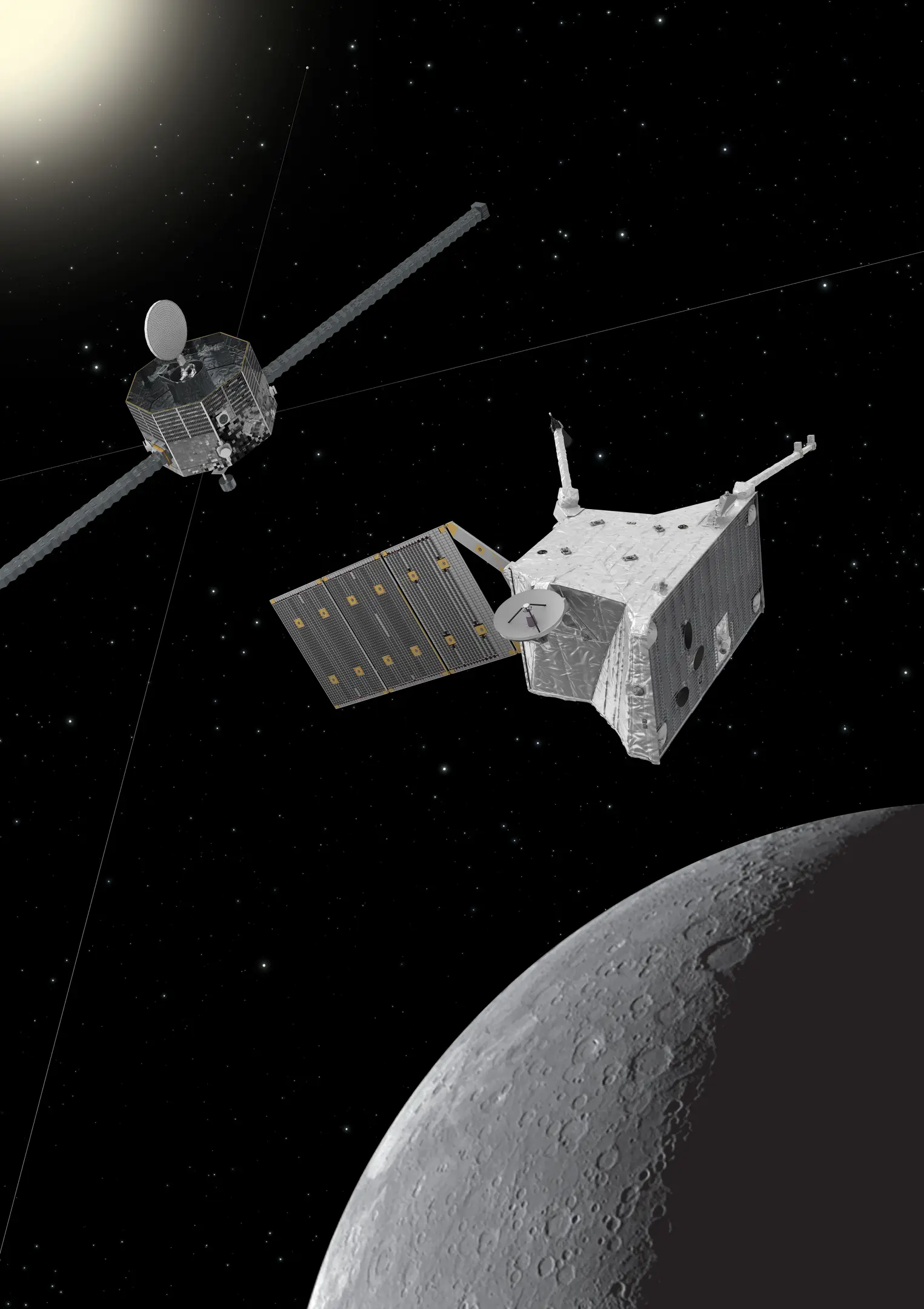

The European-Japanese BepiColombo spacecraft has successfully entered orbit around Mercury after an eight-year journey through the inner Solar System, clearing a major hurdle in a mission to investigate the planet’s surface, interior and magnetic field. However, the spacecraft faced a “software issue” during the manoeuvre.
The European Space Agency, in a social media post on Sunday, said, “Yesterday, we confirmed BepiColombo’s successful capture into orbit around Mercury.
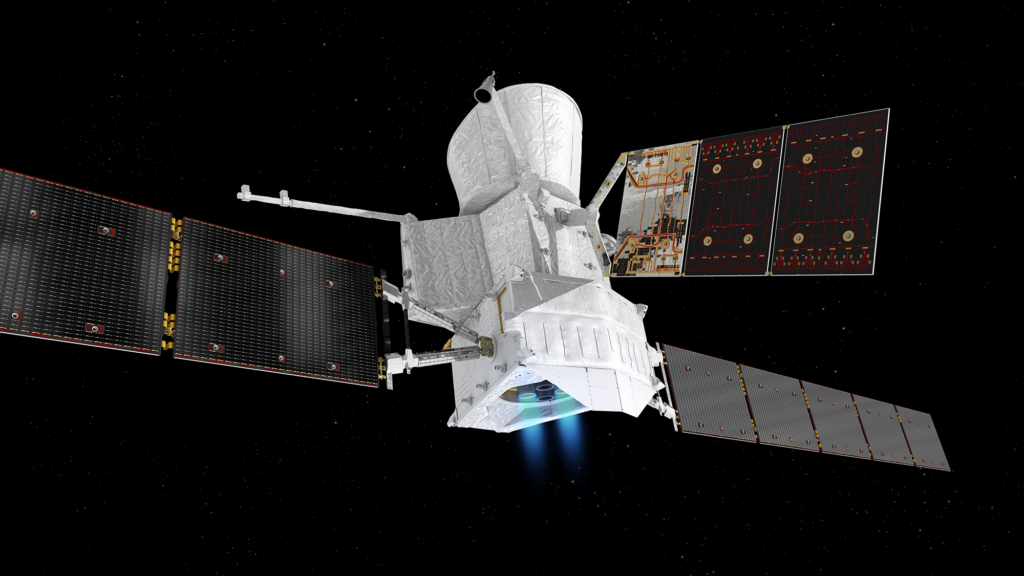
During the manoeuvre, the thruster burn was shorter than planned following a software issue. The spacecraft is safe and teams at ESOC are working to understand what happened.”
The agency will give an update later today.
BepiColombo was captured by Mercury’s gravity on 21 November following a critical engine manoeuvre. Flight controllers at the European Space Agency’s (ESA) operations centre in Darmstadt, Germany, subsequently re-established contact and confirmed that it had entered orbit.
“We’ve heard back from Bepi,” the mission team announced on Saturday, 21 November, adding that engineers were examining telemetry from the spacecraft. ESA’s flight dynamics team confirmed the orbital capture and said further details of the next steps would follow.
The arrival brings ESA and the Japan Aerospace Exploration Agency (JAXA) closer to operating two spacecraft around Mercury simultaneously for the first time. The orbiters are still joined together and will separate in December before beginning their scientific work next April.
BepiColombo was launched on 20 October 2018 aboard an Ariane 5 rocket from Europe’s spaceport in French Guiana. It has travelled approximately 10 billion kilometres, using a combination of electric propulsion and planetary flybys to reach a world that is particularly difficult for spacecraft to enter orbit around.
Why it took eight years to reach Mercury
Mercury is the closest planet to the Sun, but getting a spacecraft into orbit around it is far from straightforward.
A spacecraft travelling towards the Sun gains speed under its gravitational pull. To remain around Mercury rather than fly past it, the spacecraft must slow down sufficiently for the planet’s much weaker gravity to capture it.
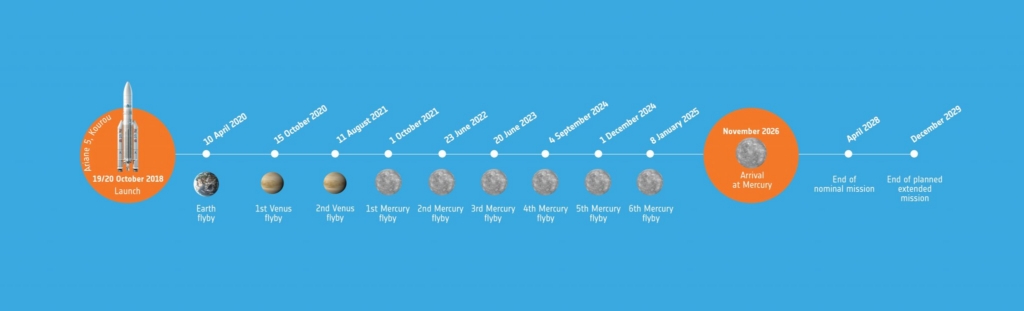
BepiColombo used nine planetary flybys to adjust its speed and direction, one of Earth, two of Venus and six of Mercury. The last Mercury flyby took place on 8 January 2025.
Much of the journey was powered by the Mercury Transfer Module (MTM), which used solar-electric propulsion. Electricity generated by large solar arrays powered ion thrusters that expelled xenon gas, providing gentle thrust over long periods while consuming relatively little propellant.
The journey also encountered technical difficulties. Reduced electrical power available from the transfer module’s solar arrays forced mission controllers to revise the spacecraft’s trajectory, delaying its arrival by about a year.
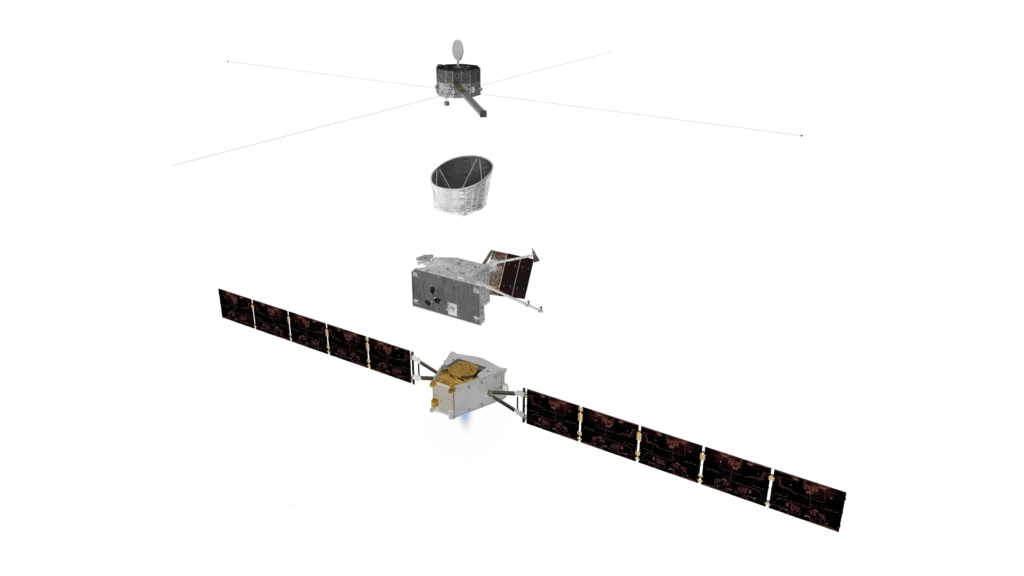
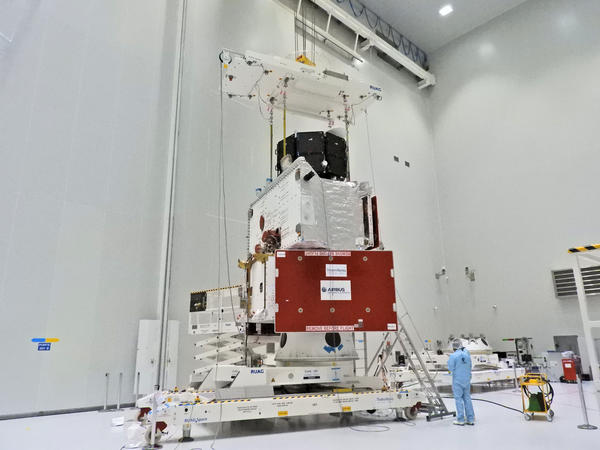
The transfer module completed its work in September 2026 and separated from the two orbiters. ESA’s Mercury Planetary Orbiter then took over the propulsion and steering needed for the final approach.
Following the successful separation, ESA BepiColombo Mission Manager Santa Martínez Sanmartín said: “I feel so proud of this team. This is the perfect start to arrival phase.”
The mission’s arrival is not complete with orbital capture. Controllers must still separate the two orbiters and place them in their different working orbits.
Two spacecraft with different jobs
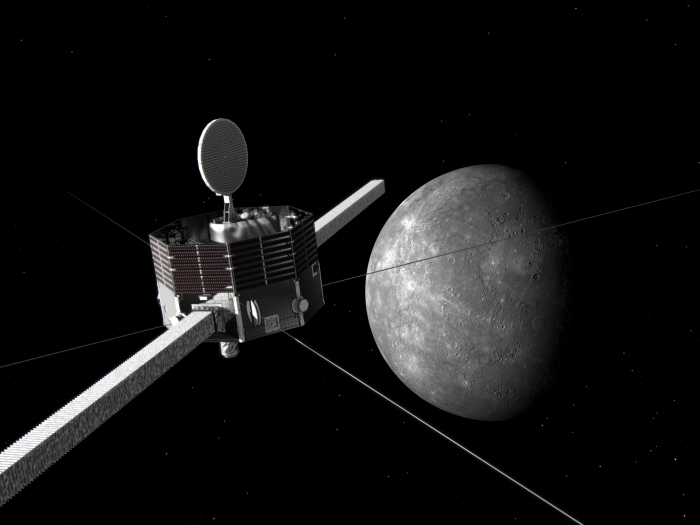
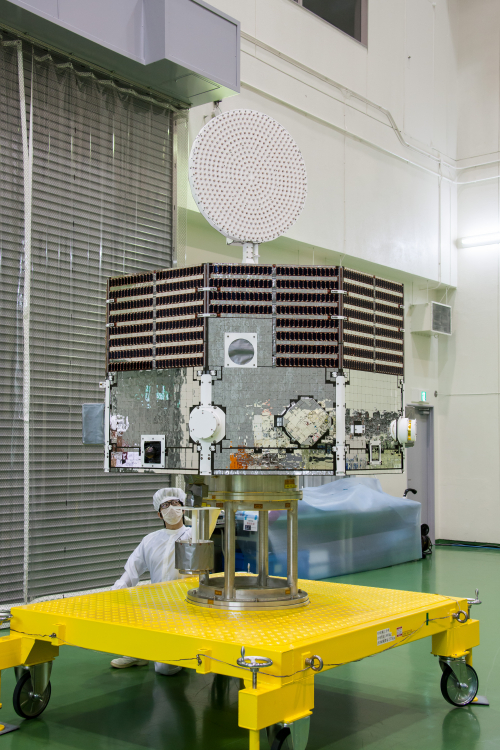
BepiColombo consists of ESA’s Mercury Planetary Orbiter (MPO) and JAXA’s Mercury Magnetospheric Orbiter, known as Mio.
The European spacecraft will concentrate on Mercury itself. Its instruments will map the surface, investigate the planet’s composition and internal structure, and study its thin outer atmosphere, known as an exosphere.
The Japanese orbiter will examine Mercury’s magnetic field and the surrounding region of charged particles, including how the planet interacts with the solar wind.
These observations are designed to complement each other. Measurements taken close to Mercury can be compared with those made farther out in its magnetic environment.
The mission carries 16 scientific instruments between the two orbiters. They include cameras, spectrometers, magnetometers and instruments that measure charged particles and radiation.
NASA has also contributed a small instrument called Strofio, part of the SERENA instrument package aboard ESA’s orbiter. It will investigate particles in Mercury’s extremely thin exosphere.
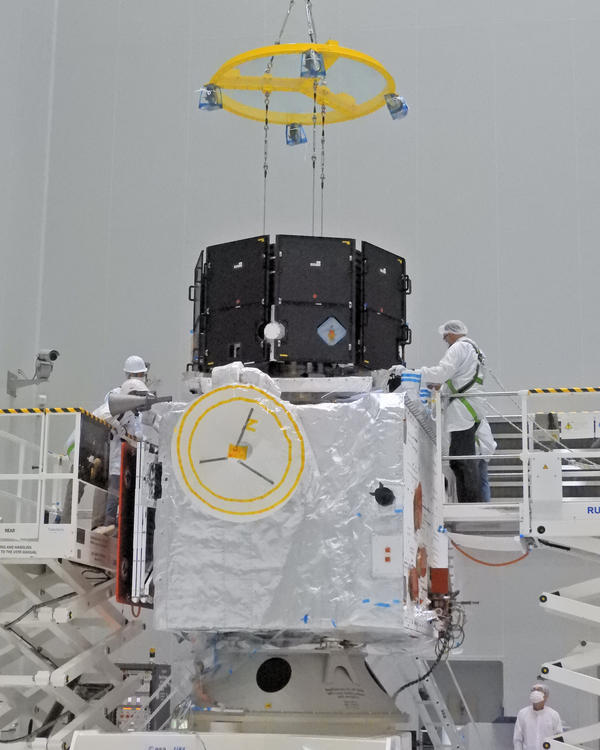
JAXA project scientist Go Murakami welcomed the successful separation of the transfer module in September and looked ahead to the next major operation.
“The next separation will be Mio. After seeing the successful separation of MTM I feel confident about what lies ahead,” he said.
Mio is designed to withstand Mercury’s harsh thermal environment, where intense sunlight and radiation place considerable demands on spacecraft systems.
ESA’s orbiter will also need to cope with high temperatures while making detailed observations of the planet’s surface.
What happens next?
The next major operation is scheduled for 9–10 December, when the two spacecraft will separate.
Mio will enter a highly elliptical polar orbit, allowing it to study Mercury’s magnetic environment at different distances from the planet.
ESA’s orbiter will remain attached temporarily to the protective structure that sheltered Mio during the journey. That structure is scheduled to be released on 16 December.
The European spacecraft will then carry out further engine manoeuvres to reach its own polar orbit, closer to Mercury’s surface, on 10 March 2027.
The two spacecraft are expected to begin their main scientific observations on 6 April 2027, after instrument checks and commissioning.
The arrival sequence involves a series of carefully planned engine burns and separation operations. Mission controllers spent months rehearsing these procedures, including simulations of equipment faults and other unexpected problems.
ESA BepiColombo project scientist Geraint Jones said in September that the mission had already produced scientific results during its journey.
“Although we already have great science from the cruise phase and nine planet flybys, it’s fantastic that we’ve taken this first important step towards finally being able to use all the powerful instruments on both MPO and Mio to study Mercury,” he said.
What scientists hope to discover
Mercury is the smallest planet in the Solar System and remains one of the least explored.
Despite its proximity to the Sun, scientists have found evidence of water ice inside permanently shadowed craters near its poles.
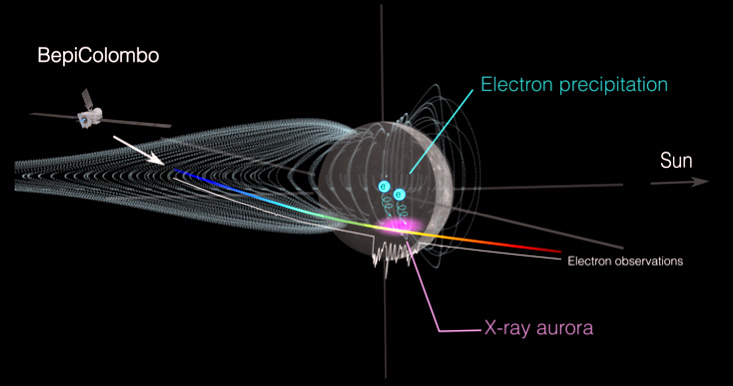
The planet also has an unusually large iron-rich core relative to its size and possesses its own magnetic field. Understanding how that field is generated is one of BepiColombo’s main objectives.
Scientists want to establish how Mercury formed, why its composition differs from that of the other rocky planets and how its surface has changed over billions of years.
The mission will also examine unusual shallow depressions known as hollows, which may have formed when volatile materials escaped from the planet’s surface.
Mercury’s magnetic environment is another important subject. Like Earth, it has a global magnetic field, although considerably weaker. That makes it particularly interesting to scientists studying how magnetic fields interact with charged particles from the Sun.
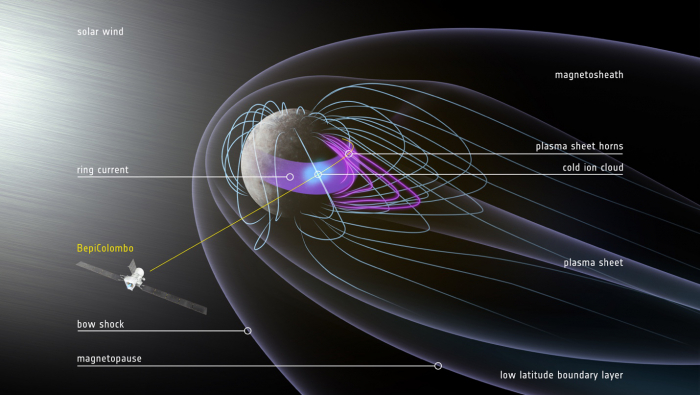
Hajime Hayakawa, a JAXA project manager involved in BepiColombo’s development, explained the scientific interest in an earlier statement published by the Japanese agency.
“We are anticipating that for the first time detailed explorations of Mercury will lead to a huge leap in knowledge about the ‘universality and uniqueness of magnetic fields and magnetosphere in universe,’” he said.
Hayakawa also linked the investigation of Mercury’s interior and surface to the wider question of how Earth-like planets formed.
Only the second mission to orbit Mercury
BepiColombo follows two earlier NASA missions to the planet.
Mariner 10 became the first spacecraft to visit Mercury in 1974, conducting three flybys and returning the first close-up images of its surface.
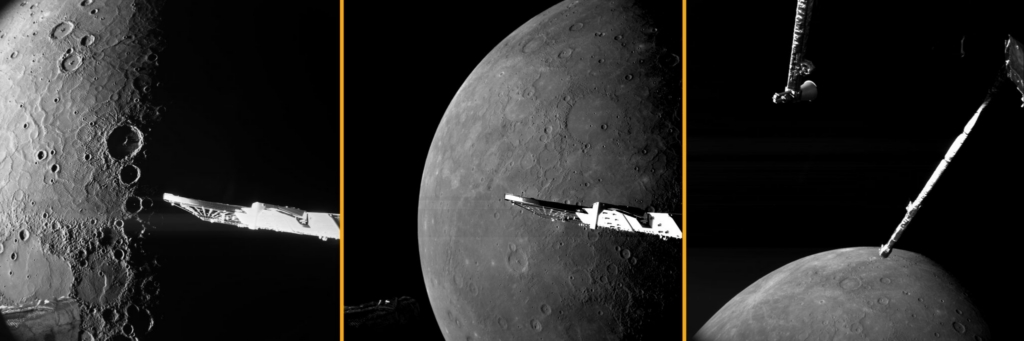
NASA’s MESSENGER spacecraft became the first to enter orbit around Mercury in March 2011. It spent more than four years studying the planet before ending its mission with a controlled impact in April 2015.
MESSENGER provided detailed surface maps and important measurements of Mercury’s composition, magnetic field and polar ice deposits.
BepiColombo will build on those findings using a broader range of instruments and two orbiters working at different distances from the planet.
The mission is named after Italian mathematician and engineer Giuseppe ‘Bepi’ Colombo, whose work helped explain Mercury’s orbital motion and contributed to the use of planetary gravity assists in spacecraft navigation.
BepiColombo is ESA’s first mission to Mercury and Japan’s first planetary mission to operate there. Its initial scientific programme is planned to last about one Earth year, with the possibility of an extension.
Sign up for our newsletter and get our latest content in your inbox.