Runway collision at LaGuardia: Warning came too late to stop crash

5 min read
“Truck 1… stop, stop, stop!”
The call came as a regional jet was already over the runway threshold, descending through its final seconds of flight. By the time the instruction was understood, the fire truck had already crossed the hold short line and was entering the runway.
What followed lasted barely half a minute.
A preliminary report by the National Transportation Safety Board lays out, in exact timestamps and distances, how Jazz Aviation flight 646, operating as Air Canada Express 8646, collided with an airport rescue vehicle at New York’s LaGuardia Airport on 22 March, killing both pilots and injuring dozens.
Air Canada Express jet cleared to land as fire trucks move to cross runway
At 23:35:07, the CRJ-900 was cleared to land on Runway 4, five miles from the airport and descending through about 1,900 feet.
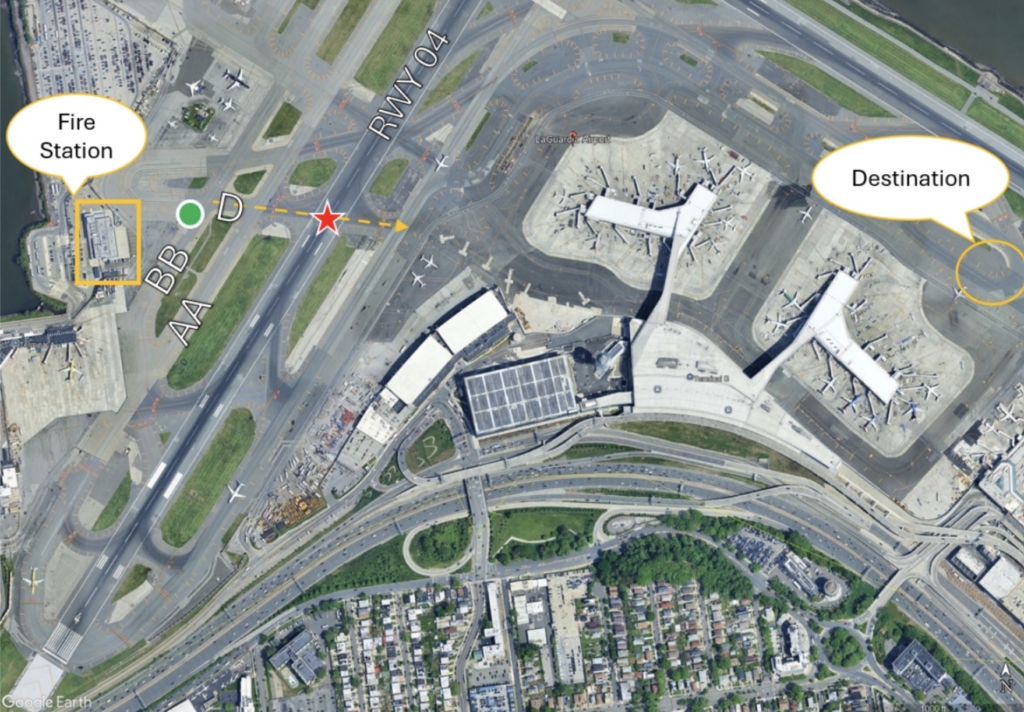
On the ground, seven emergency vehicles had begun moving in response to an unrelated incident near Terminal B. Their intended route required crossing Runway 4 via taxiway D.
What followed was an increasingly compressed sequence of events.
At 23:35:47, the lead vehicle attempted to contact the tower, but the transmission was blocked by another radio call. The convoy paused, regrouped and tried again.
By 23:36:44, with the aircraft now just 1.5 nautical miles out and descending through 400 feet, the tower controller asked which vehicle needed to cross the runway.
Seconds later, the clearance was issued.
At 23:37:04, “Truck 1 and company” was cleared to cross Runway 4.
At that moment, the aircraft was already on short final, about a quarter mile from the runway, roughly 4,400 feet from the intersection, and only 130 feet above ground.
Runway lights turned red seconds before LaGuardia crash
Nine seconds before the collision, the aircraft crossed the runway threshold.
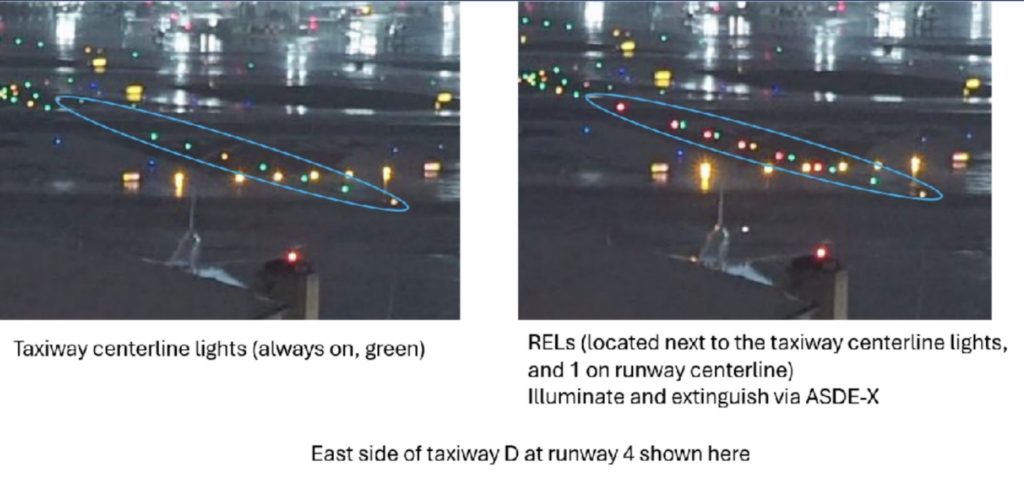
The runway entrance lights, designed to warn ground traffic, had already illuminated red as the aircraft approached. They remained active as the truck began moving.
At 23:37:07, the fire truck read back the clearance and accelerated along taxiway D.
The aircraft was now just 3,700 feet away and descending through 87 feet.
At 23:37:11, the jet crossed the threshold while the truck, moving at about 10 knots, continued toward the runway.
Within seconds, the controller recognised the conflict.
“Stop,” came the first call. But it lacked a callsign.
Inside the truck, the turret operator later told investigators he heard “stop stop stop” but did not know the instruction was meant for them.
Only when the controller repeated, “Truck 1 stop stop stop,” did the crew realise the urgency.
By then, the vehicle had already crossed the hold short line.
Final seconds before impact as aircraft lands and fire truck enters runway
At 23:37:17, the aircraft’s main landing gear touched down about 1,450 feet from the intersection, travelling at 128 knots.
The pilots deployed thrust reversers and began braking.
The truck, meanwhile, was accelerating, now approaching 29 miles per hour and less than 100 feet from the runway edge.
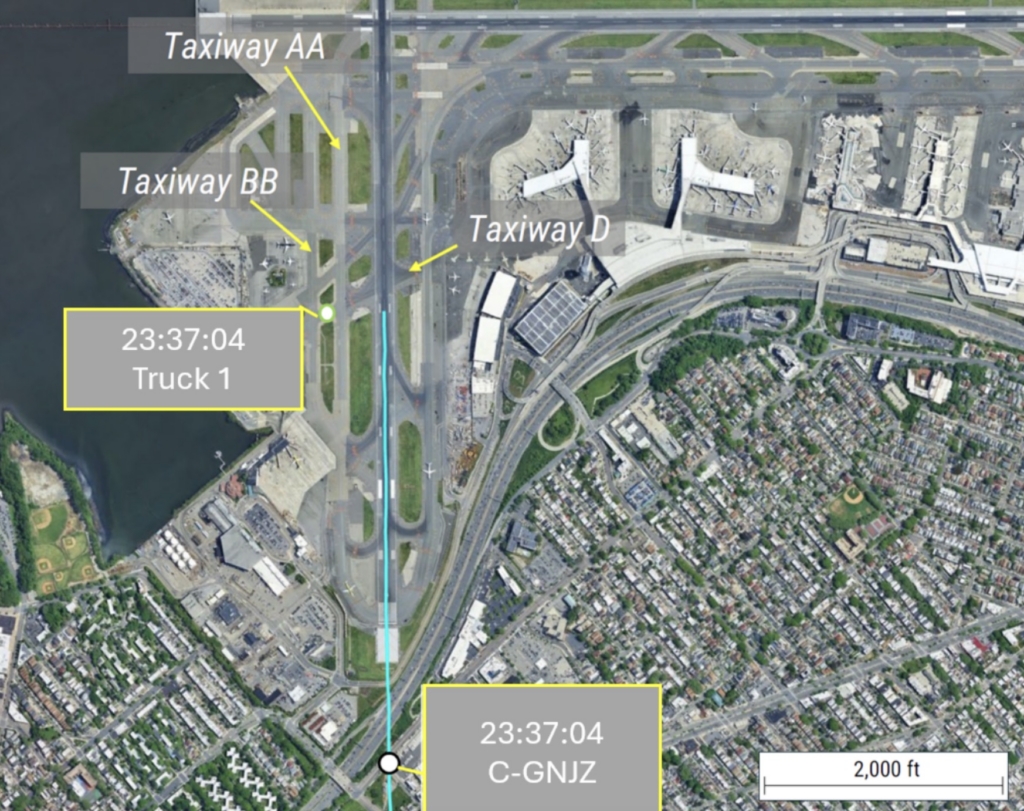
At 23:37:21, the runway lights extinguished, as designed, moments before the aircraft reached the intersection.
Two seconds later, the jet’s nose gear touched down, just 400 feet from taxiway D, still travelling at over 100 knots.
At that same moment, the truck entered the runway at roughly 30 mph. The collision followed almost immediately.
The aircraft’s final recorded ground speed before impact was 90 knots, about 104 miles per hour.
Collision destroys cockpit and kills both pilots in LaGuardia crash
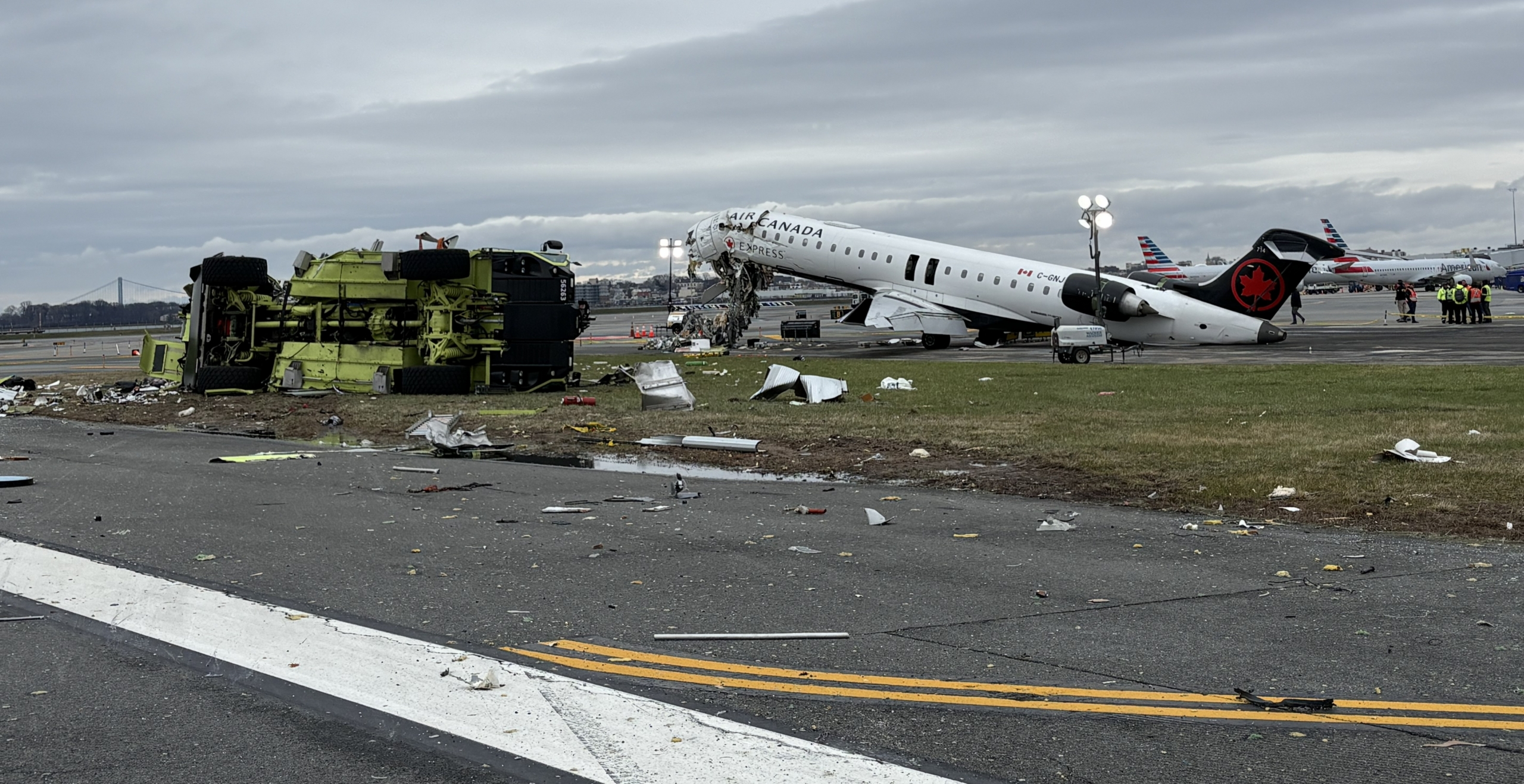
The force of the collision was concentrated at the front of the aircraft. Investigators found severe crush damage extending from the nose through the forward cabin area, including the cockpit and the first row of passenger seating.
The cockpit section was destroyed. Both pilots were killed.
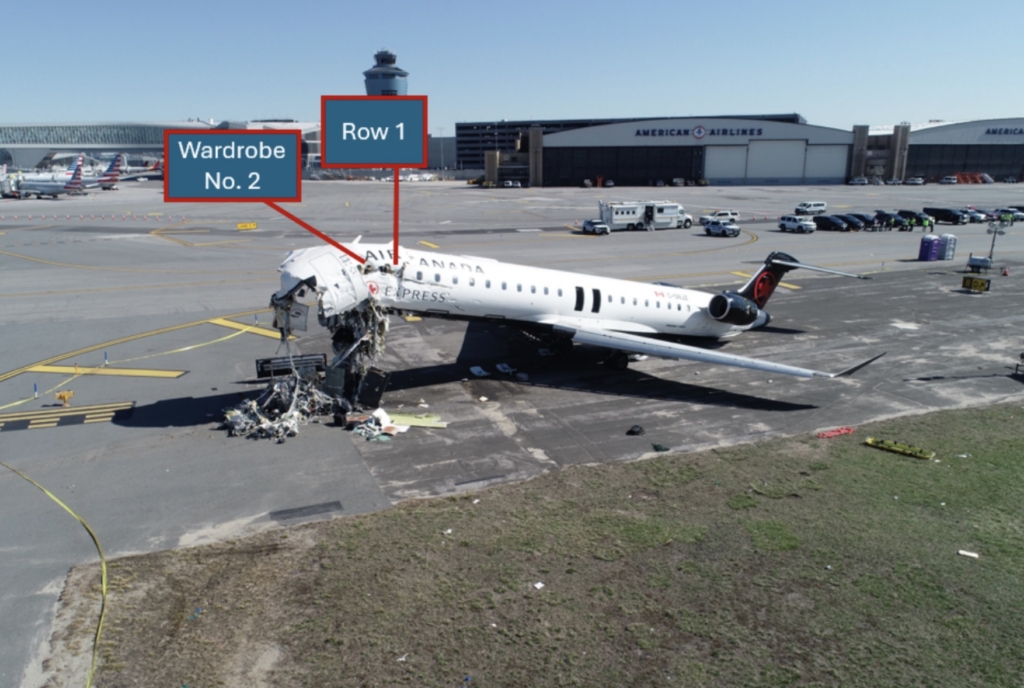
Behind them, the structure largely held. Passenger seats remained intact, and most occupants survived, though 39 people were taken to the hospital, including six with serious injuries.
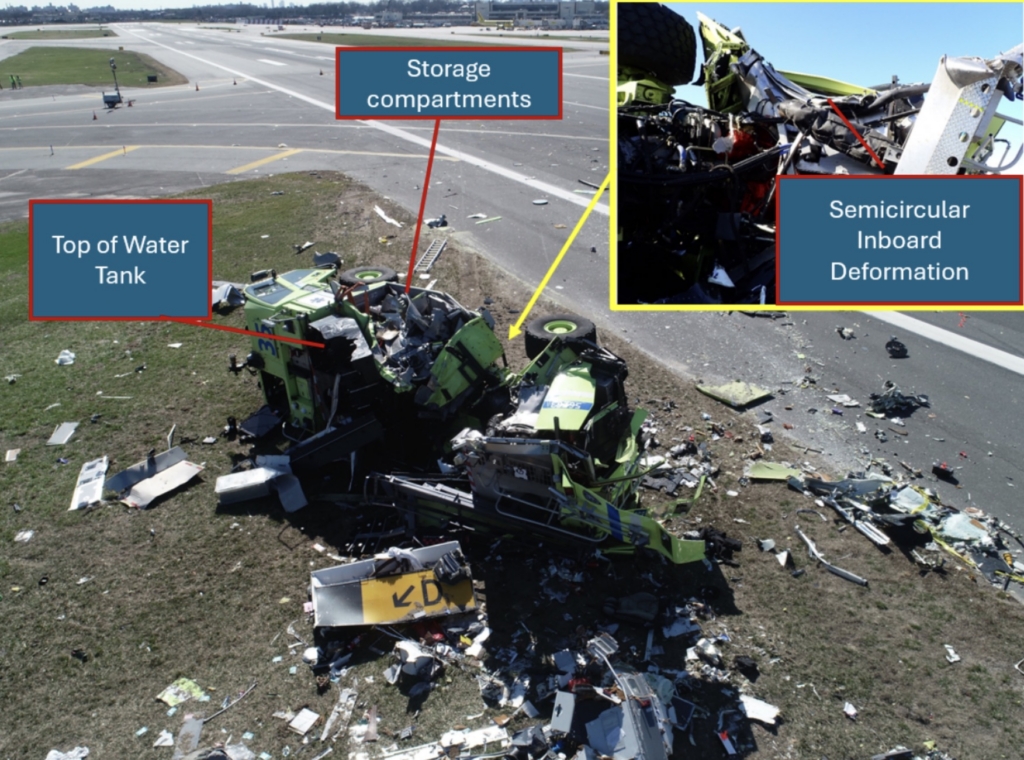
The debris field stretched approximately 300 feet in length and 150 feet in width, marking the path of the impact across the runway.
Safety systems fail to prevent runway collision at LaGuardia
The investigation highlights how several layers of safety were present, but did not align in time.
The airport’s ASDE-X surface monitoring system, designed to detect conflicts, did not generate any alert.
With multiple vehicles clustered together and none equipped with transponders, the system was unable to track them individually or predict a collision.
The runway status lights were active, but extinguished seconds before impact as part of their normal sequence.
The fire truck itself carried a situational awareness display showing aircraft and vehicle positions, but it lacked any capability to warn of an impending collision.
Even the radio warnings issued in time were initially too ambiguous to trigger immediate action.
“Without transponder-equipped vehicles, the ASDE-X system could not uniquely identify each of the seven responding vehicles… and did not predict a potential conflict,” the report states.
High workload in tower as controllers handle traffic and emergency response
The tower was operating under a typical night shift configuration with two controllers, both experienced. But the timing of events created pressure.

One controller was managing routine arrivals and departures, while also handling radio communications across frequencies, as another coordinated the ground emergency that had triggered the vehicle response.
Traffic levels were elevated at night, with aircraft arriving in close sequence. In that environment, decisions and corrections had to be made in seconds.
Less than 20 seconds between clearance and impact in LaGuardia crash
Weather conditions were not a factor. Visibility remained several miles in light rain, and braking action on the runway was reported as good.
Instead, the accident was defined by timing. A blocked radio call. A late runway crossing clearance. A warning without identification. A vehicle already moving. An aircraft already committed to landing.
From the moment the crossing clearance was issued to the moment of impact, less than 20 seconds elapsed.
In those seconds, multiple systems, procedures and human actions converged-but not quickly enough to prevent the outcome.
The investigation is ongoing. But the sequence is already clear.
Everything that could have stopped the collision came just too late.
Featured image: NTSB
Sign up for our newsletter and get our latest content in your inbox.


More from


October 17, 20264 min read