USAF nears collaborative combat drone decision as YFQ-42A returns to flight

5 min read
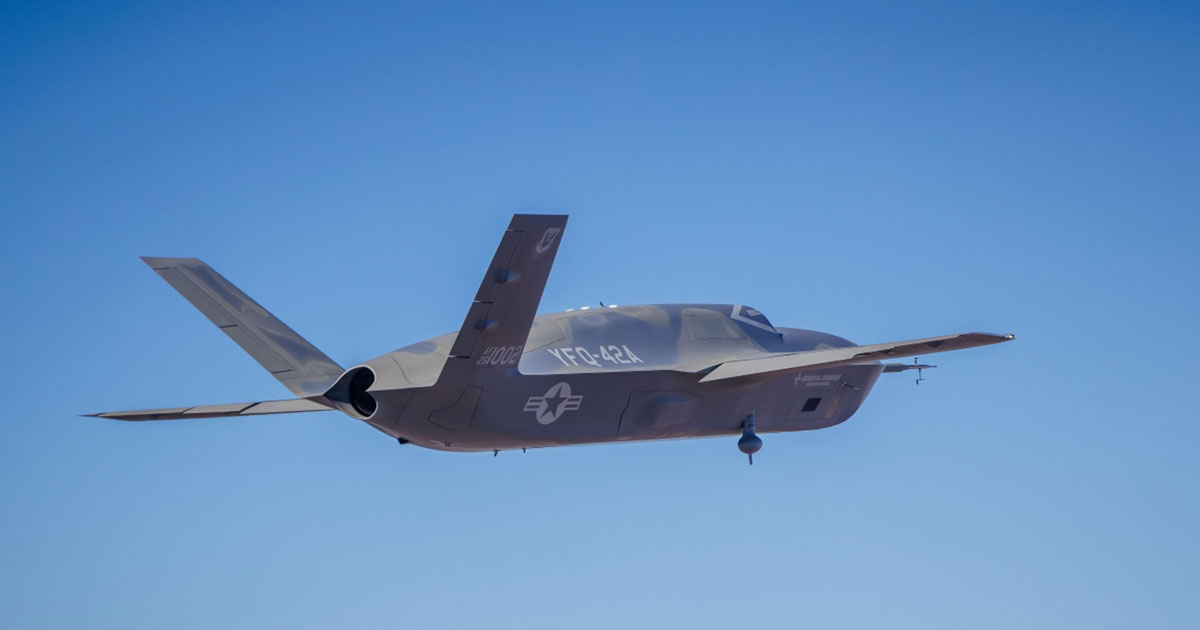
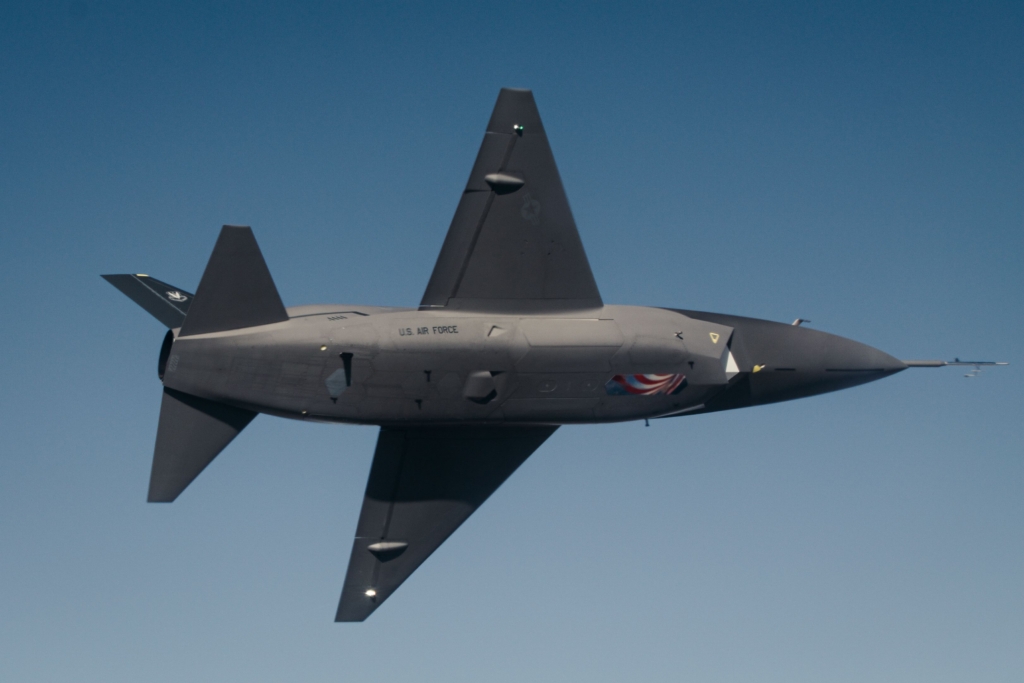
The USAF’s race to field its first semi-autonomous combat drone has resumed after General Atomics’ YFQ-42A returned to flight testing. This followed a crash that briefly threatened to slow one of the Pentagon’s most closely watched aviation programmes.
The return to flight comes at a critical moment for the Collaborative Combat Aircraft (CCA) programme, with the Air Force expected to choose between General Atomics’ YFQ-42A and rival Anduril’s YFQ-44A before the end of the fiscal year.
That decision could shape the future of American tactical airpower for decades.
Unlike earlier unmanned aircraft programmes, focused mainly on surveillance or precision strikes, the CCA effort is designed around semi-autonomous combat drones operating alongside crewed fighters such as the F-35 and the future Next Generation Air Dominance platform.
The Air Force wants the aircraft to extend range, absorb risk, carry weapons, conduct electronic warfare and overwhelm enemy air defences while operating as part of a human-machine combat team.
YFQ-42A crash traced to flight control software issue
The setback came on 6 April when a YFQ-42A crashed shortly after takeoff at a General Atomics test site in the California desert. The aircraft was destroyed, although nobody was injured.
A joint Air Force and General Atomics investigation later traced the mishap to what the company described as “an autopilot miscalculation for the weight and centre of gravity of the aircraft”.
The issue was linked to flight-control software rather than the mission autonomy system itself, and that distinction is important.
The flight-control software handles the mechanics of flying the aircraft, while the mission autonomy system acts more like an AI-enabled combat brain responsible for executing tasks assigned by a human operator.
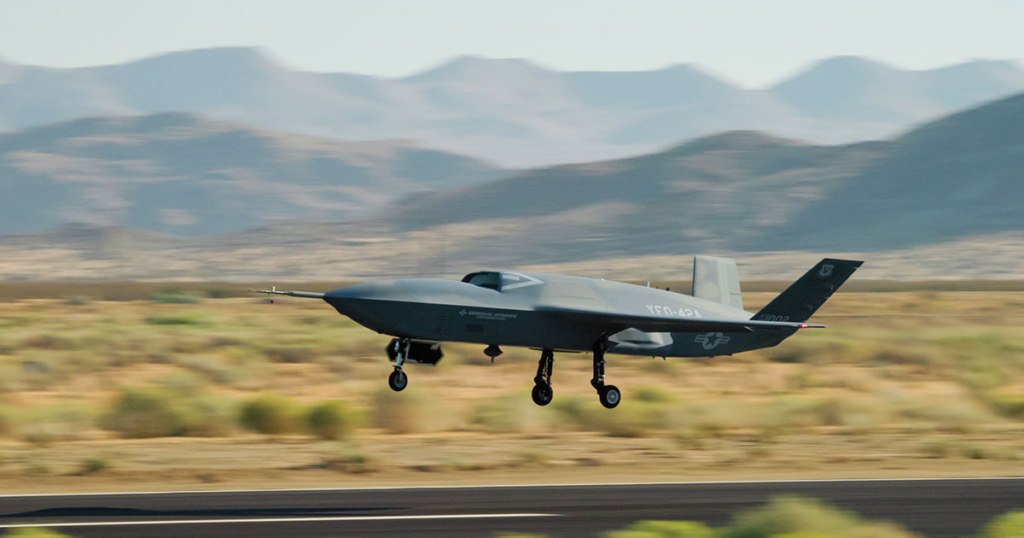
General Atomics said software corrections were introduced following the review process, allowing the aircraft to resume flight testing after a six-week pause.
“We’re excited to have YFQ-42A flying again,” General Atomics Aeronautical Systems President David Alexander said after the restart. “It’s been said that you learn more from your setbacks than your successes.”
The Air Force, notably, treated the crash less as a programme crisis and more as evidence that the testing system was functioning as intended.
“The CCA program was and is set up to learn, even when the learning comes from ‘failing forward,’” said Col. Timothy Helfrich, portfolio acquisition executive for fighters and advanced aircraft.
“The USAF and General Atomics response to the YFQ-42 mishap validates our approach to accept acquisition/test risk instead of operational risk, allowing us to accelerate the programme towards fielding,” Helfrich said. “We pushed the envelope, identified a risk, learned from the data, and have cleared the YFQ-42A to return to flight.”
USAF sees CCA drones as the future of air warfare
The CCA programme sits at the centre of the Air Force’s wider Next Generation Air Dominance effort.
Service planners increasingly view future air combat as too dangerous and too expensive to rely entirely on crewed fighters. CCA aircraft are intended to change that equation.
The Air Force has previously discussed eventually acquiring around 1,000 CCAs, based on a concept of pairing multiple autonomous aircraft with each crewed fighter. In the 2027 budget request, USAF included a billion dollars for CCAs.
Officials argue the drones could cost roughly one-third the price of a traditional fighter aircraft while providing additional weapons capacity, sensing capability and operational flexibility.
The aircraft are also expected to play a major role in future Indo-Pacific operations, where dispersed basing and long-range operations are likely to dominate combat planning.
“We are following the same detailed approach used in every other aircraft developmental test program to validate structural performance, flight characteristics and safe separation,” said Air Force Chief of Staff Gen. Ken Wilsbach. “This ensures the CCA can safely integrate inert weapons before future employment.”
“CCA is a critical part of a larger, integrated system-of-systems that will give our warfighters the overwhelming advantage,” Wilsbach said.
“This program is about delivering a network of effects that will sense, strike and shield our forces in contested environments. We are empowering our teams to take smart risks and deliver this capability faster, ensuring we can deter and, if necessary, defeat any adversary.”
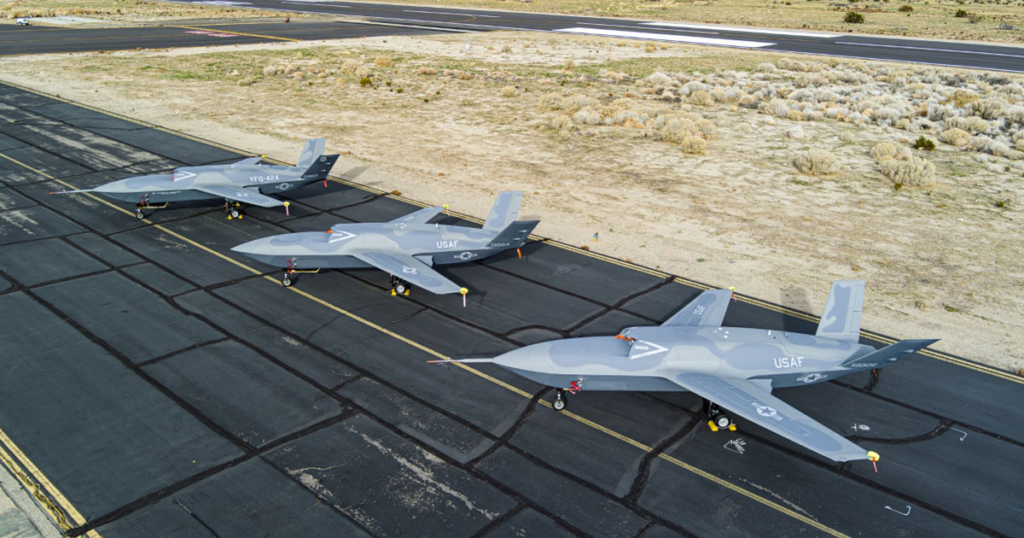
In March 2025, the US Air Force announced the designation of two Mission Design Series within its CCA programme: the YFQ-42A Dark Merlin from General Atomics and the YFQ-44A Talon Blue from Anduril.
General Atomics and Anduril enter decisive phase of CCA competition
The competition has effectively narrowed to two aircraft.
General Atomics’ YFQ-42A traces its origins to the company’s XQ-67A experimental drone and appears designed around endurance, survivability and relatively low-cost production.
Anduril’s YFQ-44A, developed from the Fury platform acquired through Blue Force Technologies, has followed a far more aggressive development narrative built around rapid manufacturing and semi-autonomous operations.
Anduril claims it moved the aircraft from clean-sheet design to its first semi-autonomous flight in just 556 days.
The company is also preparing for large-scale manufacturing at its planned Arsenal-1 production complex in Ohio.
Unlike traditional remotely piloted drones, Anduril says the YFQ-44A was designed from the outset for semi-autonomous operation rather than joystick-style remote control.
During the YFQ-42A flight pause, the Air Force continued operational exercises with the YFQ-44A through the Experimental Operations Unit at Edwards Air Force Base.
Those exercises focused less on pure flight testing and more on how autonomous aircraft might actually be deployed, sustained and operated in contested environments by frontline personnel rather than specialist test crews.
Congress increases scrutiny as CCA programme expands
The scale of the programme is already attracting close congressional scrutiny.
Congress provided $678 million in mandatory funding for CCA development in the FY2025 reconciliation act, while the Air Force requested a further $111.4 million in research and development funding for FY2026.
The House Appropriations Committee has also directed quarterly briefings on the programme’s progress.
Questions remain over procurement numbers, sustainment requirements, operational concepts and how much autonomy future aircraft should ultimately be allowed to exercise.
There are also growing debates about whether the Air Force can realistically field and sustain large fleets of semi-autonomous aircraft across dispersed Pacific operating locations.
The Air Force plans to acquire more than 100 aircraft during the programme’s first phase before expanding into additional mission sets that could eventually include electronic warfare, intelligence gathering and air-to-air combat roles.
The service is expected to decide later this year which aircraft will move forward into production.
After six weeks on the ground, General Atomics’ entry is back in the air just in time for that decision.
Featured image: GA-ASI