Double-bubble: Electra unveils turbo-electric airliner concept designed for the 2050s

3 min read
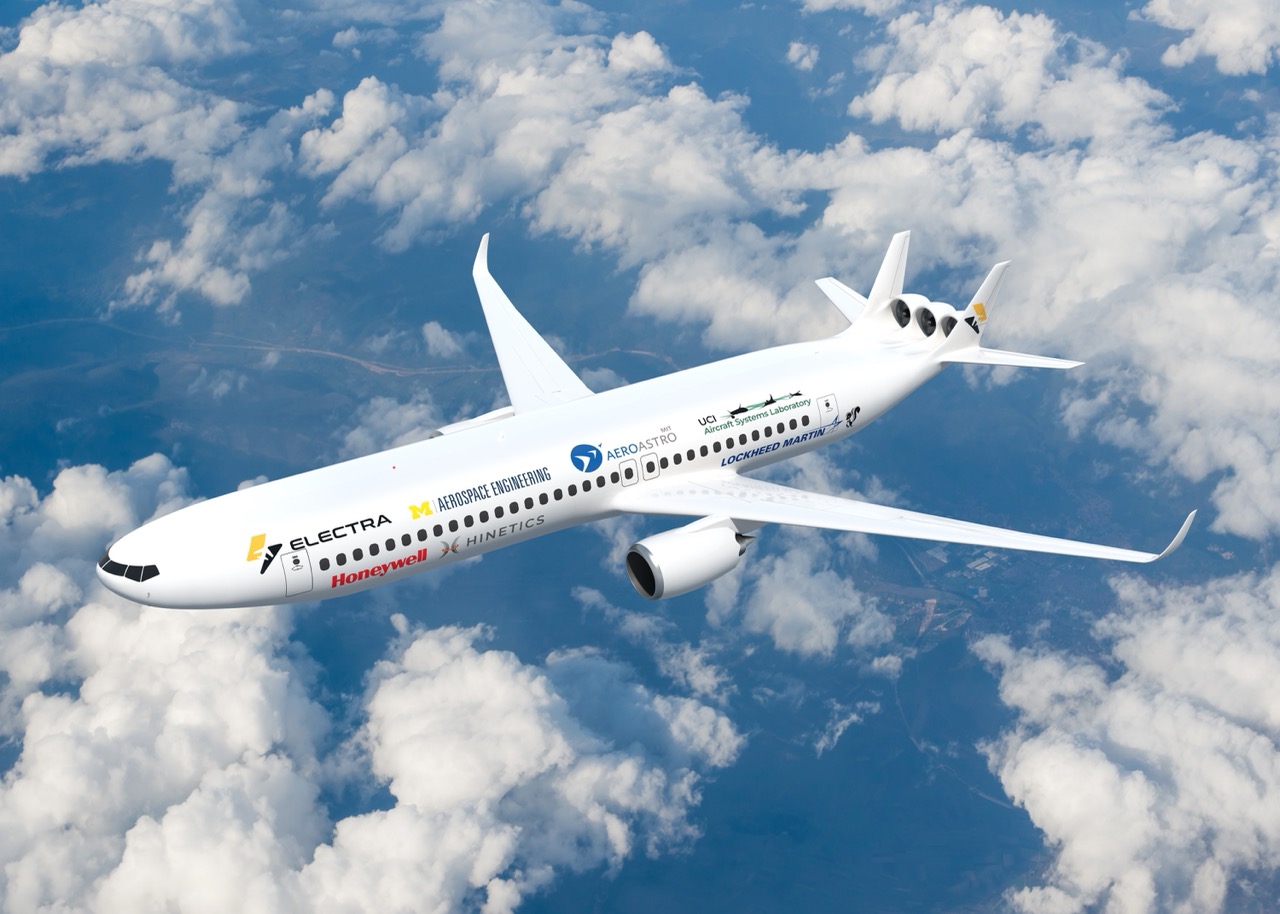
Hybrid-electric aircraft developer Electra has revealed a new turbo-electric airliner concept which could improve sustainability of commercial aviation beyond 2050. It combines a distinctive double-bubble fuselage and uses distributed electric propulsion to deliver significant efficiency gains while remaining compatible with existing airline operations.
Electra developed the concept under NASA‘s Advanced Aircraft Concepts for Environmental Sustainability (AACES) 2050 program, which is exploring technologies that could influence commercial aviation in the 2040s and beyond.
According to Electra, the design could provide up to a 17% improvement in efficiency beyond the gains expected from advances in structures, engines and aerodynamics by mid-century.
Double-bubble fuselage with electric tail fans
The aircraft, designed to transport over 100 passengers, features a wide “double-bubble” lifting fuselage, allowing the body itself to contribute more lift. Two underwing turbofan engines provide both thrust and electrical power to a pair of electric tail-mounted fans.
Those fans use a technique known as boundary layer ingestion, drawing in slower-moving air flowing over the fuselage and re-energising it to improve overall efficiency.
“The value of electrification in this concept is that it lets us put the propulsion where it couldn’t go before but does the most good,” said Dr Parker Vascik, Electra’s Director of Product Strategy. “We can radically improve how the airframe and propulsion system work together while keeping the aircraft grounded in real airline and airport operations. The goal is not just efficiency on paper, but concepts that we can actually build, certify, and use.”
Designed for existing airports and airlines
Electra’s design would fit existing airport gate dimensions and would not require substantial changes to airline boarding practices.
The aircraft would use conventional jet fuel or sustainable aviation fuel (SAF), avoiding the need for airport charging systems or alternative fuels that have yet to reach commercial maturity.
Electra said the configuration would also enable a twin-aisle cabin within a narrowbody aircraft category, potentially improving passenger comfort while speeding boarding and deplaning.
Revisiting NASA and MIT research
Dr Alejandra Uranga, Electra’s Chief Engineer for Research and Future Concepts, led the program. Before joining Electra, Uranga co-led NASA-sponsored work at the Massachusetts Institute of Technology that advanced the original double-bubble aircraft concept and the D8 aircraft design.
“This concept builds on years of research into how airframe shape and propulsion placement can work together to improve aircraft efficiency,” said Uranga. “What is different now is the ability to use electrification and distributed propulsion to more deeply integrate those systems. Designing the aircraft as a whole system is essential to realising the full potential of future commercial aircraft.”
Open-source tools and industry collaboration
As part of the AACES project, Electra produced 11 technical papers documenting the study’s methods and findings.
The company also adopted NASA’s open-source Aviary multidisciplinary design platform and developed an electrified aircraft design suite intended for public use to support broader aviation research efforts.
The project involved collaboration with American Airlines, Honeywell Aerospace, Lockheed Martin Skunk Works, Hinetics, MIT’s Department of Aeronautics and Astronautics, the University of Michigan Department of Aerospace Engineering and the University of California, Irvine’s Aircraft Systems Laboratory.
A roadmap toward 2050
Electra CEO Marc Allen said the company sees electric propulsion as ushering in a “third era of aviation.”
“Through AACES, NASA is pushing the industry to think boldly, to use our novel propulsion technologies to unconstrain design thinking for the next generation of commercial aviation,” Allen said. “The third era of aviation will bring radical change to how people and places connect, whether applied to aircraft entering service this decade, future regional platforms, or commercial transport by mid-century.”
Vascik added that bringing such concepts to market will require major technology demonstrations supported by NASA.
“Industry will not bring this concept to maturity by 2050 on its own,” he said. “That will require a NASA-accelerated technology initiative — in a double-bubble X-plane, multi-megawatt integrated generator, and kilovolt-class power distribution — to bring these capabilities to maturity by 2035 and position industry to carry them into service by 2050.”
Featured Image: Electra