Shield AI X-BAT – everything you need to know about the AI-powered fighter jet

3 min read

Few aircraft concepts are as ambitious as Shield AI’s X-BAT. Designed to take off without a runway and operate using AI-powered autonomy, the VTOL combat aircraft is attracting interest from multiple US military services as well as prospective international partners.”
In September, the programme secured its first international letter of intent from Poland, while the aircraft’s runway-independent design and autonomous capabilities align with emerging requirements across the US Air Force, Navy and Marine Corps.
What is Shield AI’s X-BAT autonomous combat aircraft?
In late September 2026, Shield AI named X-Forge 2 at the Newton City-County Airport in Kansas and X-Forge 3 in Des Moines as sites to build and test its X-BAT.
Newton will be the flight test and sustainment home for X-BAT, while Des Moines will be the production home. These sites join X-Forge 1 in Frisco, Texas and are the three sites where Shield AI will develop its X-BAT autonomous combat aircraft.
Shield AI’s plan is for X-BAT to begin production in 2029 and for the type to reach full rate in the early 2030s. Flight testing is to begin in late 2026.

It should be stressed that the Air Force has not selected the aircraft and that it is being developed with Shield AI’s own funds.
Shield AI is marketing the X-BAT to the Air Force, Marine Corps, Navy, and possibly even the Army. While it hasn’t won a US contract yet, the Navy has said it has taken note, and it lines up with the Navy’s requirements.
In September, the X-BAT received its first prospective order. Poland signed a letter of intent for the “design, production and delivery of X-BAT.”
How X-BAT fits into the US Air Force’s CCA programme
Shield AI is one of nine recognized potential vendors for the United States Air Force’s Increment 2 Collaborative Combat Aircraft (CCA) programme. The Air Force will downselect these vendors to up to six in 2027.
A useful way to understand these increments is that Increment 1 is an effort to get CCAs flying and in service as soon as possible. Increment 2 will build on Increment 1 and develop a much more capable and useful fleet of CCAs.
Increment 2 aircraft are intended to have the range needed for them to effectively operate in the Indo-Pacific and against China.
Shield AI is already a major contractor with the Air Force’s ongoing Increment 1, as its Hivemind mission autonomy software (aka ‘the brain’) already powers the incoming Anduril FQ-44 Fury.
The Air Force had a separate competition for the mission autonomy software. Anduril and General Atomics won the primary contracts for the aircraft, while Shield AI and RTX’s Collins (with ‘Sidekick’) won the mission autonomy software competition.
X-BAT specifications: range, payload and VTOL capability
The aircraft’s design reflects growing US military interest in operating combat aircraft across the vast distances of the Indo-Pacific while reducing dependence on vulnerable airbases.
It is anticipated that airbases and runways will become increasingly vulnerable in a high-end conflict. X-BAT is being built to be independent of airbases.
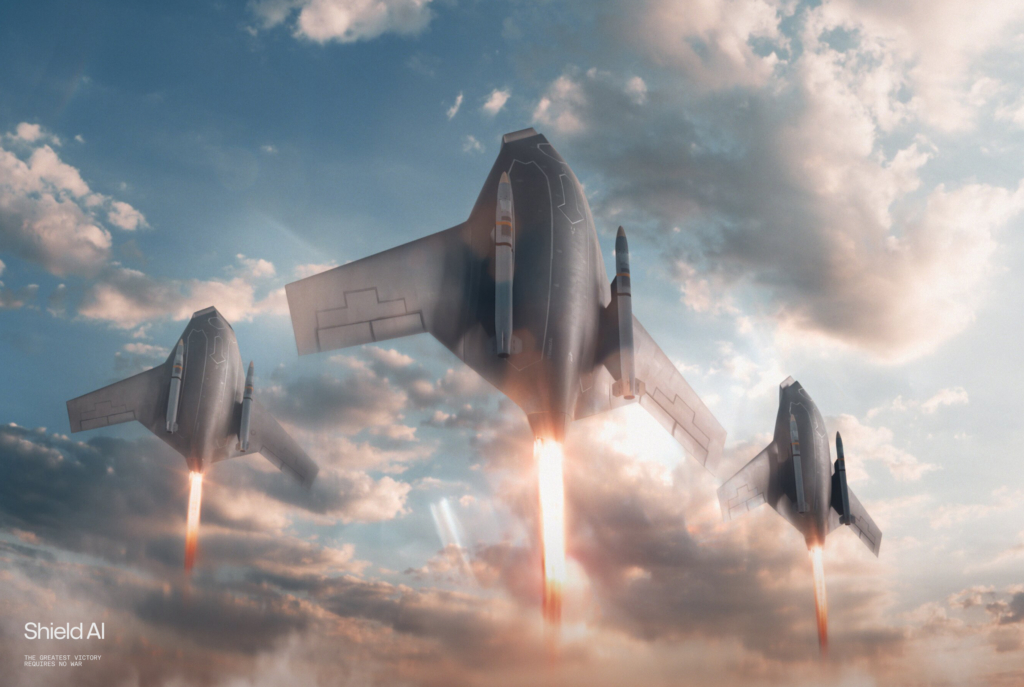
X-BAT is designed as a long-range, AI-piloted (Hivemind) strike fighter able to take off and land vertically. This means it is able to operate from ships, islands, or remote sites that lack runways.
It is to carry weapons up to the 2,000-pound class in its internal bays and have an “objective combat radius of 1,000 nautical miles and support power-intensive electronic warfare and intelligence, surveillance and reconnaissance payloads.”

Can X-BAT operate from ships?
One of the most interesting applications envisioned is that it wouldn’t need to operate from the Navy’s flattops (i.e., aircraft carriers and amphibious assault ships).
In January, Shield AI’s senior director for Navy programmes, retired US Navy Captain J.J. Cummings, wrote: “X-BAT operates from an aircraft carrier, an amphib, a destroyer, or a pickleball court.”
Shield AI’s stated concepts and promotional material show it operating from destroyers and container ships. China is already modifying container ships to operate its autonomous combat aircraft.
Shield AI has also talked about being able to deploy large numbers of X-BAT, up to around 60, on the Navy’s amphibious assault ships.