


Indian Air Force claims IL-76 altitude record after Himalayan airbase landing

5 min read
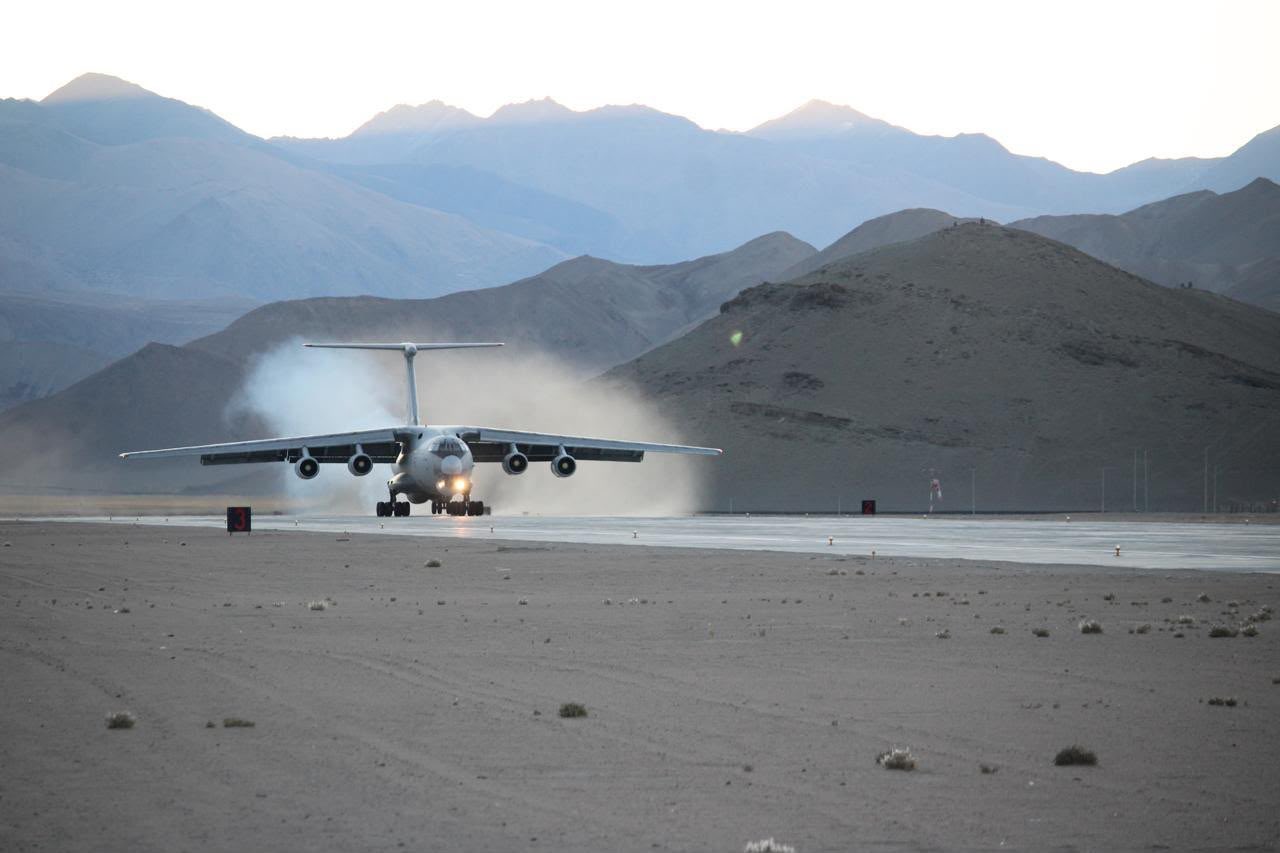
The four-engine transport aircraft touched down at 13,629 feet in Ladakh, demonstrating the capabilities of a newly upgraded airbase and a Soviet-era aircraft that remains central to India’s military airlift operations.
An Indian Air Force (IAF) IL-76 MD heavy transport aircraft has landed at 13,629 feet at Nyoma airbase in eastern Ladakh, setting what the service says is a world altitude record for the aircraft type and demonstrating its ability to operate from a newly upgraded runway near the Chinese border.
The landing, carried out on Friday and announced by the IAF on Saturday, marks a significant development for India’s military airlift operations in the Himalayas. Nyoma lies approximately 25 kilometres from the Line of Actual Control (LAC) with China, where maintaining reliable supplies to troops deployed in difficult mountain terrain remains a major logistical challenge.
The IAF described the landing as “a remarkable demonstration of the aircraft’s enduring capability, backed by the exceptional skill, precision, and professionalism /f its crew”.
It called the achievement “a milestone that reinforces India’s strategic airlift capability”.
The flight also demonstrated the continuing relevance of the Russian-origin IL-76, an aircraft India began operating more than four decades ago.
From a basic airstrip to a strategic airbase
Nyoma’s transformation is central to the significance of the landing.
The airstrip was reactivated in September 2009 when an IAF Antonov An-32 transport aircraft landed there. Until recently, its facilities were better suited to smaller tactical transports and helicopters than large military freighters.
Following the military confrontation with China that began in 2020, India accelerated infrastructure development across Ladakh, including roads, bridges, tunnels and airfields.
Defence Minister Rajnath Singh laid the foundation stone for Nyoma’s redevelopment in September 2023.
The Border Roads Organisation subsequently constructed a 2.7-kilometre paved runway under a project costing approximately INR 2.18 billion (approximately $23.2 million). The development included aircraft parking areas, hangars and air traffic control facilities.

The upgraded airbase was inaugurated in November 2025 when then IAF chief Air Chief Marshal A.P. Singh landed a C-130J Super Hercules there.
Its runway is designed to accommodate transport aircraft, helicopters and fighter operations, considerably expanding the military’s options in eastern Ladakh.
The arrival of the IL-76 provides evidence that the upgraded facilities can handle a substantially heavier aircraft than those previously operating from the old landing ground.
Why landing at 13,629 feet is difficult
High-altitude operations present challenges even for aircraft designed to use relatively austere airfields.
At Nyoma’s elevation, the air is considerably less dense than at sea level. Aircraft wings must move through the thinner air at a higher true airspeed to generate the lift needed for flight.
That means a transport aircraft can approach the runway at a higher ground speed for the same indicated airspeed, potentially increasing the distance required to stop.
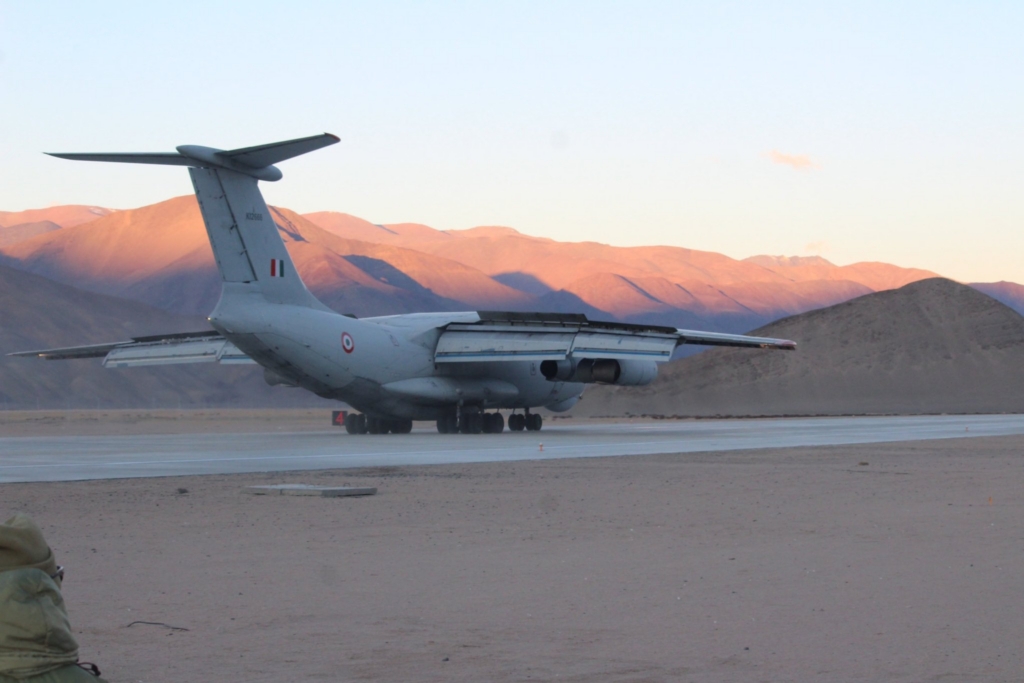
Reduced air density also affects engine performance, particularly during take-off and climb.
Crews must account for aircraft weight, temperature, wind, runway conditions and the performance margins available at the airfield.
The IL-76’s high-mounted wings, four turbofan engines and robust undercarriage were designed to support military transport operations, including from relatively demanding runways.
However, the aircraft’s published payload capability cannot automatically be assumed at Nyoma. High elevation and operating conditions can impose substantial restrictions on the weight an aircraft can safely carry.
The IAF has not disclosed the aircraft’s landing weight or cargo load during the record flight.
An earlier milestone at Daulat Beg Oldie
India has previously demonstrated high-altitude airlift capability using the American-built C-130J Super Hercules.
On 20 August 2013, an IAF C-130J landed at Daulat Beg Oldie in northern Ladakh, at an elevation of approximately 16,614 feet.
The aircraft operated from a compacted-earth landing strip near the Karakoram Pass, demonstrating the ability to deliver personnel and supplies to one of India’s most remote military outposts.
The C-130J was developed for tactical airlift operations and is equipped to operate from short, relatively austere runways.
Its four turboprop engines, high-lift wing configuration and specialised landing gear make it particularly suitable for such missions.
The distinction between the two achievements is important.
The C-130J’s landing at Daulat Beg Oldie demonstrated its ability to operate at extreme altitudes using a relatively basic airstrip. The IL-76’s landing at Nyoma is a different achievement. Unlike the smaller C-130J, the IL-76 is a heavy transport aircraft designed to carry substantially larger loads, including armoured vehicles and bulky military equipment. Operating such a large aircraft at 13,629 feet presents its own challenges because the thin mountain air affects aircraft performance.
Why India’s ageing IL-76 still matters
Known as Gajraj (King Elephant) in IAF service, the IL-76 entered India’s transport fleet in 1985, initially equipping No. 44 Squadron.
India acquired 17 aircraft between 1985 and 1989, establishing a heavy-lift capability that had previously been beyond the reach of its smaller transport fleet.
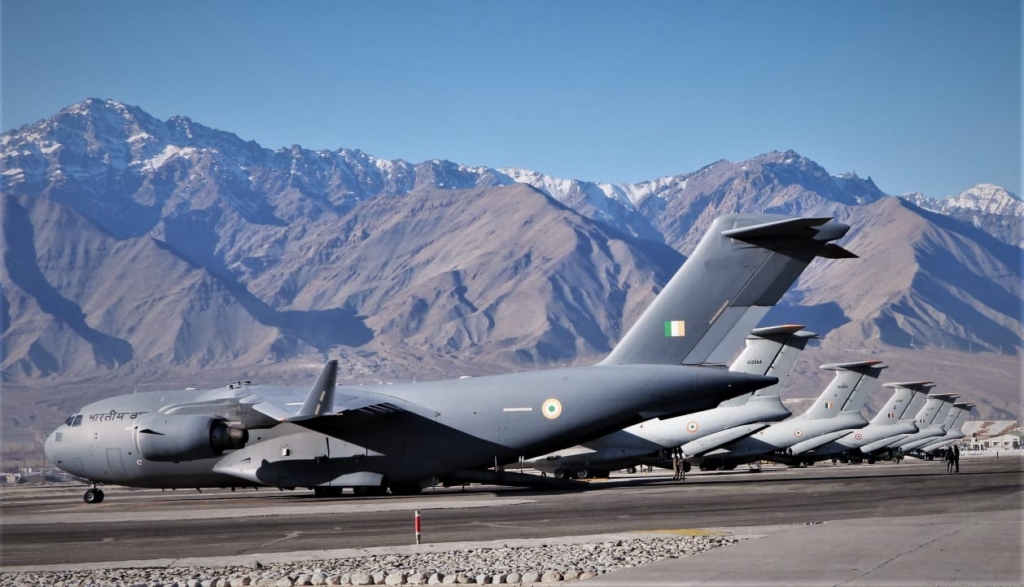
The four-engine aircraft can carry approximately 40–45 tonnes under suitable operating conditions, including military vehicles, equipment and other bulky loads.
Its rear loading ramp allows heavy cargo to be moved into the aircraft without the specialised loading arrangements required by conventional passenger aircraft.
The IL-76 has been used to transport troops, armoured vehicles and equipment to forward military areas, including Ladakh. It has also supported humanitarian assistance, disaster relief and overseas operations.
The IAF subsequently acquired Boeing C-17 Globemaster III transports, which offer greater payload capacity and modern avionics.
Nevertheless, the IL-76 remains an important part of India’s available heavy-lift capacity, particularly when multiple aircraft are required to sustain large military deployments.
Its continued service also presents growing maintenance challenges.
The ageing airframes require structural inspections, engine maintenance and a reliable supply of replacement components. Obtaining Russian-origin spares has become more difficult, with supply problems aggravated by the war in Ukraine.
India has examined extending the technical life of some IL-76 aircraft while expanding domestic maintenance and repair capabilities. Russian technical support remains important, particularly for engines and specialised systems.
Proposals to keep the fleet operational into the 2030s or beyond depend on the condition of individual aircraft, the availability of spares and the viability of further upgrades. No confirmed fleet-wide service extension into the 2040s has been established.
India is also pursuing a Medium Transport Aircraft programme as part of its longer-term effort to modernise military airlift.


