


Russia is building missile launchers for Iran, leaked documents suggest

3 min read
The Russian defence industry arranged to manufacture missile-launch equipment for Iran under an export order covering 90 helicopter-mounted launchers, according to leaked documents published by Ukrainian intelligence organisation Dallas Analytics.
The records concern launchers for Russia’s LMUR precision-guided missile, also known as Izdeliye 305 or Kh-39, and offer further evidence of military cooperation between Moscow and Tehran.
However, the documents do not establish whether the launchers were ultimately delivered.
Russian documents identify order for 90 missile launchers
A Financial Times investigation drew on the records obtained by Dallas Analytics, which subsequently published the underlying documents.
The paperwork includes a May 2024 letter from Russian missile and launcher manufacturer Vympel, part of the state-controlled Tactical Missiles Corporation (KTRV).
An accompanying production schedule identifies an export customer under the code “K-10.” Dallas Analytics links that designation to Iran through separate supplier paperwork explicitly naming the country.
🇮🇷🇷🇺 Despite Washington’s recent assertions that Moscow is not backing Tehran, confidential Russian defence records tell a different story. Dallas Analytics publishes primary industrial documents proving conclusively what the export code "K-10" designates: Iran. 🕵️ State plants built specialised missile-launch hardware – arming the forces now strangling global energy transit in the Strait of Hormuz – alongside a wider pipeline spanning Yak-130 trainers and helicopter upgrades. Read our investigation and examine the original schedules: https://t.co/uzHDyssDzr
— Dallas Analytics (@dallas_analytic) November 5, 2026
According to the organisation, the schedule allocates power units for 90 APU-L twin-rail launchers, with component shipments scheduled between late 2024 and December 2025. Those industrial delivery dates do not establish when finished equipment reached Iran.
What are the missile launchers designed to carry?
The APU-L launch system carries two LMUR missiles and is associated with Russia’s attack helicopters, including the Mi-28.
The missile weighs around 105 kg and carries a 25 kg warhead. Its electro-optical guidance system incorporates thermal imaging and a two-way data link, allowing an operator to guide it during flight.
The equipment could therefore strengthen the precision-strike capabilities of helicopters equipped to use it, rather than representing a standalone ground-based missile system.
Russia’s wider military cooperation with Iran
In 2023, Iran announced plans to acquire Russian Mi-28 attack helicopters, Su-35 fighters and Yak-130 advanced trainers.
The launcher paperwork adds another element to that relationship: the equipment needed to carry and deploy guided weapons.

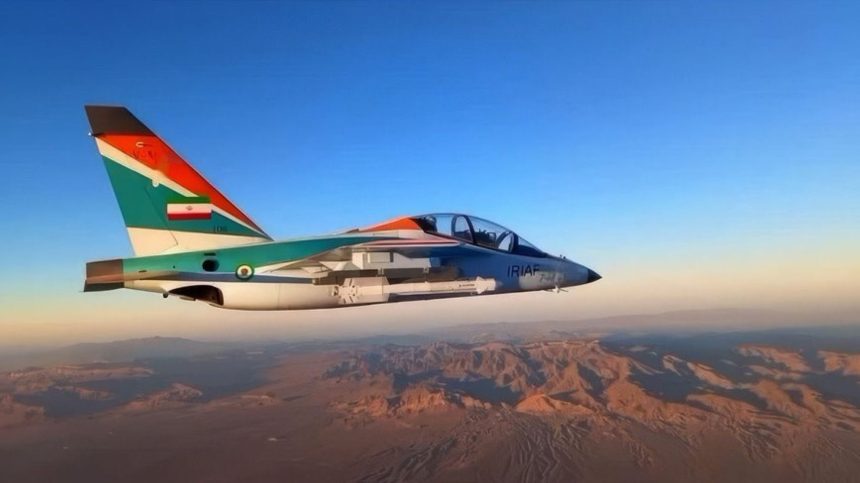
Dallas Analytics also published records concerning Yak-130 aircraft destined for the customer designated K-10. Iran publicly received its first Yak-130s in 2023.
An Iranian Yak-130 was subsequently shot down by an Israeli F-35.
Russia’s new ground-launched missile raises questions over Iran
Dallas Analytics links the K-10 export contracts to Iran through supplier paperwork that explicitly identifies the recipient as “«K10» Iran.”
The organisation also examines Russia’s recently unveiled ground-launched missile system, known as Izdeliye 347 or Product 347, which adapts the LMUR missile for launch from a mobile ground platform.
Mounted on a truck, the system provides a surface-to-surface capability without requiring a helicopter. Dallas Analytics estimates that ground launch would reduce the original missile’s range to around 10 km, while citing a Russian claim of 20 km for an upgraded version.

The organisation suggests that mobile launchers could threaten vessels in the confined waters of the Strait of Hormuz. However, its suggestion that the system may have been developed with Iran in mind remains speculative.
Dallas Analytics explicitly acknowledges that it has seen no operational or photographic evidence of ground-launched LMURs in Iranian hands. The documents concerning helicopter-mounted launchers do not establish that Iran ordered or received the truck-mounted system.


