


Ryanair 737 stairs linked to higher passenger fall rate, Italian investigators find

8 min read
Passengers using the integrated stairs on Ryanair Boeing 737s have suffered falls at a substantially higher rate than passengers using conventional airport stairs, according to a new study by Italy’s aviation accident investigation authority.
The Italian Flight Safety Agency (ANSV) published a final report on 31 August that examines multiple passenger falls from the integrated airstairs of Boeing 737 aircraft. The investigation follows three accidents in Italy in 2025 in which passengers sustained serious injuries.
ANSV examined 104 reported passenger falls during boarding and disembarkation in Italy between 2023 and 2025. Of those, 85 – around 82% – involved the integrated stairs of Boeing 737 aircraft operated by Ryanair.
That concentration is notable because Ryanair accounted for around 26% to 27% of passengers using Italian airports during the period.
After analysing different datasets, ANSV found that the rate of falls involving Ryanair’s integrated stairs was at least twice that associated with airport-provided stairs and, depending on the dataset, considerably higher.
Why does Ryanair use built-in Boeing 737 stairs?
The Boeing 737 can be fitted with an optional retractable stairway, known as an airstair, below the forward left passenger door.
It allows passengers to board and leave the aircraft without the need for mobile airport stairs or a passenger boarding bridge.
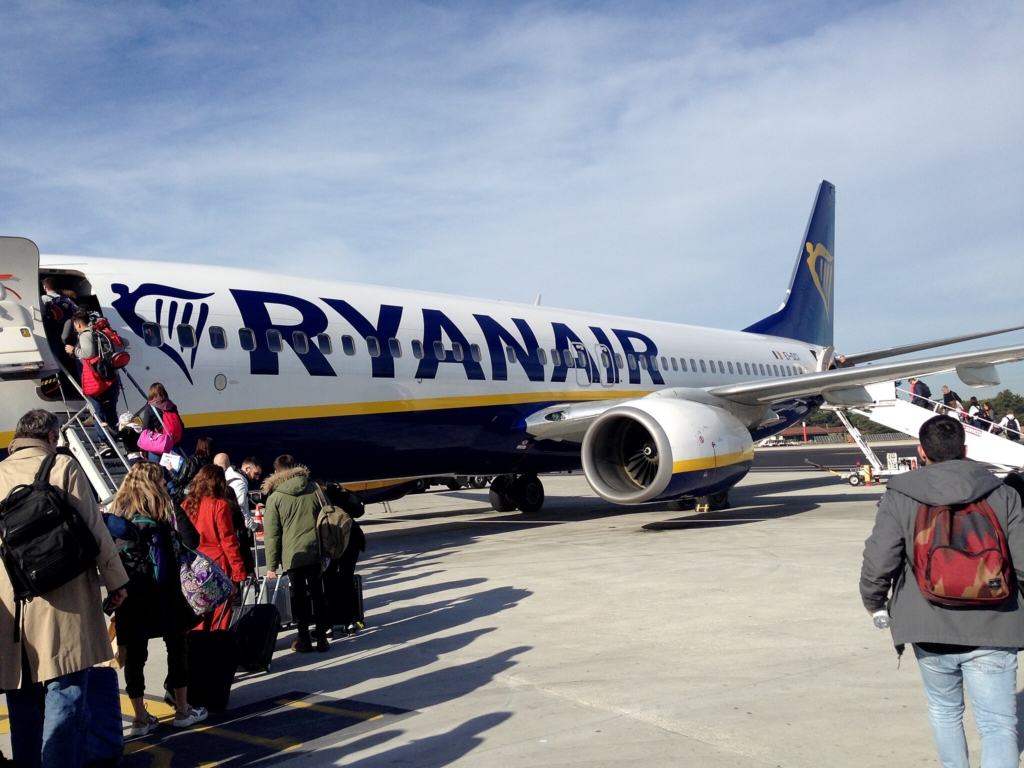
Ryanair makes extensive use of the equipment. ANSV said it was the only airline operating in Italy that systematically used Boeing 737 integrated stairs during the period examined.
However, investigators identified important differences between these stairs and the mobile stairs generally supplied by airports.
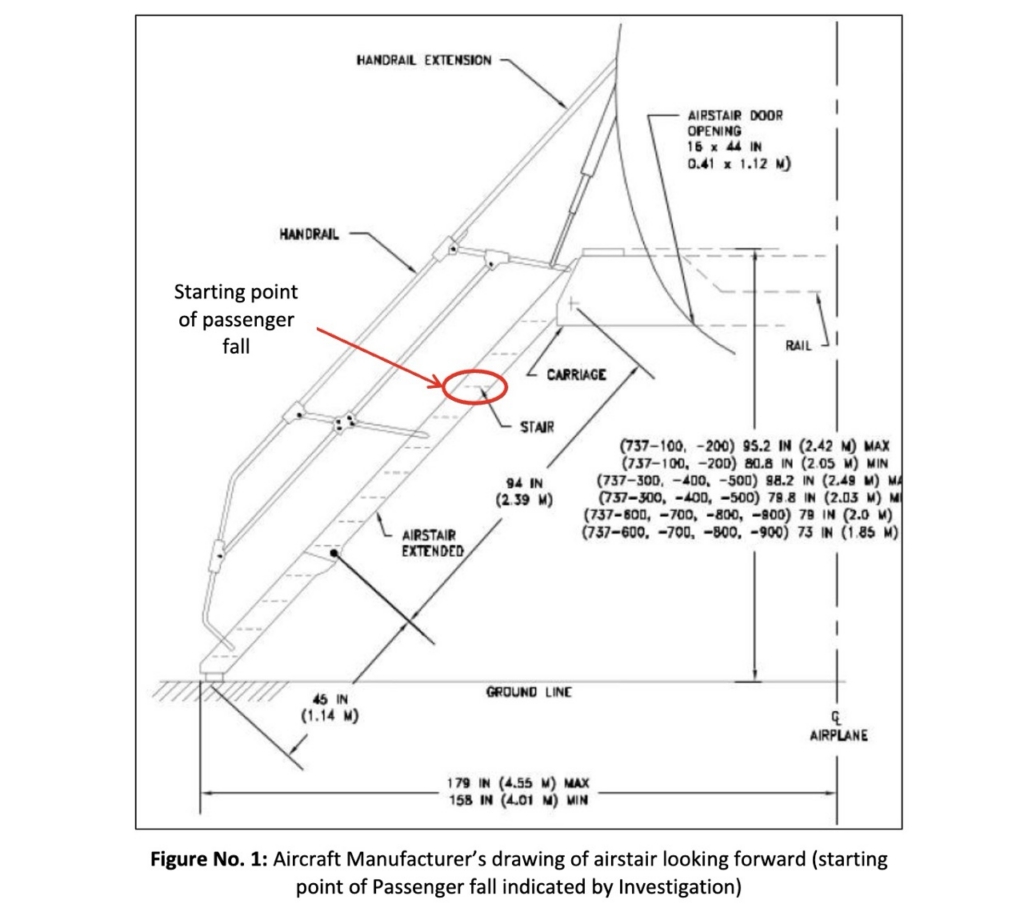
The 737 airstair has 12 steps and is around 61-62 cm wide. The steps have a rise of approximately 20cm and a tread depth of around 25cm, while the stairs are inclined at approximately 35 degrees.
The Irish Air Accident Investigation Unit (AAIU) separately noted that the 737-800 airstair is approximately 0.62 metres wide, making it narrower than mobile stairs supplied by airport ground handlers.
By comparison, ANSV notes that the EN 12312-1:2024 standard, which applies to airport passenger stairs, specifies a minimum width of 100cm for the equipment covered by that standard.
ANSV found that the 737 stairs were narrower and close to the limits for step height and inclination when compared with criteria applicable to airport stairs. The first step also differs in shape because the stairs must conform to the aircraft fuselage.
EASA rules on Boeing 737 integrated stairs explained
The regulatory difference between aircraft and airport stairs is significant.
The Irish AAIU found that there are no specific EASA CS-25 certification specifications governing the design of integrated aircraft stairs because they are not considered critical to the operation of the aircraft.
An EASA-commissioned cabin safety study had raised the issue as far back as 2009. It noted that there were no regulations specifically governing factors such as the height, angle or slip resistance of integrated steps or the provision of handrails and suggested that EASA consider incorporating relevant industry standards into airworthiness requirements.
EASA subsequently told the Irish investigation that it would continue to monitor integrated airstair occurrences through its Safety Risk Management process and consider whether additional regulation was necessary when assessing airstairs in new aircraft certification projects.
Three serious passenger falls investigated in Italy
ANSV’s study followed three accidents involving Ryanair 737-800s in Italy in 2025.
At Genoa on 22 March, a passenger fell while leaving Boeing 737-800 EI-EBC and suffered serious injuries. ANSV found passenger inattention was the probable cause. However, the reduced width and steeper configuration of the integrated stairs, together with the different step shape, could have contributed to the passenger’s loss of balance.
Two days later, another passenger fell while descending the integrated stairs of EI-DPI at Venice. The passenger was carrying two pieces of luggage, limiting their ability to use the handrail. Investigators again found that the stairs’ characteristics could have contributed.
CCTV footage captured a passenger leaving EI-EFE in Bologna on 10 July. The passenger was carrying luggage in both hands, and fell from around the third step. According to ANSV, failure to use the handrail was the probable cause. Investigators also considered the passenger’s blood-alcohol concentration of 2.34 g/l a contributing factor.
ANSV study finds hundreds of passenger falls across Ryanair’s network
ANSV also examined data beyond Italy.
Information supplied through the Irish accredited representative showed 489 passenger falls from stairs across Ryanair’s network since 2021, of which 360 – approximately 73% – occurred on integrated aircraft stairs.
ANSV calculated that falls from integrated stairs were approximately three times as numerous as falls from airport stairs in those data.
The Italian authority nevertheless stressed that the absolute number of falls is small compared with the number of passengers Ryanair carries.
Dublin Ryanair stair accident highlighted handrail risk
The problem had already attracted the attention of investigators elsewhere in Europe.
Ireland’s AAIU investigated a serious accident involving Ryanair Boeing 737-800 EI-EMM at Dublin Airport on 11 December 2021. The AAIU Report 2023-010 found that a passenger fell from near the top of the forward stairs, struck another passenger who tried to stop the fall, and landed at the bottom. The first passenger suffered a serious head injury.
Investigators found no defect in the stairs. CCTV also showed the passenger holding both handrails while carrying an item of clothing in one hand. The passenger appeared to fall forward while moving between the third and fourth steps, without first stumbling.
The aircraft already incorporated several Boeing-approved safety measures, including non-slip stair-tread material, high-visibility retractable barriers, detachable rails connecting the aircraft to the integrated handrails and signs telling passengers travelling with small children to hold their hands on the stairs.
Ryanair’s handrail procedures were already in place
Significantly, the AAIU found that Ryanair’s procedure at the time already required cabin crew to warn passengers to use the handrail.
The pre-disembarkation announcement stated: “All passengers should use the handrail provided when walking down the stairs.”
It also instructed adults travelling with children to hold their hands while descending and until reaching the terminal. The AAIU was told that the announcement was made before passengers left the aircraft involved in the Dublin accident.

But an earlier Spanish investigation had identified an opportunity to strengthen that warning.
Spain’s CIAIAC recommended that Ryanair provide the handrail warning not only in English but also in the official languages of the departure and destination countries.
It also recommended that cabin crew intervene when they see a passenger preparing to descend the forward stairs without a free hand, reminding them that they must use the handrail. Ryanair told the Irish investigation it had accepted both recommendations and was implementing them.
Investigators identify phones, luggage, alcohol and rushing as risks
The AAIU’s analysis also identified several behaviours associated with previous stair falls.
These included rushing, using handheld devices, alcohol consumption and carrying multiple pieces of luggage.
Investigators noted that such behaviour is commonplace during modern air travel and concluded that promoting safer passenger behaviour could reduce the number of falls.
The Irish authority therefore recommended that EASA undertake a safety promotion campaign highlighting behaviours passengers and crew can adopt to reduce the risk of falling while boarding or leaving an aircraft.
Spanish investigation links passenger fall to Boeing 737 stair geometry
The issue gained further attention following an accident at Alicante Airport on 17 October 2024 involving Ryanair Boeing 737-8200 EI-HAY.
Spain’s CIAIAC investigated after the tenth passenger leaving the aircraft fell from the integrated stairs and suffered a broken ankle. CIAIAC directly identified the geometry of the stairs as the probable cause.

Its investigation concluded that the passenger lost support under their right foot on the fourth step because of the geometric characteristics of the retractable integrated airstair. Investigators considered the absence of effective measures to mitigate the risk associated with the stair geometry and the possibility that the passenger was not holding the handrail as contributing factors.
The investigation resulted in four safety recommendations directed at Boeing, EASA and Ryanair.
Ryanair strengthens handrail announcements in 2026
ANSV’s new study shows that Ryanair has since taken further action.
On 23 July 2026, the airline amended its disembarkation procedure so that cabin crew regularly repeat the reminder to use the handrail as passengers leave the aircraft.
Where the language of the departure or destination country is not available through the aircraft’s automated announcement system, cabin crew should also make the announcement verbally in the relevant languages where possible.
Ryanair then introduced a dedicated disembarkation module into recurrent cabin crew training from 21 August 2026, shortly before publication of the Italian study.
ANSV considered these measures when deciding not to issue another safety recommendation of its own. Instead, the Italian authority said it substantially agreed with recommendations already issued by the Spanish CIAIAC and Irish AAIU.

The investigations do not establish that Boeing’s integrated stairs are defective. Passenger behaviour — including carrying luggage, distraction and failure to use handrails — features prominently in several accidents.
However, ANSV’s analysis indicates that the physical characteristics of the integrated 737 stairs can make those human factors more consequential.
The Irish investigation made a similar observation: although the annual number of reported airstair accidents is relatively small, passengers spend only a tiny fraction of their journey on the stairs. On a time-exposure basis, investigators concluded that using aircraft stairs represents a period of higher injury risk than the remainder of the flight.
With 85 of 104 recorded passenger falls in Italy over three years occurring on Ryanair’s integrated Boeing 737 stairs, ANSV concluded that the difference in occurrence rates compared with conventional airport stairs warranted closer attention.
Sign up for our newsletter and get our latest content in your inbox.


More from

August 31, 20265 min read


August 31, 20264 min read


