


One platform, multiple missions: Inside NOEMI’s diversification plans

5 min read
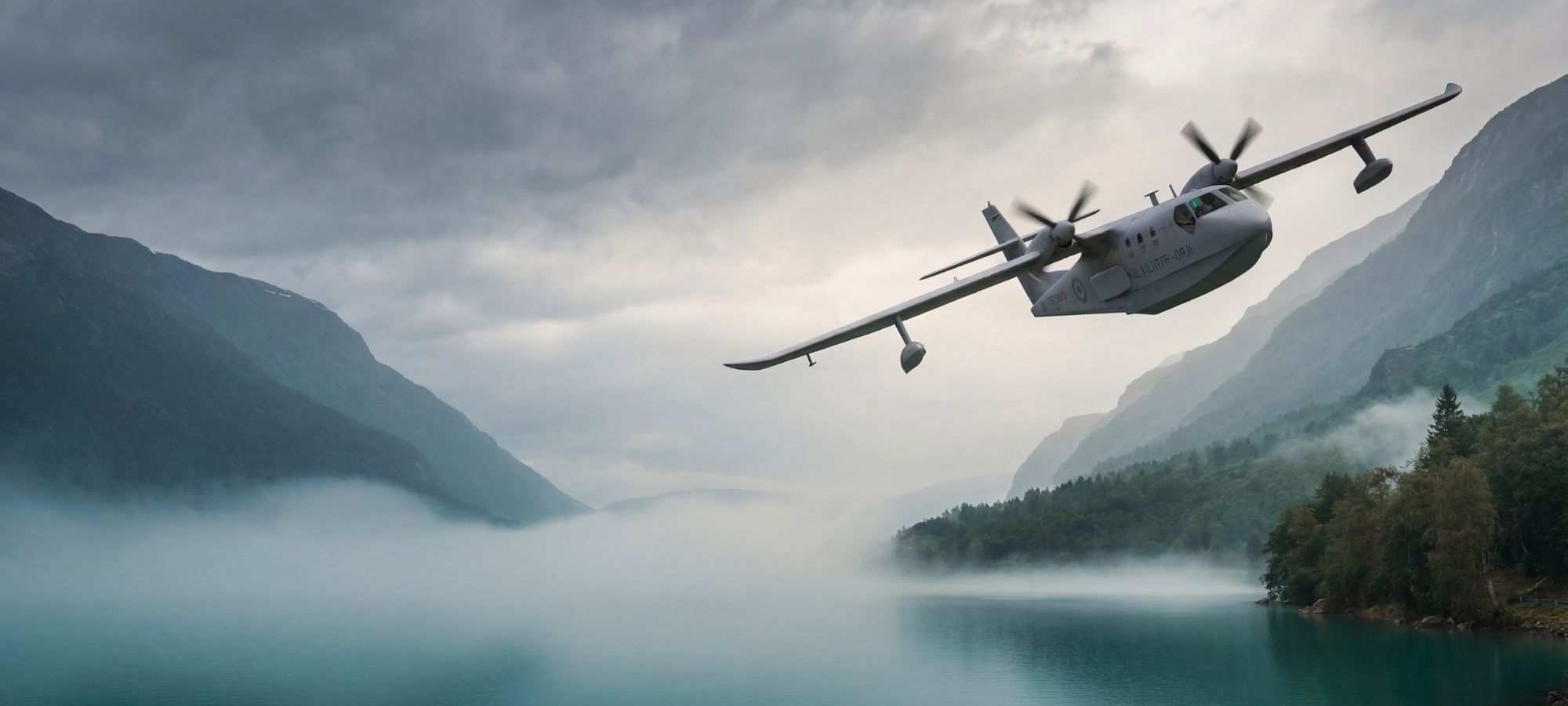
While NOEMI remains committed to its core mission of developing a fully electric amphibious aircraft for regional passenger transportation, Lithun says his strategy was always bigger than a single model.
“We are building a platform that can evolve and address multiple markets while leveraging shared technology, engineering and certification pathways,” he said.
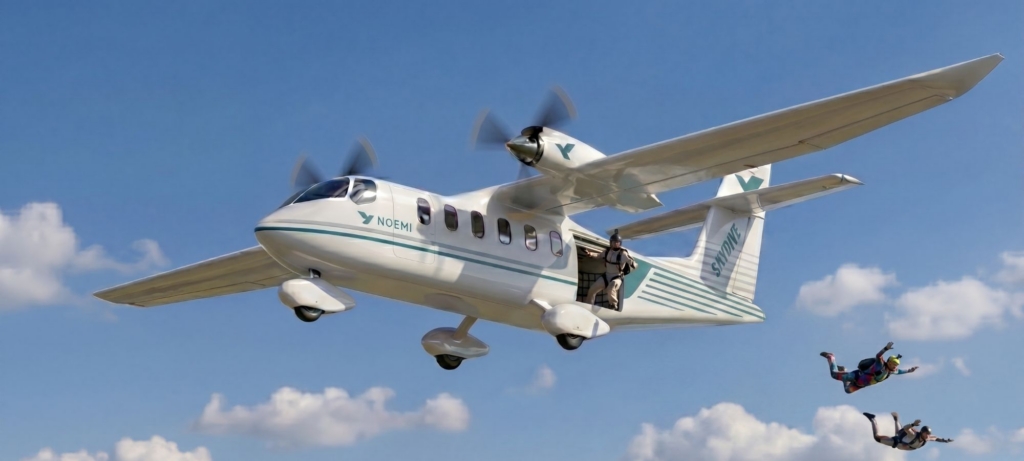
NOEMI already has more than 70 soft orders, including a US$50 million deal with VET Airways. Future applications could include skydiving operations, aerial firefighting, cargo operations and military missions.
For Lithun, there are significant long-term opportunities in adapting the same aircraft platform for additional propulsion configurations and dual-use applications.
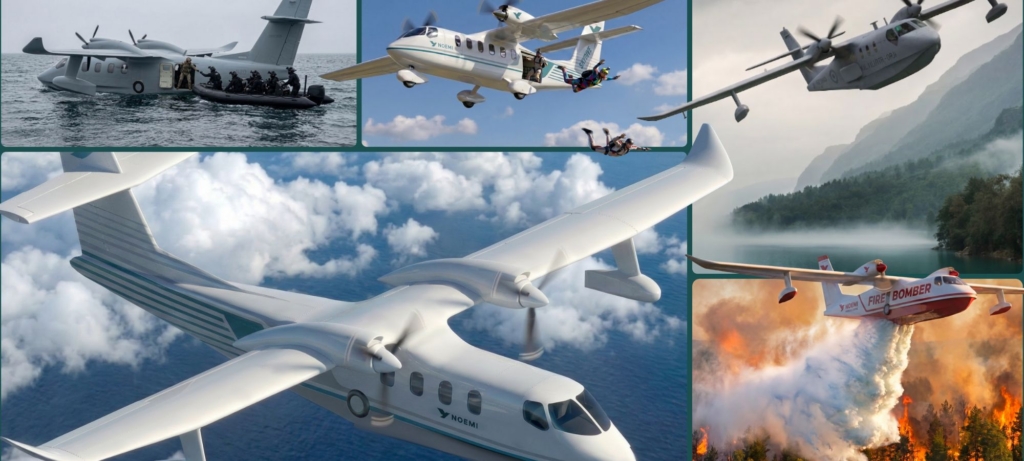
In a notable shift, future variants could move away from a fully electric amphibious aircraft. For missions that demand greater range, payload, or flexibility, NOEMI is considering hybrid-electric or conventional-fuel configurations.
NOEMI’s flight path to date
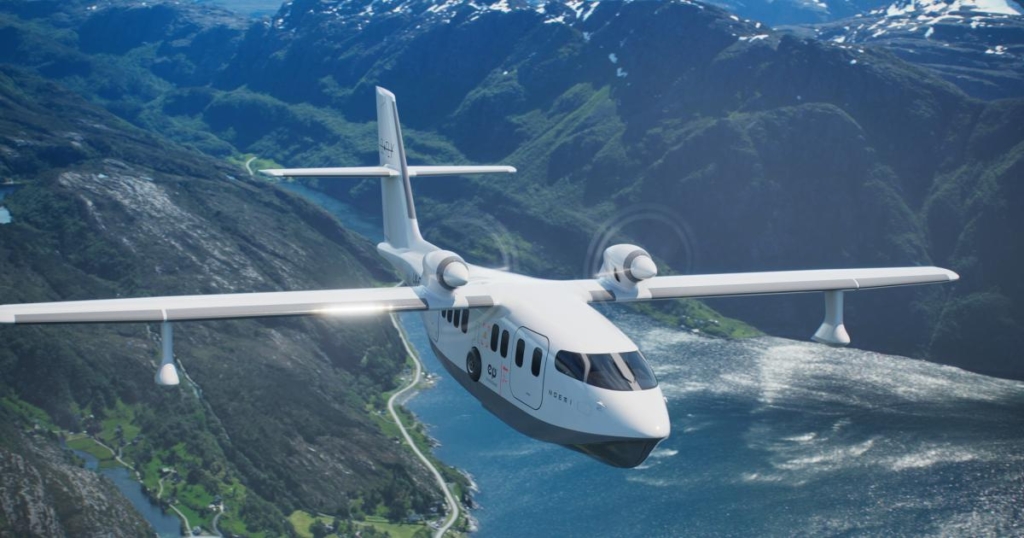
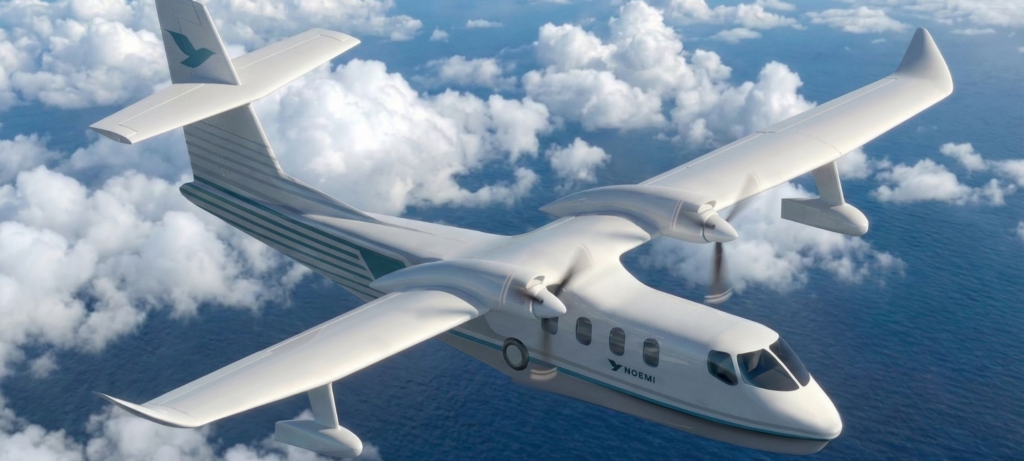
Unveiled in 2021 as the X10 concept, the NOEMI project was officially launched in 2023. Extensive research and testing carried out since then have led to a completely new hull geometry that delivers significant improvements in spray and drag reduction. The nine-passenger cabin measures 156cm wide and 167cm high — the largest in its class.
Co-founder and Chief Technology Officer Tomas Brødreskift cited seaplane designs from the 1920s through the 1950s, noting that spray was often overlooked.
“We needed to protect our propellers and reduce saltwater ingestion”, he said.
The solution was a twin-chine hull: a low-speed chine positioned forward and a high-speed chine further aft on the forebody.
“This has proven to be a very good overall design,” said Brødreskift. “It delivers better spray characteristics and drag reduction, enabling the aircraft to get up and out of the water more quickly while keeping cruise power below 330kW, which is needed to achieve a 200km range.”
A low flying speed of 58 knots presents one of the more demanding constraints. While a tough target for an aircraft of its size, this is essential for safe and comfortable water operations. NOEMI spans 21m across the wing, stretches 16m in length and stands 6m tall.
Developing an aircraft with aerodynamic and hydrodynamic characteristics
Considerable aerodynamic and hydrodynamic work has gone into shaping the aircraft to meet certification requirements for both flight and hydrodynamic characteristics.
Brødreskift also highlighted the added complexity of the flight deck. Unlike a conventional aircraft cockpit, a seaplane’s flight deck is “a lot more intricate, as it must also account for operations as a marine vessel in congested waterways,” he explained.
“On the water, you take off your seatbelts and operate the vessel like a boat,” he said. He also noted that this drives specific requirements for visibility, crew movement, and cockpit layout.
Regarding propulsion, the company has made a strategic decision to base its powertrain on off-the-shelf automotive components, combined with a proprietary gear-and-governor system developed largely in-house. “The automotive sector is fully driving the electric powertrain shift,” said Brødreskift.
“We want to be in a position to fully utilise the technology that comes out of that ecosystem,” said Brødreskift. He noted the propulsion rig is scheduled for testing in August.
Funding and programme timeline
The total programme cost for NOEMI is estimated at US$150 million. The company has secured $20 million to date – $10 million from the Norwegian government and the remaining $10 million from Lithun and his co-investors.
Seed funding has enabled sub-scale analysis and sea trials of the amphibious aircraft. NOEMI is now entering its Series A phase, expected to run through 2029. During this period, validation flights of demonstrators TAC1 and TAC2 are expected by the end of 2027 and 2029, respectively.
Series B funding between 2029 and 2030 will support type certification of TAC2, with first deliveries targeted for 2032.
Expanding the NOEMI platform
NOEMI’s chief engineer, Simon Bendrey, emphasised that the certification process is integral to expanding the IP’s production potential to cover multiple use cases.
“We are not just creating a single aircraft. We are creating a platform,” he said. “By going through the design process, we own all of the IP around the composite structures: the structural design, analysis, and the mould manufacturing processes. We’ve defined all of that for this aircraft.”
“The same applies to the propulsion process,” he continued. Although the hardware is sourced from the automotive sector, the integration, control architecture and safety systems are all proprietary.
“Effectively, the aircraft is agnostic to its propulsion system, which we can develop to take advantage of the latest technologies, as they emerge.”
Lithun sees the seaplane category as uniquely positioned for an innovation push.
“We are designing NOEMI to fly, slow and short distances – and that combination gives you the possibility to go battery-electric from day one.”
The amphibious configuration adds further commercial appeal because the aircraft can operate from conventional airfields and access water, which covers 70% of the planet’s surface.
“That opens up an exciting business case for accessing city centres directly,” he said.
Using the de Havilland Canada Twin Otter as a competitive benchmark, NOEMI is targeting lower drag through its flying-boat configuration and composite construction suited to saltwater environments.
“Most of the aircraft currently being flown in this environment are old and expensive to run,” said Bendrey. “The same savings we’re offering on the seaplane can be realised across other markets.”
From seaplane to skydiving and aerial firefighting
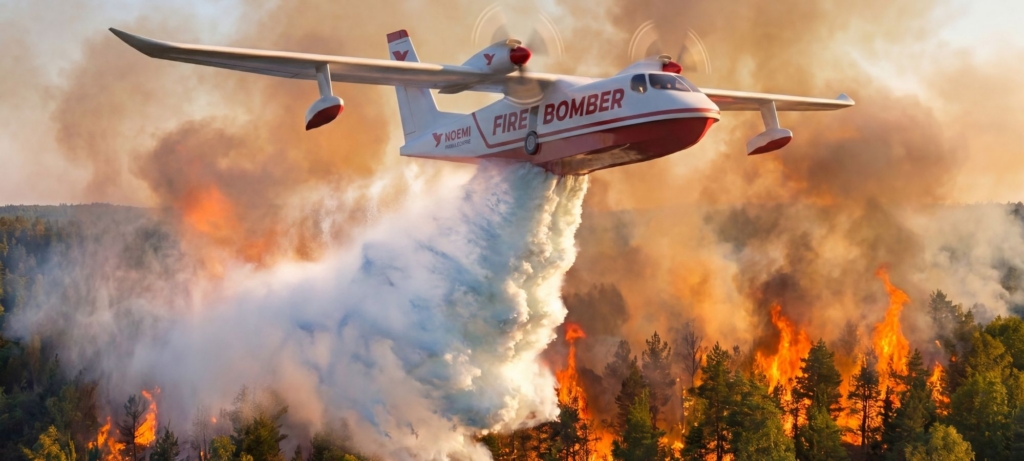
Aerial firefighting is one early priority. Demand for firefighting aircraft has surged in recent years, driven by the scale of wildfire damage globally.
Bendrey believes NOEMI can address the smaller-category segment in this sector, currently served by aircraft such as the Air Tractor, which carries around three tonnes of retardant.
“It’s a relatively simple modification to the hull to scoop up three tonnes of water in seconds and deposit it onto a fire,” he said.
He added that with its ability to operate on land and water, NOEMI could be the first electric aircraft offered for this mission type and anticipates strong demand.
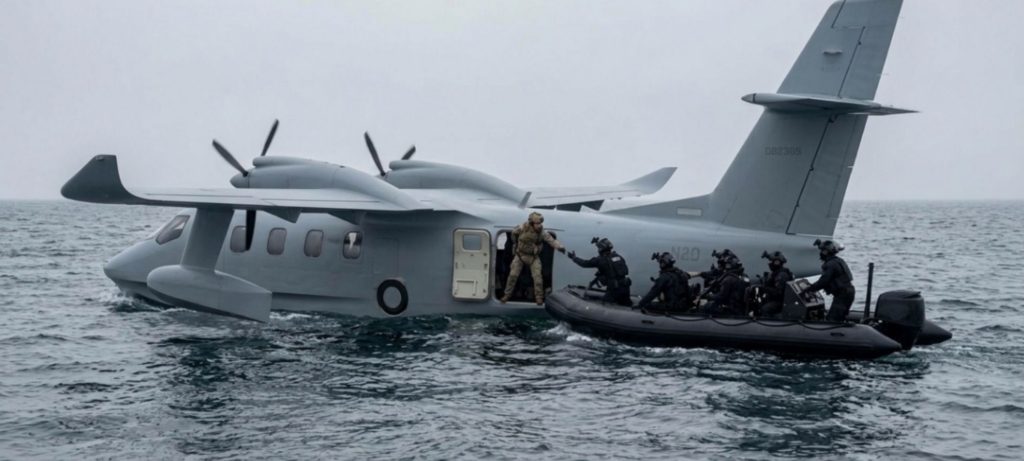
Skydiving has also been identified as a potential market, as have military and dual-use applications. Lithun reiterated the platform’s ability to fly low, slow and under radar, combined with its amphibious capability, makes it well-suited to coastal reconnaissance, search and rescue and medical evacuation missions.
“NOEMI can serve multiple missions,” concluded Lithun. “The combination of electric propulsion with amphibious capabilities, combined with our vision for other applications, will enable us to unlock routes and opportunities with minimal infrastructure requirements.”
Featured image: NOEMI
Sign up for our newsletter and get our latest content in your inbox.


More from


September 6, 20264 min read


