Replacement Red Arrows: What aircraft could supplant the iconic Hawk T1?

4 min read

In May 2026, hopes of a British-designed successor to the RAF‘s Hawk fleet faded when aerospace start-up Aeralis collapsed.
With no domestic contender remaining, the replacement for the RAF’s Hawk T1 and Hawk T2 aircraft is now likely to be based on an overseas design.
The Hawk has been one of Britain’s most successful military aircraft programmes and export successes.
However, with the Hawk T1 due to retire from RAF service around 2030 and the wider Hawk fleet approaching the end of its operational life, a replacement will need to be selected in the near future.
The programme to find a Hawk replacement
In 2026, the UK Ministry of Defence issued a request for information to replace its Hawk aircraft. It requires a new trainer for its Red Arrows to serve as an aerobatic aircraft and a replacement for its 28 (now 27) Hawk T2 trainers.
The MoD is likely to select a common platform for the two aircraft variants, so whichever design wins the T1 competition will likely also be the one winning the T2 competition.

The MoD has said the aircraft should be “designed to support the transition to fifth- and sixth-generation air systems, ensuring UK pilots are equipped with the skills needed for modern and future combat environments.”
Prospective contractors were to place their submissions by the 11 September. A key requirement was for Britain to have a significant workshare.
BAE-Boeing-Saab T-7 Red Hawk
BAE Systems has announced a partnership with Boeing to offer the T-7 Red Hawk (designed for the US Air Force) to the Royal Air Force. This is widely viewed asthe most likely option for the Hawk T1 and T2 replacement.
BAE stated in July, “The agreement marks a significant milestone in the partnership between the three companies and commits to a new UK-based final assembly and integration facility.”
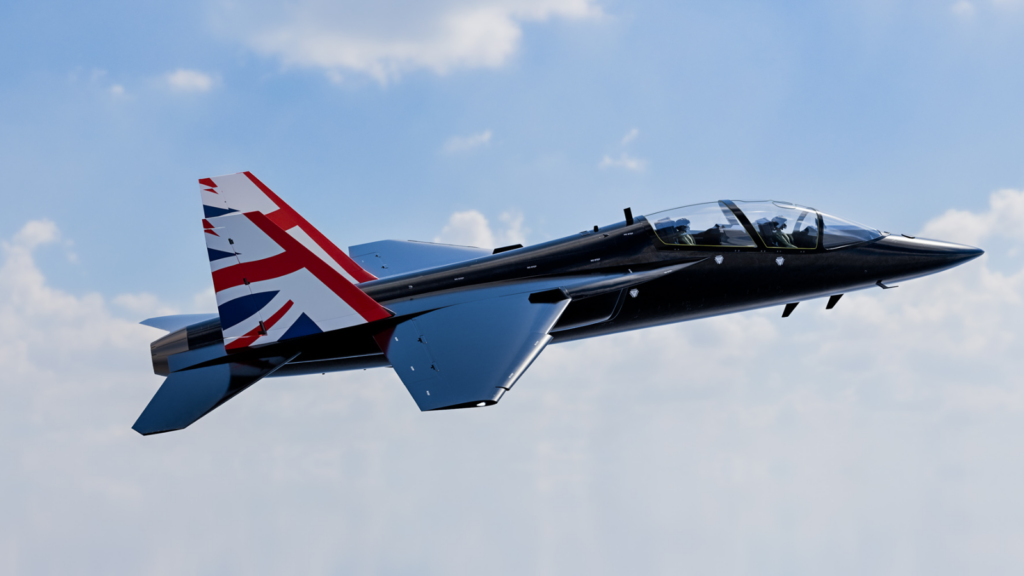
The T7 is undergoing flight testing, is set to enter serial production, and is soon to enter service with the US Air Force. The type would be a comparatively low-risk option and an aircraft that has been designed for future improvements.
BAE CEO Charles Woodburn said, “Our offer represents a modern, integrated training solution which aligns with the ambition of the Defence Investment Plan, while strengthening the UK’s sovereign industrial capability.”
Italy’s Leonardo M-346 Master
The Leonardo M-346 Master is a popular and capable trainer that has the benefit of being a mature aircraft and would help the UK build on its close relationship with Italy.
The Master is regarded as one of the leading alternatives to the T-7.
The Italian Air Force selected the M-346 for its national aerobatic team, the Frecce Tricolori, in 2024. These will replace the team’s existing fleet of ten Aermacchi MB-339s. The team will receive the first in 2027 and transition in 2028.
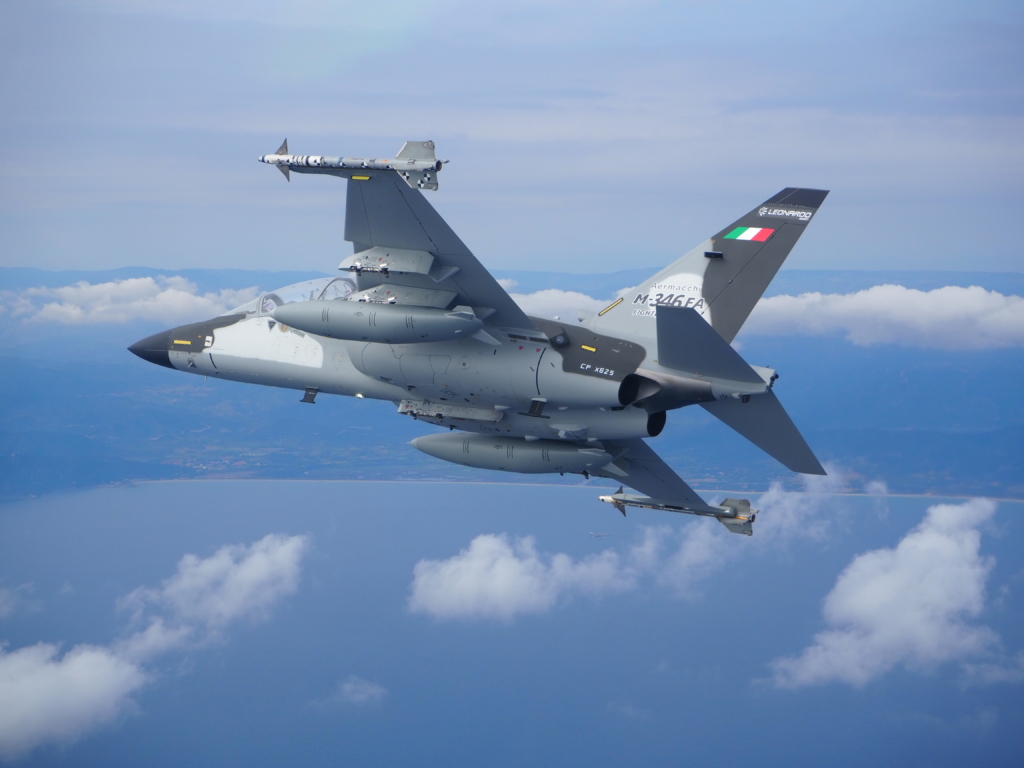
Overall, the Leonardo M-346 offers lower development risk as the T-7 is not yet mature. It is also already in service with the air forces of Italy, Israel, Poland, Singapore, Qatar, and Greece.
The contracting British party is Babcock.
Other, less likely, options
The other two bidding aircraft are the Lockheed Martin KAI TF-50 and the Turkish Aerospace Hürjet. These are generally considered by industry experts as being less likely to win, especially the Hürjet.
Lockheed and South Korea’s KAI are offering a version of the popular T-50 Golden Eagle family. The aircraft first entered service in 2005, and variants have since been exported to Poland, Indonesia, Iraq, the Philippines, and Thailand.
Like the M-348, the Golden Eagle is also a mature design offering low risk. Notably, since 2010, South Korea’s Black Eagles aerobatic display team has also used the T-50B Golden Eagle as its display aircraft.
| Factors in Hawk replacement | T-7 Red Hawk | M-346 Master | TF-50 | Hürjet |
| Manufacturer | Boeing–Saab | Leonardo | KAI–Lockheed Martin | Turkish Aerospace |
| Country / industrial base | US / Sweden | Italy | South Korea / US | Turkey |
| Status | In US Air Force development and testing | Operational, established export platform | Based on an operational aircraft family | Development and flight testing |
| Supersonic | Yes, designed for supersonic flight | No | Yes | Yes |
| Engines | 1 | 2 | 1 | 1 |
| Main advantage | Modern design and UK industrial partnership | Maturity and established training system | Supersonic performance and proven family | Potentially competitive industrial package |
| Overall assessment | Leading visible UK campaign | Mature, lower-risk alternative | Serious contender | Less mature alternative |
Turkey is also offering the Hürjet single-engine advanced trainer, which it is delivering as an advanced trainer, aerobatic display aircraft, and for light-combat missions.
Its unclear if the jet would realistically be ready within the RAF’s 2030 timeframe.
In 2025, Spain approved a budget of around $3.6 billion to purchase up to 45 upcoming Hürjet jets, showing there is some solid export interest in the jet.
However, this is in the context of deeper Spanish and Turkish military-industrial cooperation.
While the outcome of the competition remains uncertain, the RAF’s requirement is likely to be shaped by a combination of training capability, programme risk, industrial participation and value for money. W
ith Hawk retirement approaching in the next decade, the eventual winner will not only become the RAF’s next advanced jet trainer but could also take on one of British aviation’s most visible roles as the aircraft of the Red Arrows.