


The Su-30 has a FOD problem: Here’s how Malaysia plans to solve it

4 min read
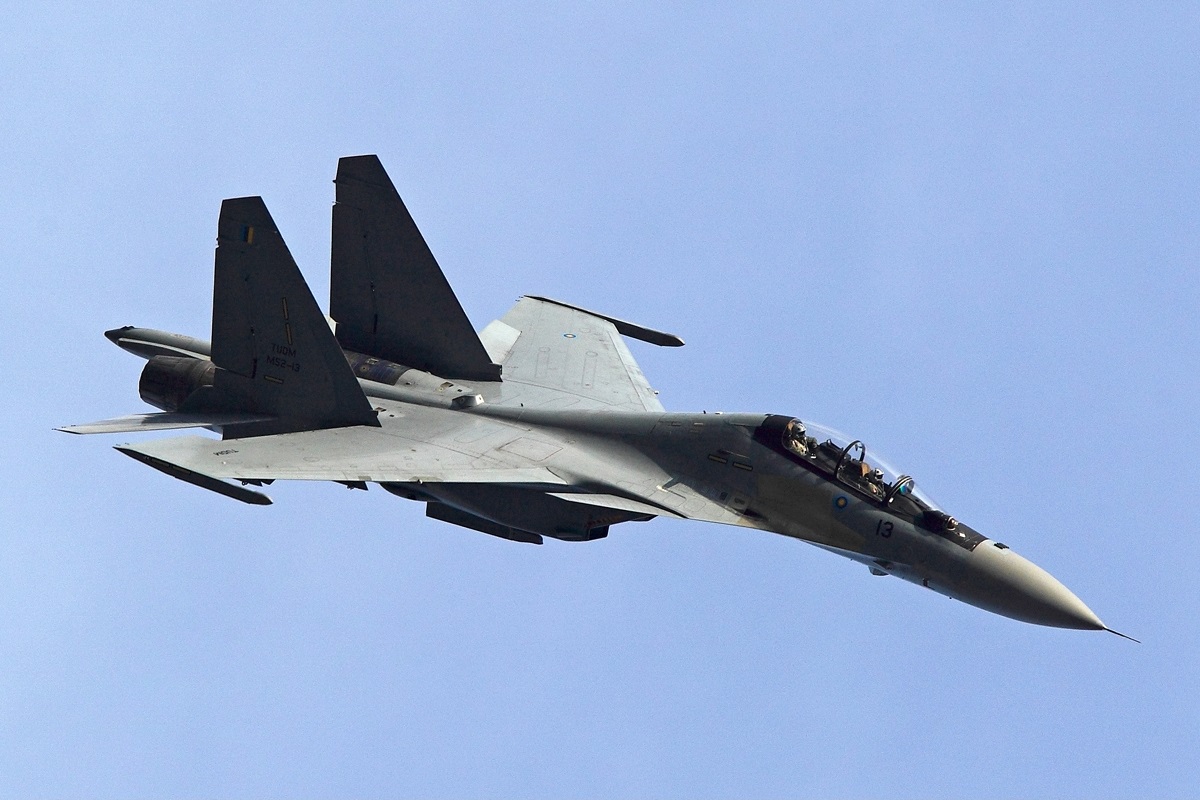
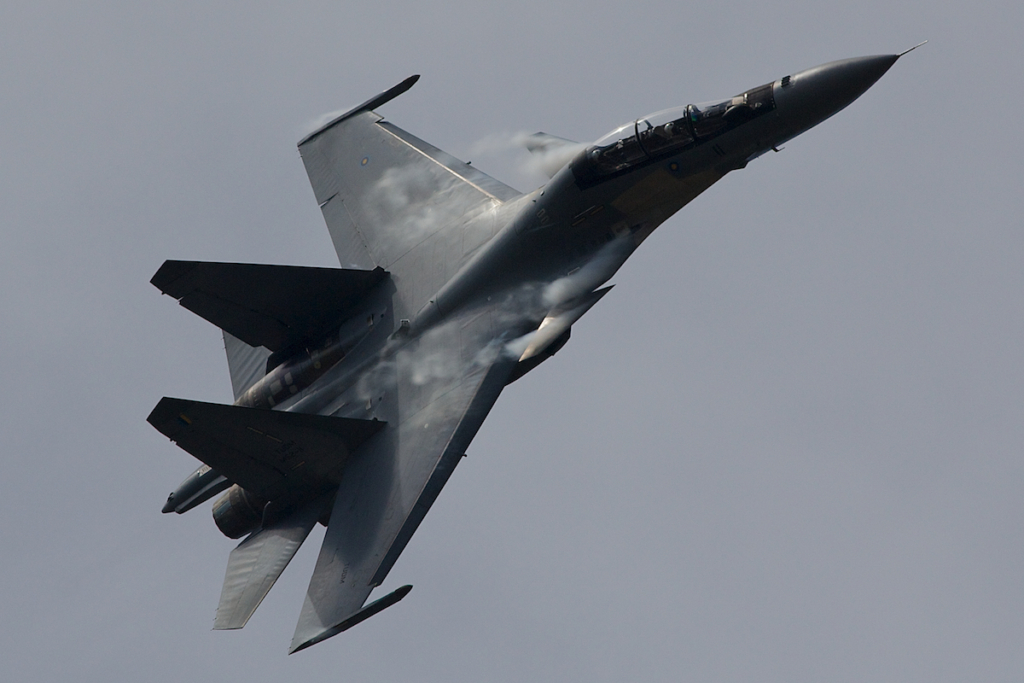
Malaysia has taken the step of modifying its Su-30MKM Flankers to better protect the engines from debris ingress and reduce maintenance costs. For now, the Su-30 remains the backbone of Malaysia’s combat air power.
Malaysia develops its own protective covering for Su-30MKM fighters
According to FW-MAG, the Royal Malaysian Air Force (RMAF) has developed an indigenous Malaysian air intake screen for its Su-30MKM fighter jets. The modification is designed to reduce the risk of foreign object damage (FOD) in the Saturn AL-31FP engines during take-off and landing.
The modification was recently unveiled at the Defence Services Asia (DSA) exhibition in Kuala Lumpur and has been designated the AIS-MOD or air intake screen modification.
Malaysia says the modified air intake screen has prevented at least six bird strikes since the modification entered service in 2025. It was designed and manufactured by Malaysia’s Aerospace Engineering Service Centre (Pusat Penyelidikan Pertahanan Nasional, PUSPEKA).
Beautiful shots of the Royal Malaysian Air Force (RMAF) Su-30MKM Multirole Fighters, which are the closest technical equivalent to Russia’s Su-30SM.
— OSINTWarfare (@OSINTWarfare) August 31, 2025
Under Malaysia’s contract, all Israeli-made avionics and fire-control components (present in India’s Su-30MKI) were replaced. The… pic.twitter.com/IalD1YplVk
The Malaysian Air Force also estimated that the cost savings of preventing engine damage are around MYR 150 million (around $38 million or £28,000). It is unclear if that is cumulative or annual savings.
Fixing a Su-30MKM design weakness
The issue is that the Su-30MKM came with a protective engine air intake screen that was only designed to shield the engine while the aircraft was on the ground. The default manufacturer’s screen retracts immediately after take-off at just one foot off the ground.
A Royal Malaysian Air Force (RMAF) Su-30MKM Multirole Fighter releases flares during a flying display at the Singapore Airshow 2026. pic.twitter.com/mv5cebA1ZV
— OSINTWarfare (@OSINTWarfare) February 3, 2026
While it may protect the engine during taxis, etc., it was insufficient to protect the engines from bird strikes and debris once the aircraft was higher than one foot off the ground.
FW-MAG states, “The retrofit was undertaken by the RMAF in response to a known vulnerability associated with air intake design of the SU-30 MKM, which is prone to bird strikes and FOD, an issue also encountered by other SU-30 operators, including the Indian Air Force (IAF).”

The new air intake screen is designed to retract at 200 metres or 656 feet after take-off, providing significantly more protection to the turbofans.
Get the latest aerospace defence news here on AGN.
Malaysia’s fleet of Su-30MKM fighter jets
Malaysia currently operates a fleet of 18 Su-30MKM aircraft, delivered starting in 2007. They are expected to remain in service until 2035.
Malaysia is awaiting final U.S. approval to finalize the purchase of 30 F/A-18 Hornet fighters from Kuwait. pic.twitter.com/1H2grAvzTH
— International Defence Analysis (@Defence_IDA) February 4, 2025
It also operates a modest fleet of eight F/A-18 Hornets and a fleet of 16 BAE Hawk 200 light fighters/advanced trainers. Malaysia has placed an order for 18 South Korean KAI FA-50M Golden Eagle Block 20 light multirole/advanced trainer aircraft.
The contract for the Golden Eagles was signed in 2023, and deliveries are expected to commence in 2026. First deliveries will start with a patch of four to six aircraft, with the rest delivered in 2027 and 2028.
Malaysia had planned to purchase ex-Kuwaiti F/A-18 legacy Hornets from Kuwait as an interim stopgap measure. This was officially scrapped in 2026 due to delays, technical concerns, and uncertainties about long-term US support. Seperately, it was one of these Hornets that shot down three US F-15s in 2026.
RMAF F/A-18D Hornet Crash in Malaysia
— aircraftmaintenancengineer (@airmainengineer) August 22, 2025
A F/A-18D Hornet fighter jet from the Royal Malaysian Air Force was completely destroyed in an accident when it ignited during takeoff from a runway at Sultan Haji Ahmad Shah Airport (RMAF Kuantan Air Base) in Malaysia.
The incident occurred… pic.twitter.com/xSRWnN2AWo
In the longer term, it wants to purchase two squadrons of multirole fighters to replace its legacy Hornets and Su-30s.
The US’s CAATSA Act makes Russian fighter jets seem unlikely, while the Super Hornet is poised to go out of production in 2027. Other possible aircraft include the KF-21, the Eurofighter, the Rafale, and the Gripen.
Featured Image: Wikimedia Commons


