How many satellites are orbiting Earth — and is space getting too crowded?

5 min read
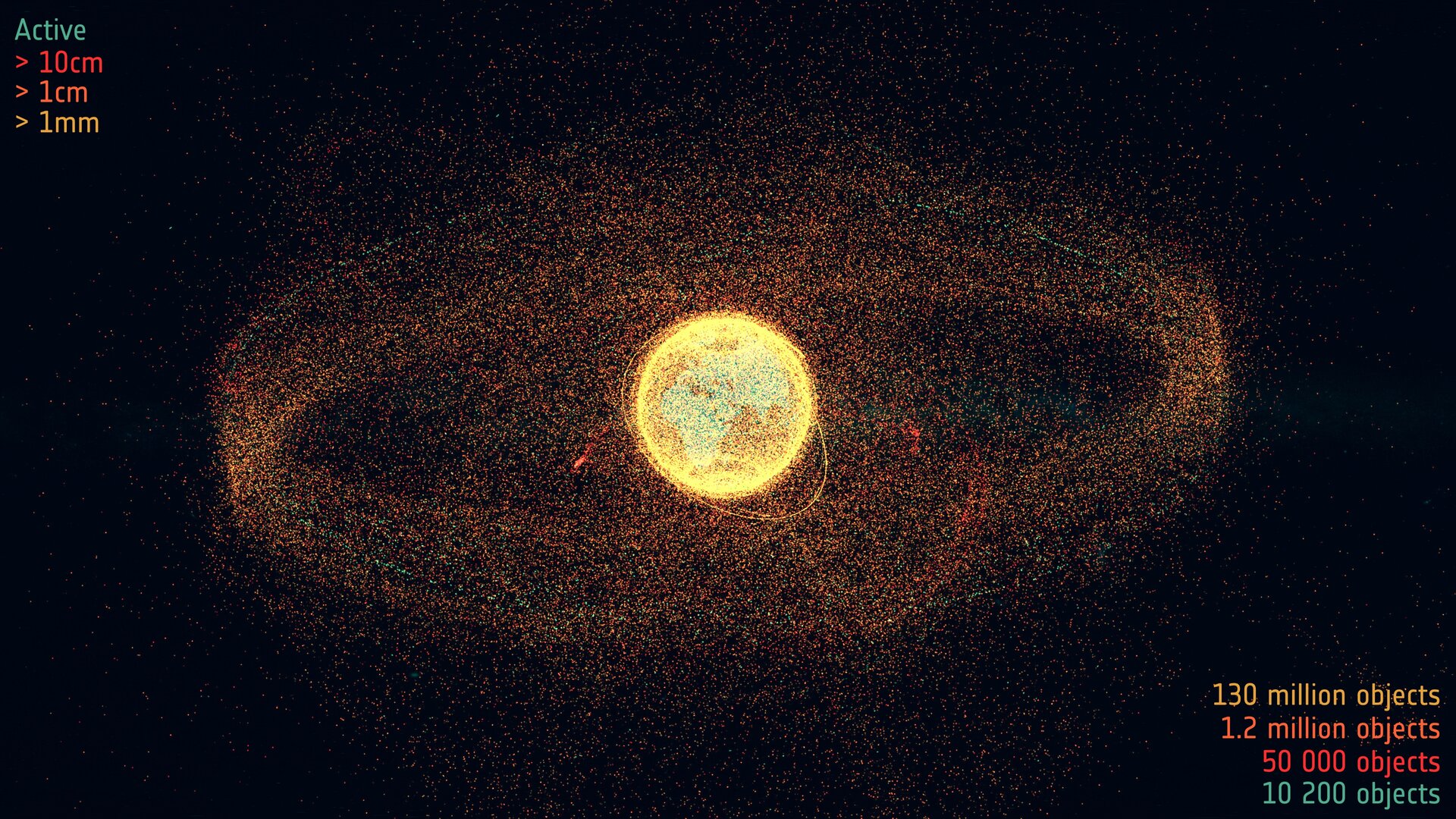
There are now around 16,000 functioning satellites orbiting Earth, but they account for only about a third of the large human-made objects being tracked in space.
Add dead satellites, discarded rocket stages and debris, and the number rises to more than 46,000 tracked objects. Millions of smaller fragments are too small to be routinely tracked.
The population is also growing rapidly, driven largely by commercial satellite constellations such as SpaceX’s Starlink, Eutelsat OneWeb and Amazon Leo.
How many satellites are orbiting Earth?
The European Space Agency’s latest Space Environment Statistics provide one of the clearest snapshots. Updated on 31 July 2026, they show that about 27,490 satellites have been placed into Earth orbit since the beginning of the space age.
Around 18,840 remain in space, of which approximately 16,000 are still functioning. That leaves roughly 2,840 non-functioning satellites still in orbit.
Space surveillance networks regularly track around 46,450 objects.
| Category | Approximate number |
| Functioning satellites | 16,000 |
| Non-functioning satellites still in space | 2,840 |
| Other tracked objects* | 27,610 |
| Total regularly tracked objects | 46,450 |
ESA defines space debris as non-functioning human-made objects in Earth orbit, meaning dead satellites themselves are technically debris as well.
There is much more debris in orbit than we can track
The catalogue represents only the objects large enough to be regularly followed. ESA estimates there are around 54,000 objects larger than 10cm in orbit. There are another 1.2 million pieces of debris between 1cm and 10cm, and an estimated 140 million between 1mm and 1cm.
Orbital speed turns even small objects into potentially destructive projectiles. ESA says debris larger than 1cm can cause catastrophic damage to spacecraft.
Active satellites can sometimes manoeuvre away from a known threat. Dead satellites, rocket bodies and fragments cannot.
Why satellite numbers are rising so quickly
Large commercial constellations have transformed the orbital population. Instead of launching one large communications satellite into geostationary orbit, operators can deploy hundreds or thousands of smaller satellites into low Earth orbit (LEO).
LEO has major advantages for communications. Satellites fly much closer to Earth than geostationary spacecraft, reducing signal delay. This has proven to be an advantage to in-flight WiFi, significantly reducing latency when compared to Geostationary satellites.
But each LEO satellite covers a smaller area, so operators need large fleets distributed across multiple orbital planes to provide continuous coverage.
ESA says the growth in commercial communications constellations has driven a steep increase in satellite launches. Some LEO altitude bands have developed large concentrations of spacecraft.
SpaceX operates by far the largest satellite fleet
SpaceX‘s Starlink constellation surpassed 11,000 satellites in physical orbit in August 2026, although the number in operational orbit is lower because newly launched satellites need time to reach their operational altitude and retired spacecraft remain in orbit as they are deorbited.
Independent astronomer Jonathan McDowell, who keeps a close eye on the growth of the constellation, had tallied 11,102 Starlink satellites in orbit as of August 27.

That single constellation now accounts for over two-thirds of the world’s approximately 16,000 functioning satellites. It far exceeds competitors in LEO.
The next largest commercial LEO broadband fleet is Eutelsat OneWeb. Eutelsat says its first-generation constellation comprises 654 satellites at an altitude of around 1,200km, with more than 600 providing global high-speed, low-latency connectivity.
Amazon Leo, formerly Project Kuiper, is expanding quickly. Amazon reported nearly 400 satellites in orbit in its second-quarter 2026 results and plans a constellation numbering in the thousands.
Is Earth’s orbit becoming overcrowded?
Earth is not running out of physical space. The problem is that satellites are concentrated in specific, useful orbital regions.
ESA describes Earth’s orbital environment as a finite resource. Its modelling shows that around 550km altitude, the number of debris objects posing a threat is now of the same order of magnitude as the number of active satellites.
More spacecraft also mean more close approaches. ESA says collision-avoidance events are increasing in LEO because of the combination of growing satellite traffic and existing debris. Operators need to coordinate manoeuvres to avoid both other active spacecraft and stationary objects.
This does not mean LEO is full or that satellite collisions are inevitable. Modern spacecraft can be manoeuvred, collision risks can be calculated, and satellites can be deliberately removed from orbit at the end of their lives.
But managing space traffic becomes more complicated as the satellite population grows.
Old debris may be the bigger long-term threat
The growth of constellations is attracting attention because thousands of new satellites are now visible in the statistics. However, uncontrolled legacy hardware poses a different problem.
ESA has recorded more than 660 break-ups, explosions, collisions and other fragmentation events since the space age began. One collision can create thousands of additional objects, which can in turn collide with other spacecraft.
This debris problem would not disappear even if humanity stopped launching satellites tomorrow.
ESA says there is scientific consensus that debris would continue increasing because collisions and fragmentation create new objects faster than existing debris naturally falls back into the atmosphere.
That feedback loop is known as the Kessler syndrome. In the worst case, repeated collisions could make certain orbital regions increasingly difficult, or even unsafe, to use.
How long can orbit remain usable?
The answer depends increasingly on what happens when satellites reach the end of their lives.
Operators can reduce risk by reliably deorbiting spacecraft, disposing of rocket stages, preventing batteries and fuel systems from exploding and choosing lower orbits where atmospheric drag removes failed satellites more quickly.
ESA is also pushing its Zero Debris Approach, which aims to significantly limit debris generation from future missions by 2030 and to support the active removal of existing objects.
Satellite constellations set two very different trends. Some parts of LEO are busier than ever before. But many newer satellites are also designed to be deliberately removed and replaced rather than abandoned indefinitely.
With around 16,000 functioning satellites already overhead and thousands more planned, Earth’s orbital population will continue to grow.
The question is whether operators can launch, manoeuvre and dispose of them quickly enough to keep Earth’s valuable orbital highways usable.