


75% of UK passengers hit by flight delays and cancellations in 2025

4 min read
A CMAC Group white paper, Aviation Disruption in 2025/2026: Passenger Expectations vs Reality, reveals the scale of flight disruption in the UK, and how technology could help airlines close the response gap.
UK flight disruption has surged by 40% since 2023
Flight disruption for UK passengers has reached record levels, with three out of four travellers experiencing a delay or cancellation this year, according to CMAC Group’s white paper. The independent survey of 1,100 UK travellers, conducted in September 2025, found disruption up 40% since 2023 — marking one of the steepest increases in years.
Technical failures (46%), industrial action (38%) and severe weather (36%) have overtaken post-pandemic staff shortages as the leading causes of disruption, creating what CMAC calls aviation’s “defining challenge.”
“Disruption is rising. Left to manual solutions, it impacts passengers, operations and EU261 costs — causing lasting damage to airline brands and bottom lines,” Peter Slater, CEO of CMAC Group, said. “The lesson for airlines is clear: those that meet the challenge with speed, transparency and care will not only protect passengers in the moment but strengthen loyalty in the years ahead.”
The response gap: passengers expect answers from airlines within an hour
According to the report, 74% of passengers expect airlines to respond to disruption within an hour, and nearly 50% expect a response within 30 minutes. However, only 18% receive one in that timeframe, and one in five travellers report receiving no communication at all.
“When things go wrong, passengers now expect a response within an hour; however, on average, they are left waiting nearly two hours,” said Matthew Ratcliffe, COO, CMAC Group. Closing this gap is critical to easing passenger stress and protecting brand loyalty.”
Passengers also waste considerable time during flight disruptions; most (41%) lose 1-2 hours.
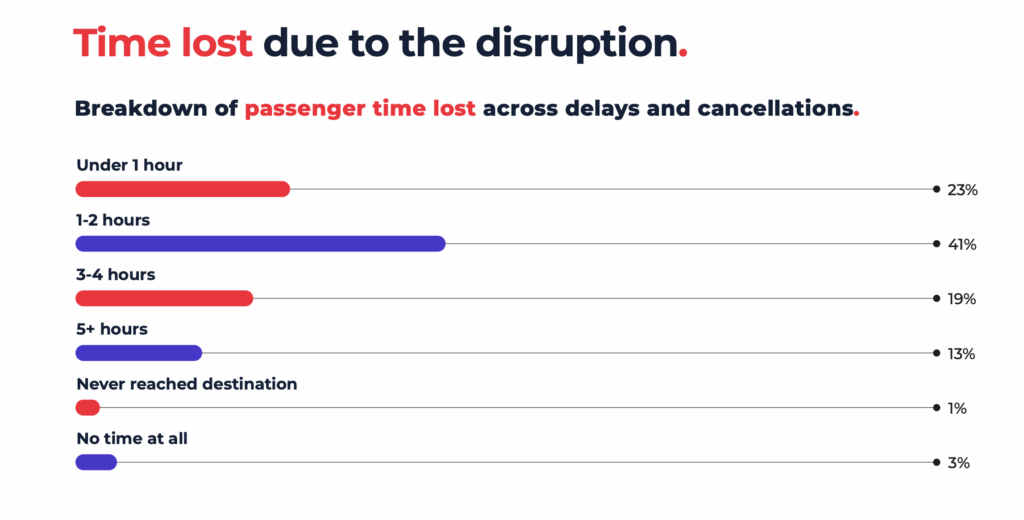
As a result, 34% of travellers report heightened stress, 23% lose sleep, and 13% lose valuable holiday time due to disruption. Among business travellers, nearly one in three reported missing essential meetings, with 12% saying their client relationships suffered.
Digital self-service can help airlines respond to flight disruptions more effectively
Despite record levels of disruption, passenger satisfaction is improving. Negative sentiment toward airlines has dropped to 33%, down from 41% in 2023, and the proportion of travellers “less likely to fly again” has fallen to 28%, from 46% two years earlier. CMAC attributes this shift to airlines’ growing use of digital self-service tools.
One in three passengers now receives a self-service link during disruption, and 69% actively use it — particularly among business travellers. According to CMAC’s data:
- 85% found self-service rebooking easy to use
- 94% received a choice of hotels or transport
- Satisfaction with rebooked accommodation rose from 72% to 84%
- Flight rebooking satisfaction jumped from 57% to 87%
“Technology is increasingly part of the solution,” said Ashley Seed, CCO of CMAC Group. “One in three passengers surveyed used a digital self-service link during travel interruptions, with 87% pleased with rebooking flights and 84% with accommodation.”
However, Seed cautioned that digital tools “cannot replace empathy,” noting that 21% of passengers still received no communication during disruptions.
Turning flight disruption into a brand opportunity
The report concludes that disruption handling has become a key brand differentiator for airlines. CMAC recommends five strategic priorities:
- Communicate clearly within 60 minutes of disruption.
- Enhance human support with automation to balance speed with empathy.
- Strengthen supplier networks for global resilience.
- Monitor rising expectations shaped by digital-first industries.
- Treat disruption as a loyalty opportunity, not just an operational challenge.
COMAC suggests that rapid disruption support can boost passenger loyalty. “Gestures of goodwill, seamless alternatives, and visible care can turn a delay into a demonstration of reliability,” the company states in the report.
CMAC Smartlink: automating care during flight disruption
CMAC has created Smartlink, an automated disruption management platform that integrates digital rebooking with human support. Airlines can bulk-book hotel rooms and ground transport, automatically allocate them to stranded passengers, and issue confirmations via SMS, email, QR code, or in-app notification — cutting response times from hours to minutes.
The company’s technology is backed by a network of 17,000 hotels and 8,000 transport partners worldwide, managing over 5 million passenger and crew movements annually. CMAC says its systems can deliver “fast, empathetic care at scale” during major events, citing recent examples such as the Heathrow substation fire, the Valencia floods, and Storm Éowyn — where it arranged thousands of hotel rooms and transfers within hours.
Featured Image: Markus Mainka | stock.adobe.com
Sign up for our newsletter and get our latest content in your inbox.


More from

September 17, 20263 min read

September 17, 20265 min read
September 17, 20263 min read


