Boeing adds Leonardo, Eaton and Hensoldt as MQ-28 programme partners

4 min read

Boeing delivered an update on the continued development of its autonomous MQ-28 Ghost Bat drone at the Farnborough International Airshow on 21 July, during which the firm formally announced that Italy’s Leonardo, the UK’s Eaton and Germany’s Hensoldt had joined the programmed as official partners.
Announced by Glen Ferguson, the MQ-28 Global Program Director at Boeing Australia – the addition of the three European defence firms comes as Boeing begins to ramp up its bid to sell the Australian-made Collaborative Combat Aircraft (CCA) to export customers around the globe.
The announcement came less than a month after Boeing announced its new Block 3-standard Ghost Bat at the ILA Berlin Air Show on 10 June. As previously reported by AGN, this package will significantly broaden the MQ-28’s overall range, payload capacity, connectivity, and combat potential.
✅ >25% larger wing
— Boeing Australia (@BoeingAustralia) June 10, 2026
✅ Increased fuel and payload capacity
✅ Beyond Line of Sight capability
✅ Internal weapons stations for greater mission configurability
MQ-28 Ghost Bat enhancements deliver flexibility, range and capacity advancements.
More: https://t.co/IPZLUy5Qub pic.twitter.com/7EK5fUD11h
The addition of Leonardo and Eaton represent a significant industry boost for the MQ-28 programme team, with Eaton providing the VELocity payload launch systems for the Block 3 Ghost Bat’s two internal weapons bays and Leonardo providing the Skyward infrared search-and-track (IRST) system for the new-generation MQ-28, which is one of the most matured CCAs currently in development.
While Leonardo has only just been formally added to the Ghost Bat team, the company has worked with Boeing Australia for the last eight years, contributing various electronic systems to the early-model MQ-28s.
Meanwhile, Hensoldt has joined Rheinmetall, Diehl Defence and Rohde & Schwarz in partnering with Boeing to pitch the MQ-28 to the Luftwaffe (German Air Force) as Berlin eyes its own sovereign CCA capabilities. Hensoldt will serve as a platform-independent partner and will provide mission system integration and sustainment and lifecycle support for the MQ-28 as part of the German bid.
One last hurrah? First three MQ-28s soon to be retired
The MQ-28 that made its Farnborough International Airshow debut at this year’s event is the second airframe to be constructed by Boeing in Australia and completed its maiden flight some five years ago.
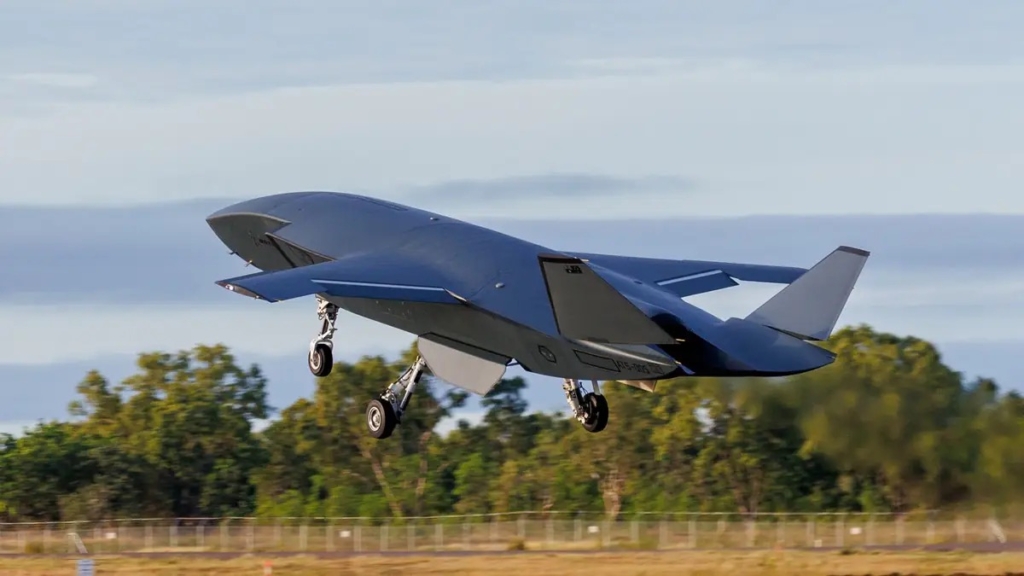
While the platform and its sisters have together flown 240 hours across more than 200 test sorties, these aircraft will soon be retired from use as Boeing shifts its focus to the newer Block 3-standard variant. These MQ-28s are expected to be phased out of use in the coming months.
Although these aircraft are to withdrawn, Boeing is confident in the results of the live tests, as well as the more-than 200,000 simulated flight hours it has flown with the Ghost Bat during its development so far.
No timeline yet for first Meteor firing from MQ-28
A key observation at the Farnborough International Airshow is that the MQ-28 that appeared on static display was joined by one of MBDA’s Meteor beyond-visual-range air-to-air missiles (BVRAAM).
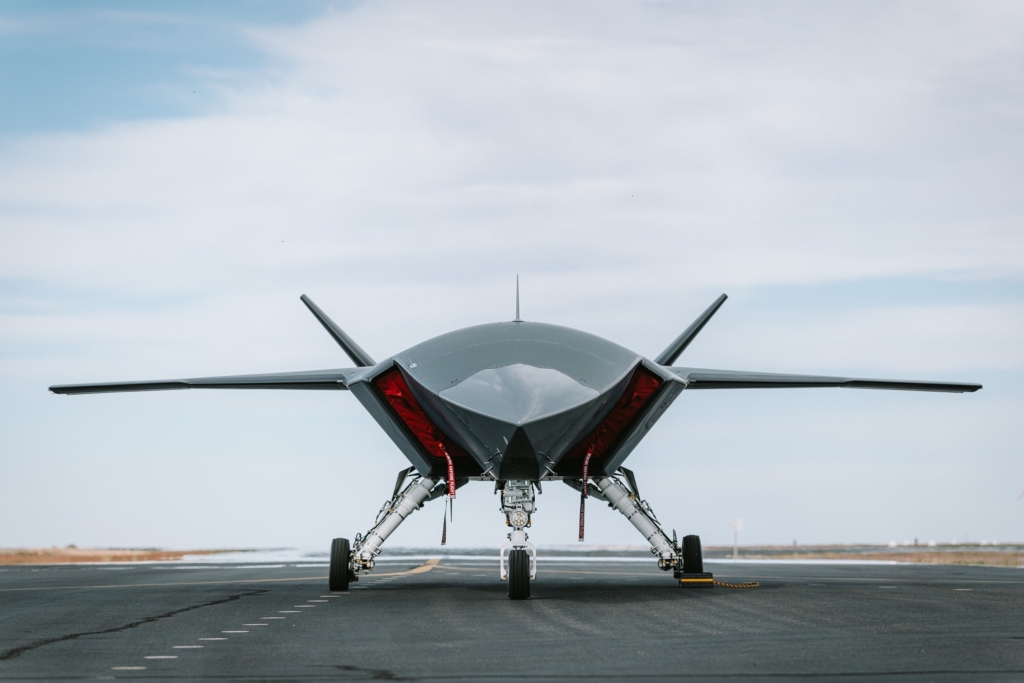
While the planned integration of Meteor on the Ghost Bat has been planned for some time, a specific timeline for the first live-fire event between the CCA and its future munition has yet to be finalised.
Ferguson even noted that a live trial may not even be necessary, suggesting that the trials could be carried out in the virtual space thanks to the advanced nature of the simulation software used by the Ghost Bat team.
Expanding MQ-28 production across the globe
While Boeing has already secured a launch customer through Australia – which has invested more than AU$2.4bn into the Ghost Bat programme to date – the nation is in discussion with several countries regarding potential exports, but has not publicly disclosed any plans to market the aircraft outside of Germany thus far.
Australia presently remains as the main production hub for the MQ-28, with the site having already manufactured eight Block 1 demonstrators – which were delivered as test and evaluation aircraft – and three Block 2 MQ-28s, which were ordered in February 2024.
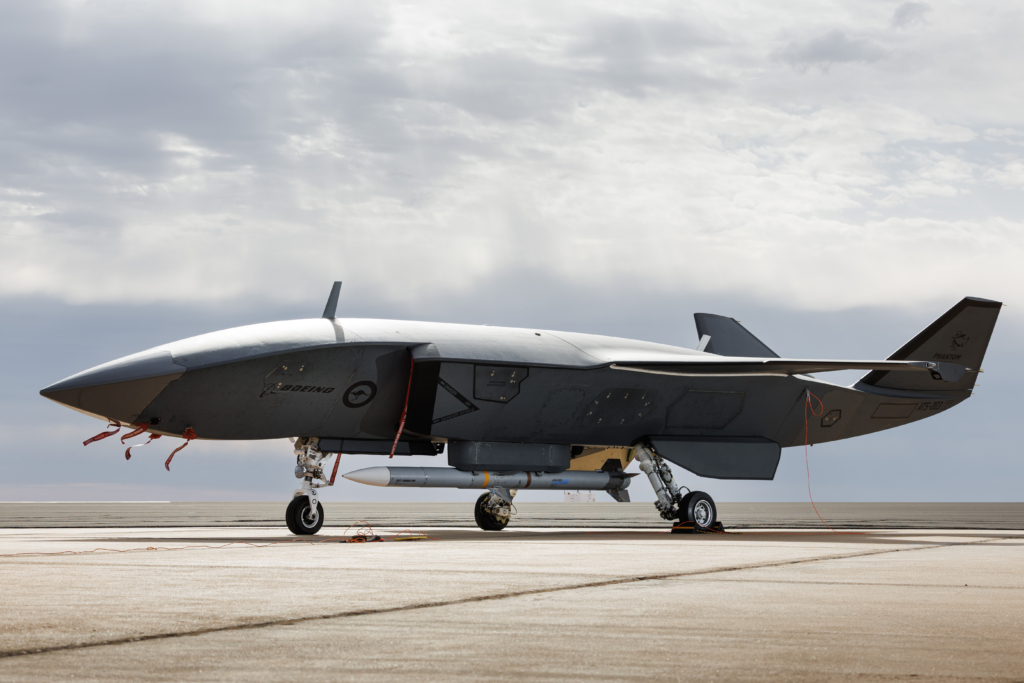
In December 2025, Canberra ordered a further six Block 2 jets for the Royal Australian Air Force (RAAF), as well as the first Block 3 prototype for advanced development purposes. The first of these are expected to be delivered to the RAAF in 2028, followed by the Block 3 prototype in 2029. Boeing is aiming to expand production of the MQ-28 to two airframes per month.
While Australia currently serves as the only production and final assembly line for the Ghost Bat, Boeing is keen to expand these operations to third party nations and prospective export customers, such as Germany, to reinforce sovereignty and step away from large-scale manufacturing processes at just one location.
Sign up for our newsletter and get our latest content in your inbox.


More from


October 13, 202612 min read