BALPA warns of Airbus engine shutdown risk linked to fire switch release

5 min read
BALPA, the union representing pilots in the UK, has warned of the risk of an uncommanded engine shutdown on Airbus aircraft linked to potentially defective engine fire pushbuttons.
In a note to members, the union’s Accident Analysis and Prevention (AAP) Group said there had been two recent occurrences involving an Airbus A320 and an Airbus A350 when the engines were inadvertently shut down in flight.
In one case, involving the narrow-body, the pilots were forced to divert and perform a single-engine landing. In the other, the pilots of an A350 were able to restart the engine and continue to their destination.
What is the problem causing the Airbus engine shutdowns?
BALPA says the issue came to light when an A320neo (registered ZK-NHA) operated by Air New Zealand experienced an uncommanded engine shutdown around 40 minutes after take-off from Wellington.
The aircraft was en route to Sydney in December 2024 when one of the aircraft’s two engines was shut down apparently without any pilot input. The crew declared a mayday and landed in Auckland, with no injuries or damage reported.
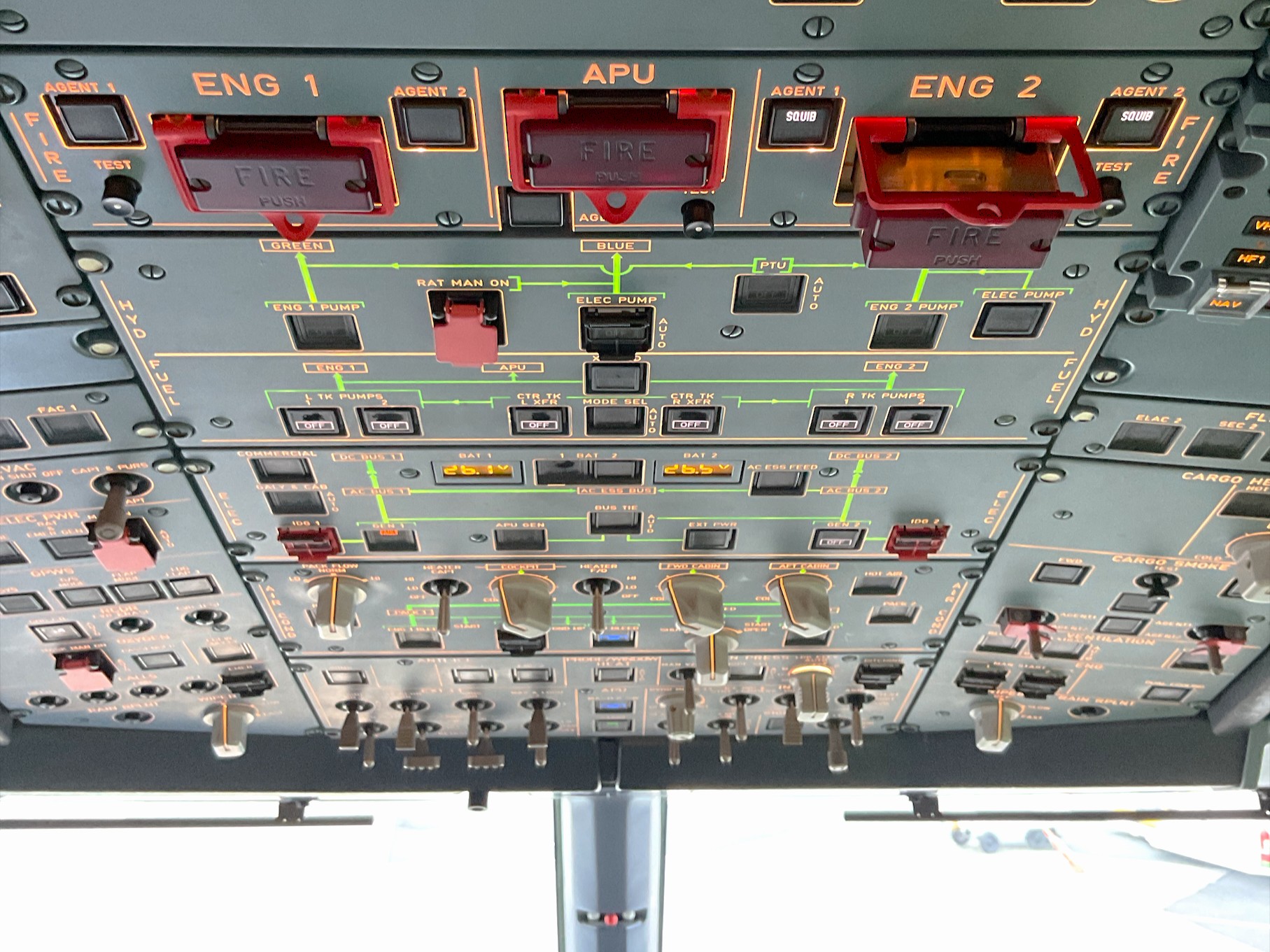
An investigation by New Zealand’s Transport Accident Investigation Commission (TAIC) found that the shutdown was caused by the engine fire pushbutton on the overhead panel releasing by itself.
The probe noted that a retaining pin inside the switch had been bent before installation, preventing it from securing the switch properly. Routine vibration during the flight subsequently caused the switch to release, automatically shutting down the engine.
Both pilots later said that they had not touched the switch, and since the applicable checklists did not require the crew to verify the fire button’s position following an engine shutdown, they were not aware of the cause of the shut down.
TAIC Chief Investigator of Accidents Louise Cook said: “The switch is part of a panel above and behind the heads of the pilot and co-pilot; neither had touched the switch, and post-shutdown procedures didn’t tell them to check it.
“The same type of fire panel is fitted to all Airbus A320-family aircraft worldwide and larger Airbus types use similar switches.”
Air New Zealand said it had removed switch panels promptly in early December 2024 after TAIC told them about the problem.
A second incident earlier this year involved an A350 flying from Las Vegas to London Heathrow.
On this occasion, the fire pushbutton for the number two engine dislodged while the aircraft was halfway home overhead Halifax in Canada.
The captain was said to have been resting at the time and the first officer, who was the pilot flying the aircraft, stabilised the plane. The captain returned to the flight deck and a successful engine relight was carried out before the aircraft continued to London where it landed uneventfully.
What has BALPA said about the shutdowns?
The two incidents have prompted BALPA to issue a notice to crew warning them of the problem and advising pilots to monitor the overhead panel, the top of which is where the fire pushbuttons are located, during any event involving engines, electrics or fuel system.
The union said that the dislodged pushbuttons are “easy to miss” since they sit high on the overhead panel, are recessed and guarded, and are not part of the normal scan, unless a fire warning is active in which case the ECAM will instruct the pilot to push them.
Since the mechanical release does not make any caution or warning chimes, and the movement itself is subtle, especially at night, the inadvertent dislodging of the button may not be immediately apparent.
“This makes a popped fire switch surprisingly easy to overlook,” BALPA’s Accident Analysis and Prevention (AAP) Group said. “Both events underline the value of a deliberate overhead check whenever fuel valve or generator related ECAMs appear unexpectedly.”
How serious is the risk to flight safety?
BALPA says the risk to safety of an affected flight depends on when the fire switch self-releases.
This ranges from merely “challenging” in the cruise phase of flight, when there is potentially time to consider an engine relight, to “potentially hazardous” were the pushbutton to dislodge during the initial climb. This would be exacerbated in situations where the departure airport is surrounded by high terrain, or when there are specific departure routing restrictions which require a certain climb gradient to be met.
Most pertinently, the risk is raised to “critical” were the event to happen at V1 – the speed at which a take-off cannot be safely rejected. This mirrors the standard philosophy for an engine failure at take-off, where a failure at V1 is associated with the highest risk and elevated workload for the pilots.
That said, BALPA stressed that the likelihood of a shutdown remains low. That is reflected in the data, with just a small number of incidents spread across thousands of aircraft operating multiple sectors every day.
As for potential consequences, BALPA said they range from serious to catastrophic, depending on the phase of flight and particularly if the loss of thrust is not immediately identified.
The pilots union has deemed the overall risk “medium to high” until all affected switches across the fleet have been inspected and replaced.
What is being done to mitigate the risk of an engine shutdown?
Switch manufacturer Safran Electronics & Defense issued service information and bulletins in September and October 2024, prior to the Air New Zealand incident, listing affected components and recommending inspections.
Airbus then alerted operators on 18 December 2024, weeks after the Air New Zealand incident, and has since issued inspection bulletins for affected A320-family aircraft.
The EASA AD 2025‑0274 now mandates inspection and replacement of affected switches across the global fleet by November 2027.
EASA said SAFRAN had issued instructions for inspection and/or replacement of the fire push buttons in shop, and a list of parts which have been determined to require an in-shop inspection and repair.
Commenting on the inspection mandate, BALPA said: “This is a serious mechanical defect, and it’s completely latent – no ECAM cue until the moment it happens. So far, outcomes have relied on solid crew handling, but the long compliance window understandably feels uncomfortable. Until the hardware is replaced, awareness and disciplined SOPs remain our best mitigation.
“BALPA will continue to monitor regulatory progress on AD 2025-0274 and urges members operating affected Airbus types to familiarise themselves with the service bulletin details and raise any concerns with their operators without delay.”