ATSB investigation concludes on Qantas A380 that flew to the US and back with a work light left inside the wing

7 min read

The Australian Transport Safety Bureau (ATSB) has published its final report on the Qantas Airbus A380 which flew from Australia to the United States and back with a maintenance work light left inside. The aircraft, Airbus A380-842 VH-OQK, operated two passenger flights with the work light in its left wing.
The investigation of the January 2026 incident found weaknesses in foreign object control and tool accountability procedures at Qantas, as a series of checks failed to identify the missing tool.
Despite the incident, the ATSB found that the light caused no structural damage or disruption to aircraft systems. However, investigators highlighted that several layers of maintenance procedures failed to prevent the aircraft from entering passenger service.
How a work light was left inside the Qantas A380
The A380 arrived at Sydney Airport from Los Angeles on 7 January 2026 carrying 485 passengers and 26 crew.
Maintenance was then carried out on its air conditioning system. Engineers needed access to an internal area of the aircraft’s left wing to change an outlet temperature sensor on an Air Generation Unit.
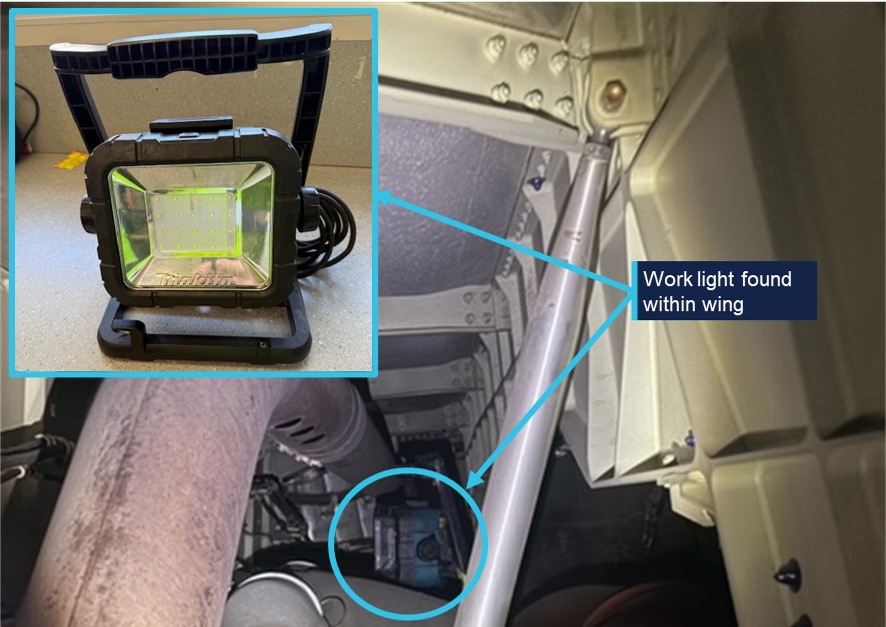
A portable work light was taken into the wing to illuminate the work area.
After the maintenance was completed, the engineers carried out foreign-object clearance inspections. However, none noticed that the light remained inside the wing.
The ATSB found that the type of tools used during the sensor replacement, combined with subsequent troubleshooting involving the auxiliary power unit, contributed to an engineer returning tools without realising the work light was still signed out.
The missing light was also not detected by the unreturned-tool check at the end of the shift.
A380 was cleared to fly despite missing tool
The aircraft was then certified as fit to return to service.
“The licensed aircraft maintenance engineer issued a certificate of release to service with a tool unaccounted for,” the ATSB concluded.
The ATSB found that Qantas’s maintenance information system did not provide a prompt or other control to alert the certifying engineer to the missing tool or the outstanding unreturned-tool report before the engineer issued a certificate of release to service.

As a result, the aircraft departed Sydney later on 7 January for Dallas Fort Worth.
It arrived in Dallas on 8 January, where further maintenance was performed by an external maintenance organisation operating under its own Part 145 approval. Again, the maintenance lamp went undetected.
VH-OQK then departed as Qantas flight QF8 for the return journey to Sydney.
The aircraft landed in Sydney at 06:55 on 9 January, meaning it had completed two ultra-long-haul passenger sectors with the light still inside the wing.
Missing lamp discovered two days later
The issue was discovered later that morning when an operator at Qantas’s Hangar 191 tool crib reviewed a report showing equipment that remained signed out.
They noticed that a work light issued against VH-OQK two days earlier had never been returned.
A search was initiated, and the light was found inside the aircraft’s left wing near the Air Generation Unit heat exchanger.
The ATSB said there had been “no adverse consequences, structural damage, or system disruptions” as a result.
What happens when tools are left inside aircraft?
Tools and other objects being left behind after maintenance are a recognised aviation hazard. They are categorised as foreign object debris, or FOD.
Foreign objects left inside aircraft can present serious risks if they move, interfere with aircraft systems or damage components.
The outcome can range from nothing happening at all to serious damage to the aircraft or engine. Much depends on where the object is left and on what happens as it is subjected to the vibration, airflow and acceleration typical of flight.
ATSB finds multiple maintenance defences failed
Aviation maintenance relies on several overlapping controls rather than a single inspection. However, in this case, multiple opportunities to identify the missing lamp were unsuccessful. Engineers failed to find the missing lamp during foreign object inspections, end-of-shift tool controls, and return-to-service inspections.
“Even well-established processes can be vulnerable when they rely solely on consistent human performance, particularly during maintenance tasks, which are often conducted in challenging environments and under operational pressures,” said ATSB Chief Commissioner Angus Mitchell in the announcement of the final report. “Tool control systems and procedures must account for this variability, with safeguards to detect and recover from errors.”
Qantas changes tool-control procedures
Qantas has taken several steps following the investigation.
The airline issued a safety directive mandating a review of unreturned-tool reports before an aircraft can receive clearance to return to service.
It has also established a tooling working group to review its tool-control processes and examine technologies that could strengthen tool accountability.
The ATSB noted that this was not the first recent case involving a tool being left inside a Qantas A380. It is also not the first incident involving lost tools the ATSB has investigated.
The ATSB has recorded several cases of tools left behind on planes
The latest Qantas A380 incident had no adverse consequences, but several recent examples demonstrate why maintenance organisations have strict systems for accounting for tools.
In fact, Qantas experienced a similar incident with another A380 just over two years earlier.
Qantas A380 flies with nylon turning tool in engine
During maintenance at Los Angeles in December 2023, engineers left a 1.25-metre nylon turning tool inside an engine on A380 VH-OQI. The tool was used to rotate the intermediate-pressure compressor during a borescope inspection.
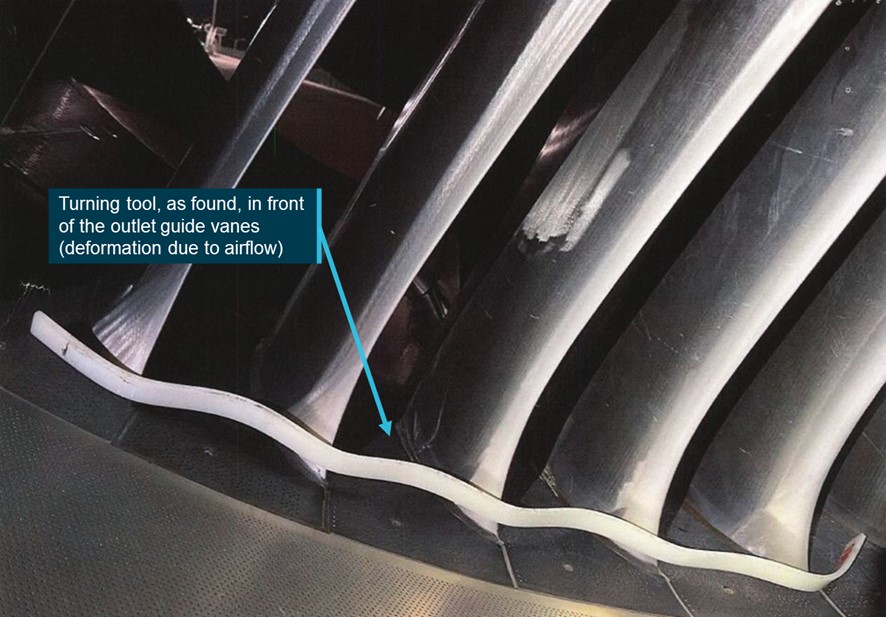
It was not discovered until the aircraft returned for maintenance on 1 January 2024. By then, the A380 had completed 34 flights and almost 294 flying hours with the tool wedged inside the low-pressure compressor. The airflow had deformed the tool, but fortunately the engine itself was not damaged.
Jetstar A320 engine damaged by forgotten screwdriver tip
A Jetstar Airbus A320, VH-VFF, experienced engine power loss at Brisbane Airport, Queensland, on 23 October 2020, which was later attributed to a lost-tool incident.
As the aircraft was accelerating, pilots heard loud popping sounds and felt intense vibrations. Witnesses saw flames spewing from the engine. The captain aborted takeoff in time, and the aircraft came to a safe stop.
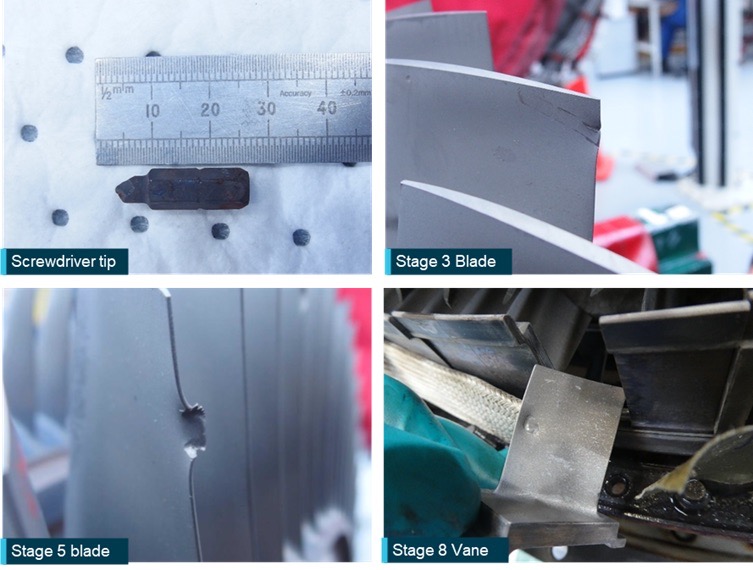
Investigators traced the engine failure to a removable screwdriver bit left inside the engine during maintenance.
Remarkably, the screwdriver tip had remained inside the engine for more than 100 flights before causing the failure. It had damaged compressor blades and vanes, with at least two defects developing fatigue cracks. One blade failed during the Brisbane take-off, causing further compressor damage and the engine surge.
Roll of lock wire left behind on Airbus A330 engine cowling
In February 2025, maintenance engineers working on an Airbus A330 in Brisbane left a roll of lock wire beneath an engine cowling.
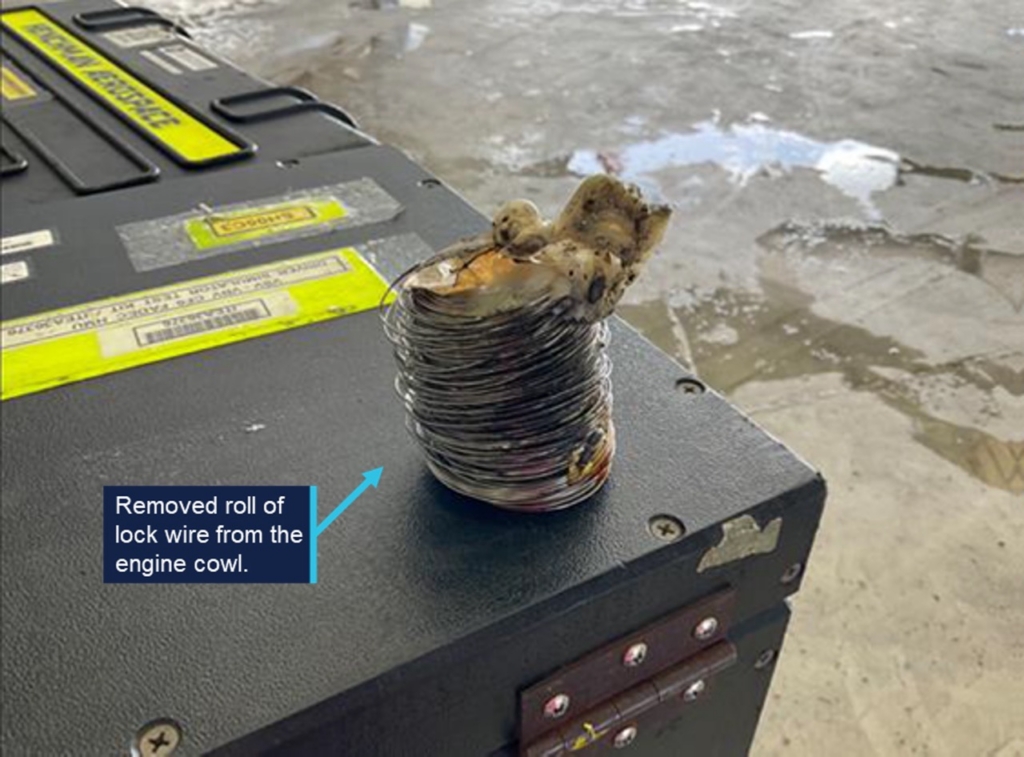
The aircraft was signed off as safe to return to service and completed 51 international flights. The forgotten wire was later discovered during a routine maintenance check the following month. In this case, no damage occurred to the aircraft engine.
Boeing 787 flies with passenger blanket left behind in engine
FOD is not limited to conventional tools. In 2018, engineers discovered a passenger blanket inside the engine cowling of a Boeing 787 after a flight from Bali to Melbourne.
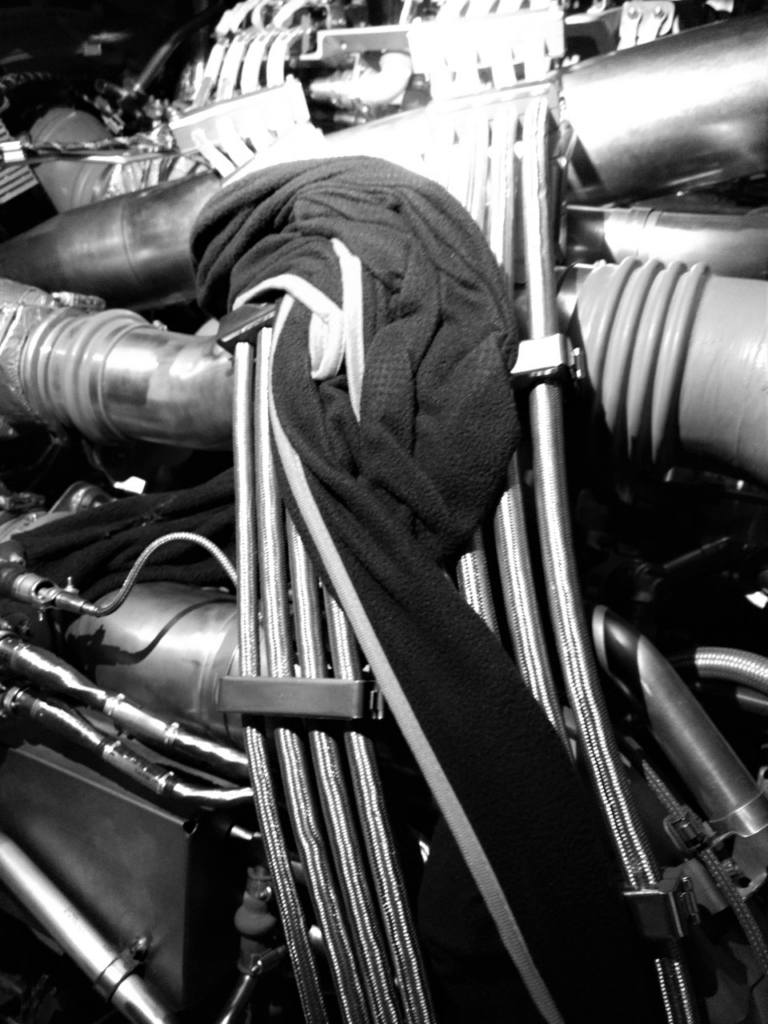
Maintenance personnel in Bali had used five cabin blankets to protect against hot surfaces while working on the aircraft, but only four were removed afterwards. The fifth was discovered inside the engine cowling after the aircraft flew to Melbourne. The ATSB recorded no aircraft damage.
Tool control is essential to aircraft maintenance procedures
Tool control is a fundamental part of aircraft maintenance. Tools are signed out and recorded as returned, so that maintenance organisations can verify that everything taken into an aircraft is accounted for. Physical inspections for foreign objects provide another layer of protection.
A missing tool should trigger a search and procedures should prevent an aircraft from entering service until the tool is found.
The investigation of the latest Qantas incident confirms that several of those defences failed to stop the aircraft from operating flights. The incident raises questions about the effectiveness of aviation maintenance safety systems. The aim is to ensure that no forgotten object could end up somewhere much less forgiving.
The ATSB again draws attention to maintenance tool accountability, urging human-error-proof safeguards to ensure that all tools taken onto an aircraft during maintenance are returned before the aeroplane resumes passenger service.