Gulfstream targets production of 200 private jets a year as orders surge

3 min read
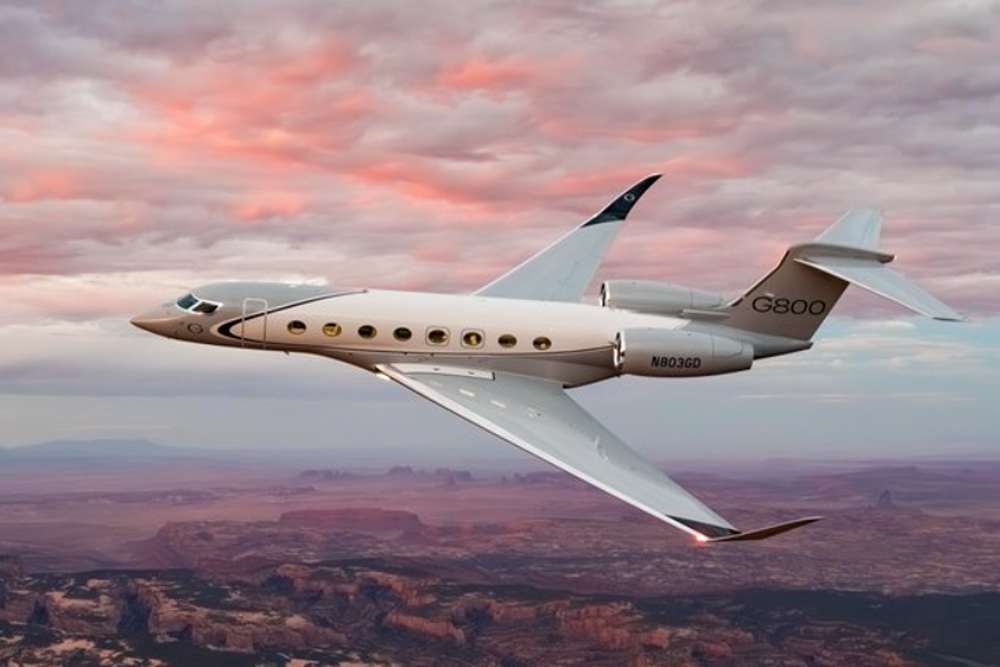
Gulfstream Aerospace plans to produce at least 200 private jets annually. The US business jet manufacturer expects to build around 160 aircraft this year, but believes its factories can support higher production rates.
Speaking at the NBAA Business Aviation Convention & Exhibition (NBAA-BACE) in Las Vegas, Gulfstream president Mark Burns said demand justified increasing output.
“Demand is not the concern right now. If we can build more aeroplanes tonight, we can sell more aeroplanes today,” Burns told reporters, as reported by Aviation Week.
The company expects production to increase during 2027, 2028 and 2029, although it has not announced a firm date for reaching its target of 200 aircraft annually.
Gulfstream backlog exceeds $25 billion
Gulfstream has seen sustained demand for its large-cabin business jets, particularly the G500, G600, G700 and G800.
The manufacturer’s order backlog exceeded $25 billion by mid-2026, up about $4 billion from late 2025, according to Aviation International News.

In its financial results published in July, Gulfstream’s parent company, General Dynamics, reported aerospace orders of $5.3 billion in the second quarter of 2026. The company reported $3.5 billion in aerospace revenue, up 15.1% from the previous year.
Gulfstream delivered 41 aircraft during the quarter, compared with 38 in the same period of 2025. Deliveries for the first six months reached 79 aircraft, up from 74 a year earlier.
New Gulfstream aircraft support production growth
Gulfstream’s production plans centre on a family of six business jets developed over the past decade.
Four models are already in service, while the G400 large-cabin jet and G300 super-midsize aircraft are progressing through development and flight testing.
The G700 received certification in March 2024, followed by the longer-range G800 in April 2025.
Burns said Gulfstream had delivered 135 G700 aircraft and 35 G800s. Deliveries of the G600 and G500 have each reached around 200 aircraft.

The manufacturer has invested in two production campuses in Savannah, Georgia, with assembly facilities designed to accommodate different aircraft models according to demand.
One campus supports G700 and G800 production, while the other accommodates the G400, G500 and G600.
The facilities were designed with additional capacity, allowing Gulfstream to increase output without requiring an entirely new production system.
Burns said the company already had the capacity to manufacture more than 200 wing sets annually.
Supply chain recovery allows Gulfstream to plan higher output
Gulfstream also expects fewer supply chain constraints as it increases production.
“I don’t see the supply chain as limiting us today. I think we will see growth in 2027, 2028 and 2029,” Burns told Aviation Week.
The manufacturer has produced its own wings since 2014 and is considering bringing additional manufacturing activities in-house.
The approach would give Gulfstream greater control over components that previously caused production delays, particularly during the COVID-19 pandemic.
However, increasing aircraft assembly rates also requires additional capacity for cabin completion, deliveries and customer support.

Gulfstream is expanding its global spare parts network and maintenance capabilities to accommodate its growing fleet.
According to Aviation International News, the manufacturer has invested approximately $3 billion in spare parts inventory and operates 12 distribution centres worldwide.
The company has also expanded its Atlanta distribution facility and increased component repair capabilities in the Dallas-Fort Worth area.
Gulfstream expects further growth through 2029
Moving from 160 aircraft annually to 200 would represent a 25% increase in production.
It would also establish a new annual manufacturing rate for Gulfstream, supported by its expanded product range and existing order backlog.
The company has not committed to a specific production timetable, but Burns expressed confidence that the increase would happen.
“Barring any unforeseen catastrophe, I think it’s inevitable,” he said.
For Gulfstream, the immediate priority is increasing production of its certified aircraft while completing development of the G400 and G300.
Both aircraft will broaden the manufacturer’s portfolio and create additional growth opportunities as production capacity increases.