


F-104 Starfighter to carry rocket on first STARLAUNCH test flight in December

4 min read
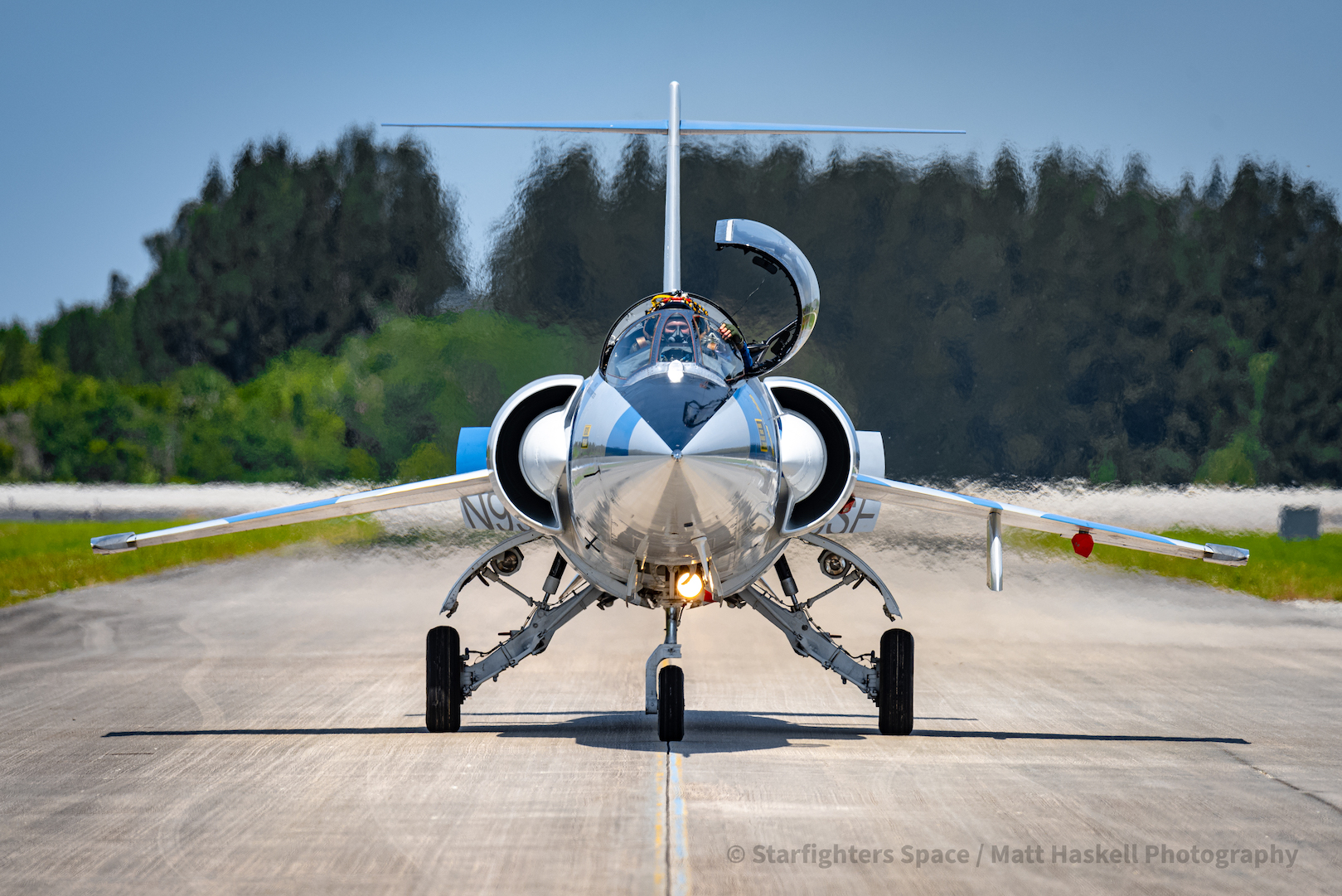
A Lockheed F-104 Starfighter is expected to carry the first STARLAUNCH 1 flight vehicle beneath its wing in December, beginning a test campaign intended to culminate in an air-launched rocket reaching suborbital space.
Starfighters Space has finalised the vehicle’s airframe design and ordered inert flight hardware from Italian manufacturer Robby Moto Engineering, with delivery to its Kennedy Space Center hangar expected in November.
The first flight will carry STARLAUNCH 1 from Kennedy Space Center to the FAA-licensed Cecil Spaceport in Jacksonville, Florida. The rocket will remain attached to the aircraft throughout the captive-carry mission, allowing engineers to examine its aerodynamic behaviour, test the interface between the two vehicles and develop operating procedures for later flights.
“The planned captive-carry flight would move STARLAUNCH 1 from design and ground-based development into flight testing,” said Starfighters Space CEO Tim Franta. “Our approach is deliberately incremental: build the hardware, integrate it with the aircraft, fly it, collect data, and use those results to advance towards separation and powered flight.”
F-104 rocket test will pave the way for Atlantic drop
The December sortie is expected to be the first step in a multi-flight campaign rather than an attempt to release or ignite the rocket.
Starfighters plans to follow it with a drop test over the Atlantic Ocean and subsequently a demonstration of the integrated propulsion system. Data will also be collected for the FAA and US Space Force as the company works towards a propulsive air launch.
STARLAUNCH 1 is being developed as an initial suborbital vehicle, while the larger STARLAUNCH 2 would use experience gathered during the flight campaign to advance the company’s longer-term launch ambitions.
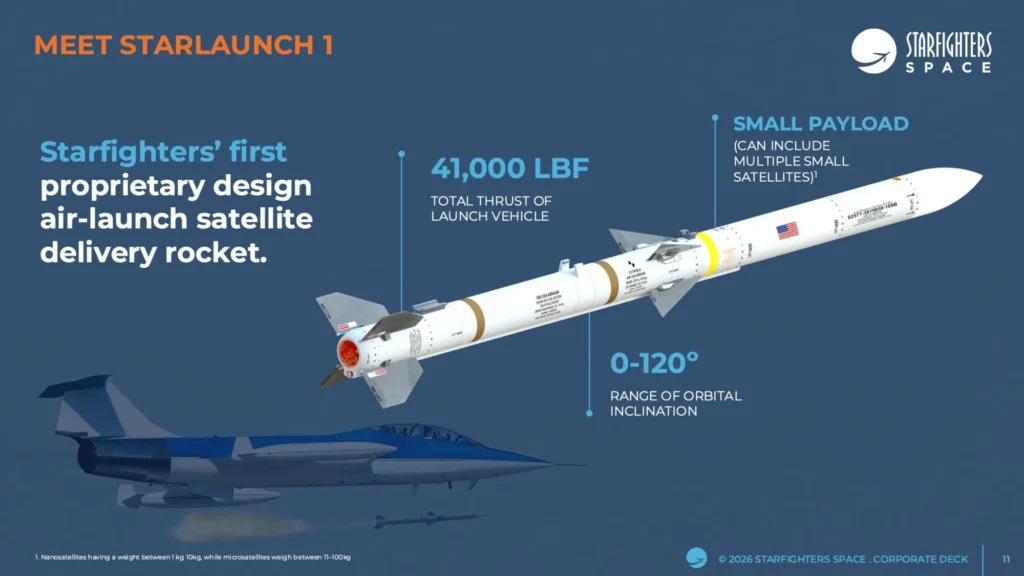
Speaking exclusively to Aerospace Global News in August, Franta said the company was trying to avoid developing new systems where proven hardware was already available.
“We do not reinvent the wheel for anything,” he explained. “If there is a connector, we use an existing connector. If there is an existing separation system, we use that.”
The programme has already completed ground-based wind-tunnel testing at Mach 0.85 and Mach 1.3, which Starfighters said found no adverse aerodynamic interactions during simulated separation from the F-104.
Vaya developing STARLAUNCH hybrid rocket motor
Florida-based Vaya Defense & Space is developing a hybrid rocket motor aligned with the STARLAUNCH 1 flight-hardware specifications.
The companies announced an agreement in September to assess Vaya’s Vortex-Hybrid propulsion system, which combines a 3D-printed thermoplastic fuel grain with a liquid oxidiser. The system is intended to be throttleable and restartable while avoiding the handling risks associated with an explosive solid-fuel motor.
“Vaya has spent years maturing a propulsion technology that is throttleable, restartable and non-explosive, which is close to an ideal profile for a vehicle carried under the wing of an aircraft,” Franta said when the partnership was announced.
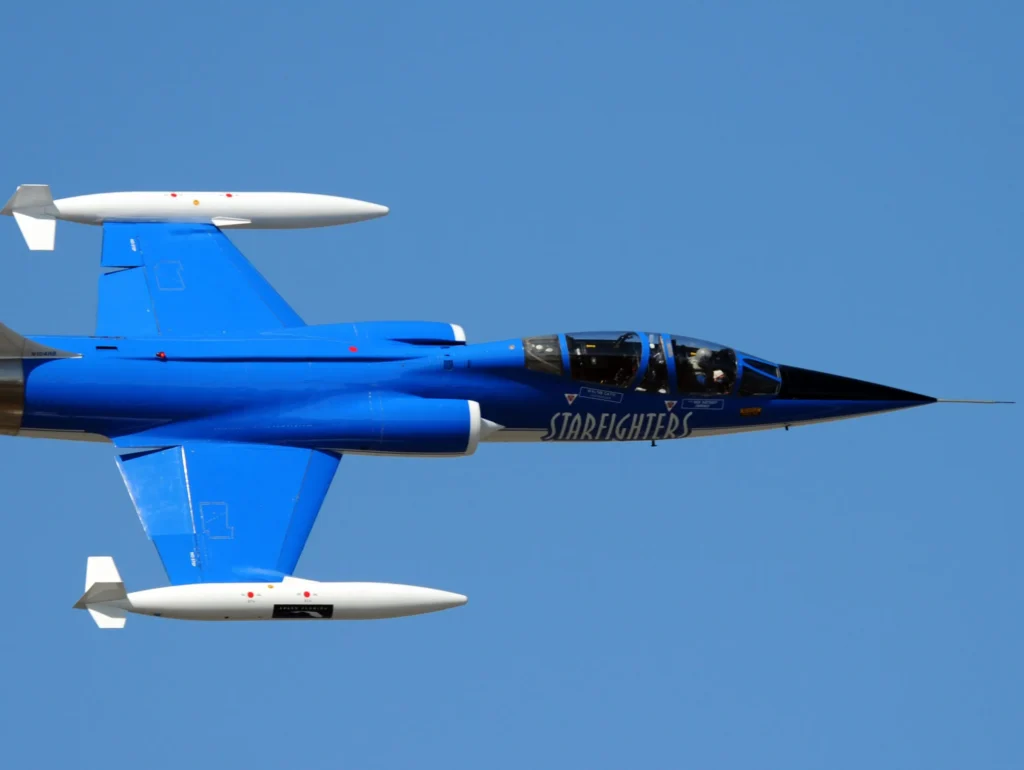
Starfighters will also work with The Bionetics Corporation to develop payload-processing procedures. Bionetics is expected to prepare different classes of small payloads, including pre-flight assembly, integration, testing and post-flight data retrieval, at the Space Life Sciences Laboratory at Cape Canaveral.
Franta told AGN that Starfighters was examining approximately 400 prospective payloads for suborbital missions at the time of the interview, of which around 70 appeared likely candidates. Two sensor payloads from separate customers had already been provisionally manifested for the third powered mission because both required the same flight profile.
For the first powered suborbital test, the company plans to use paraffin as a mass simulator alongside a camera to collect imagery and flight data. Franta said the mission was being designed to reach approximately 109 km, above the internationally recognised 100 km boundary of space, and provide more than five minutes of microgravity.
A second powered flight would follow a more horizontal trajectory over the ocean to explore the vehicle’s maximum speed and range. However, Starfighters has not announced dates for either powered mission.
“When we fly it one way, it’s to test hypersonics. When we fly it another way, it’s suborbital space,” Franta said. “Same vehicle, same platform. Nothing changes except the flight profile.”
‘Wind tunnel in the sky’ could join December flight
The December mission could carry a second experimental vehicle beneath the F-104’s opposite wing.
Starfighters completed the first hardware for its Wind Tunnel in the Sky programme in October, comprising two modular flight articles manufactured by Robby Moto Engineering. Each measures 3.65 metres long and 178 mm in diameter, with interchangeable noses, fins, tail assemblies and internal payload compartments.
The company is examining whether one could fly on the opposite wing from STARLAUNCH 1 as a customer-funded rideshare payload, while simultaneously acting as an aerodynamic counterweight.
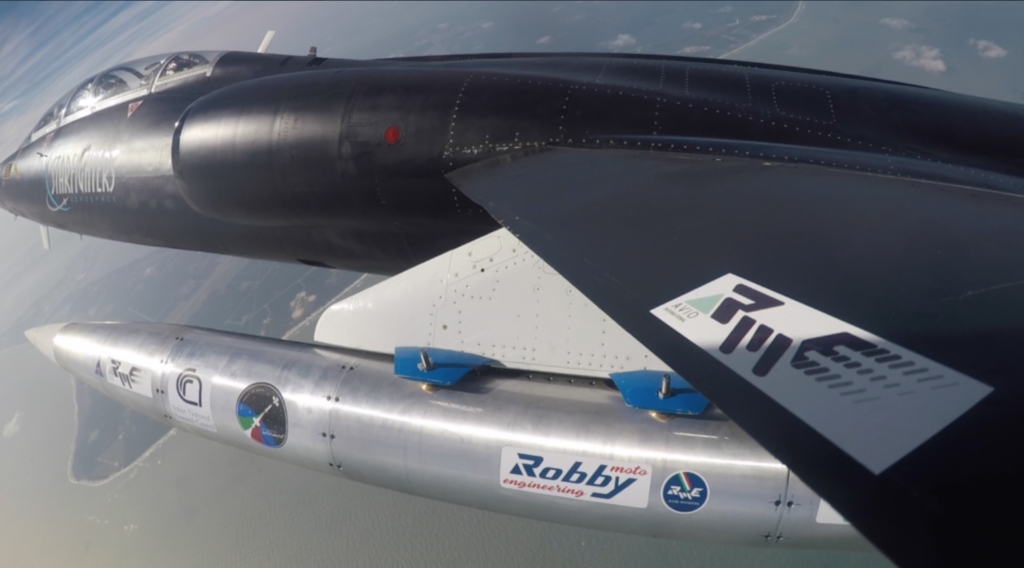
The Wind Tunnel in the Sky is designed to expose sensors, avionics, communications equipment, advanced materials and hypersonic components to sustained speeds above Mach 2 in real atmospheric conditions.
Franta previously told AGN that the platform could give developers more than five minutes of supersonic test time, compared with runs lasting between 30 seconds and one minute in some ground facilities.
The STARLAUNCH and Wind Tunnel vehicles share interchangeable systems and integration components, allowing data and operating experience from one programme to support the other.
“We’re right at the area where it gets very interesting,” Franta said. “Mach 2 is where you really start to see the problems and advantages of going really fast.”
Sign up for our newsletter and get our latest content in your inbox.



More from


October 13, 202612 min read






