


China tests Boeing 747-length airship airborne wind turbine at 4,000 metres

3 min read
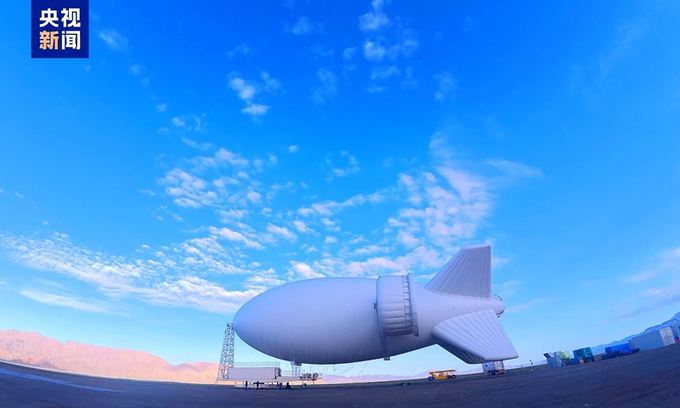
China has successfully launched the Boeing 747-length S4000 helium airship airborne wind turbine as it races to harness the enormous energy potential of the troposphere.
Airborne wind turbines are just one of the several use cases being made for a return of airships. Air Nostrum is gearing up to introduce Airlander 10 airships for passenger transportation, while other use cases include cargo and hydrogen transportation.
China tests its new S4000 high-altitude wind power prototype
China’s state-run news outlet, Global Times, reported last weekend that it has completed a full-process flight test of its new S4000 Stratosphere Airborne Wind Energy System (SAWES) at a base in Northwest China.
The development is heralded as a “major breakthrough.” It is a high-altitude wind power technology and is designed to generate electricity in the troposphere. It is claimed to have a design life of 20 years.
While Global Times writes that the flight “marks the transition of China’s stratospheric high-altitude wind power technology,” an altitude of 4,000 metres is in the troposphere. The Stratosphere starts at around 10,000 metres at mid-latitudes.
China's domestically developed S4000 Stratosphere Airborne Wind Energy System (SAWES) has recently completed a verification test in northwest China, marking a new breakthrough in the country's stratospheric high-altitude wind power technology.
— People's Daily, China (@PDChina) August 24, 2026
With a maximum operating altitude… pic.twitter.com/f4dhLaRerC
Global Times reported, “The test covered the entire process of ascent, station‑keeping, power generation testing, and smooth recovery, with all indicators meeting the required standards, fully verifying the system’s reliability in complex and extreme high‑altitude environments.”
Windmills or wind turbines started as land-based platforms set on hills to harness the wind. As time went on, they have grown taller, being placed offshore, and as offshore floating wind turbines.
The SAWES idea is an interesting extension of that, with floating adapted versions up to high altitudes to generate electricity. The Chinese system has a ground station and a helium airship with turbines connected by a conductive tether.
Building on the earlier S2000 SAWES
The S4000 is an upgraded version of the earlier S2000 SAWES. The S2000 prototype flew to 2,000 metres and generated electricity, feeding 385 kWh into the power grid.
At the time, a Euronews analysis stated that the real significance of the demonstration was successful grid connection, not just the flight.
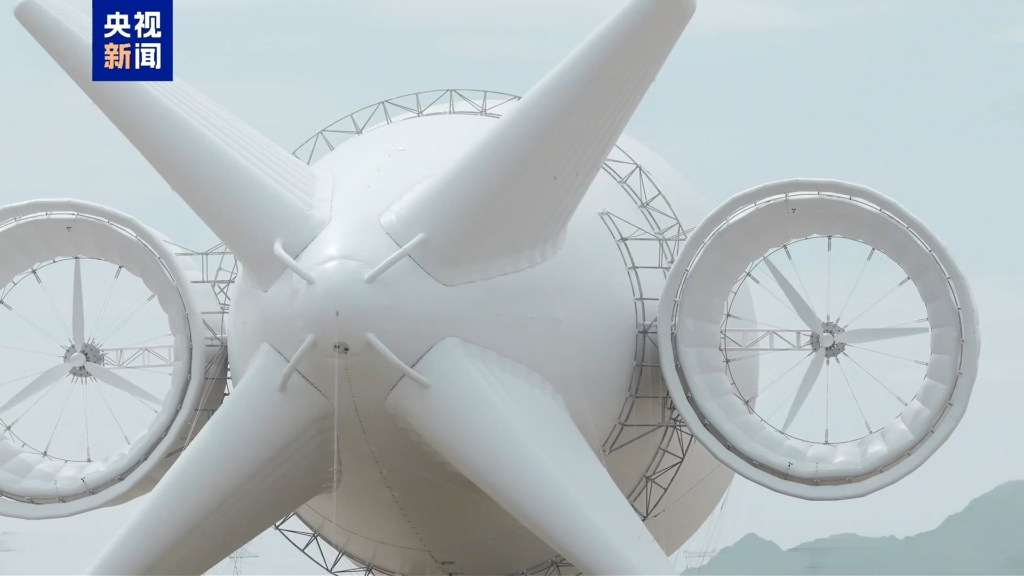
The S4000 model adopts a new configuration with improved overall performance. The craft’s maximum operational altitude is up to 4,000 metres, “making it suitable for deployment in the vast majority of regions across China.”
There are efforts around the world to harvest the stronger and more consistent winds found at higher altitudes. At altitude, power density can be several times higher than at ground level.
German kites vs Chinese helium blimps
China is not alone in developing the technology. Examples of Western companies include Altaeors Energies and Windlift in the US; SkySails Power, Kitemill, and kiteKRAFT in Germany; Kitepower in the Netherlands; and others.
The main categories include buoyant/aerostat-based systems (like the S4000), kite or soft-wing systems, and rigid-wing aircraft/energy kites. Companies in Europe and North America have been pursuing the technology for over a decade, although they tend to use kites rather than blimps.
News on the horizon: Airborne Wind Energy takes off in East Asia. Our Technology has captured the attention of https://t.co/dKAunBgzlu https://t.co/e7j9mm6HNf., illuminating the path of this remarkable innovation. 🗞️Stay tuned! https://t.co/MDxBbJskB9 pic.twitter.com/flA6GP6nVO
— SkySails Group (@SkySailsGroup) August 8, 2023
Google X backed the Makani project until 2020. Although the programme was cancelled, it generated substantial experience in autonomous flight, airborne power generation and control systems that has informed subsequent airborne wind energy research.
The SkySails Power kite system in Mauritius has been operating as a grid-connected commercial demonstration project since late 2021/early 2022. It uses a 120-square-metre kite flying at altitudes of up to 400-750 metres, generating around 300-400 MWh.
In July 2025, SkySails deployed a similar Venyo-class system to Taiwan. In 2025, SkySails launched the much larger Kyo system with up to 450 kW in rated cycle power, with first deliveries expected in 2028.
Sign up for our newsletter and get our latest content in your inbox.


More from


August 16, 20265 min read


