A closer look at l’aérOnde’s perplexing flying doughnut

4 min read
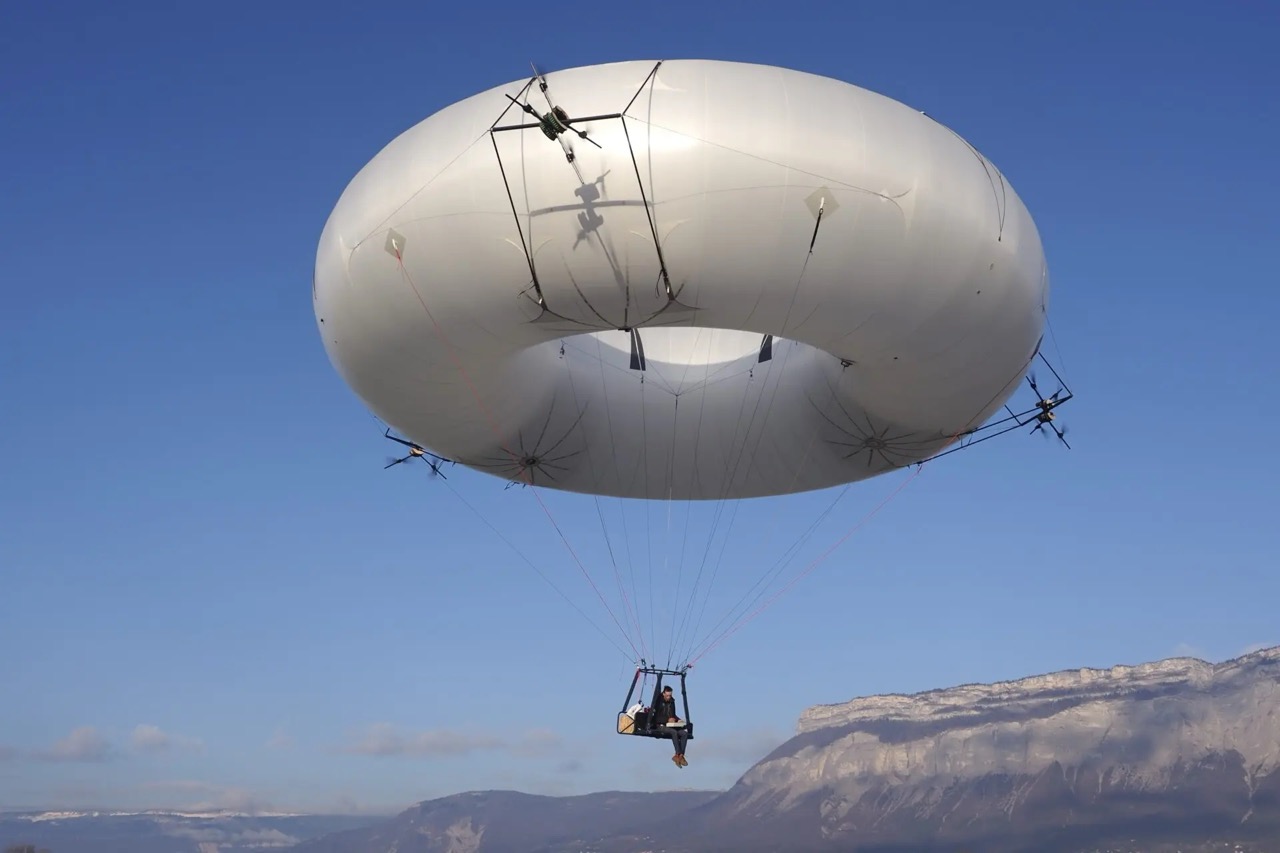
French aviation start-up l’aérOnde has developed a doughnut-shaped electric personal dirigible, which can be seen flying over Grenoble, France, occasionally displaying advertising.
There have been a few perplexing aviation accomplishments over the centuries, from Leonardo D’Avinci’s ornithopter design for personal strap-on wings that inspired Batman, to Lawnchair Larry, the California man who, in 1982, strapped 42 helium-filled weather balloons to a lawnchair and took off from his backyard, rising to 16,000 feet and running straight into Long Beach Airport air traffic.
L’aérOnde has the distinction not just of being a bit different, with questionable safety standards, but also of raising an impressive €1.65 million in development funding despite these drawbacks. Larry could have used that kind of funding to help pay his fine for violating federal airspace back in the day.
Another way to fly
In all fairness to l’aerOnde, the flying doughnut is a functioning radio-controlled dirigible with unique features that could make it useful for remote installations, repairs, and rescue missions where reaching the target by any other means of transport could be difficult or impossible.
The unusual helium-powered aircraft combines elements of an airship, an eVTOL and a drone into an aerial vehicle designed for slow, precise and ultra-efficient flight. The company believes it could offer a practical alternative to helicopters for a range of applications, from infrastructure inspection and aerial work to tourism and emergency response.
Why a doughnut?
The most distinctive feature of the Aéronde is its toroidal, or doughnut-shaped, envelope. Unlike conventional oval blimps, the circular shape is intended to reduce the “weathervane effect” that causes traditional airships to align with the wind. According to the company, the design also simplifies manufacturing, allows the aircraft to fit into smaller hangars, and makes ground handling easier regardless of wind direction.
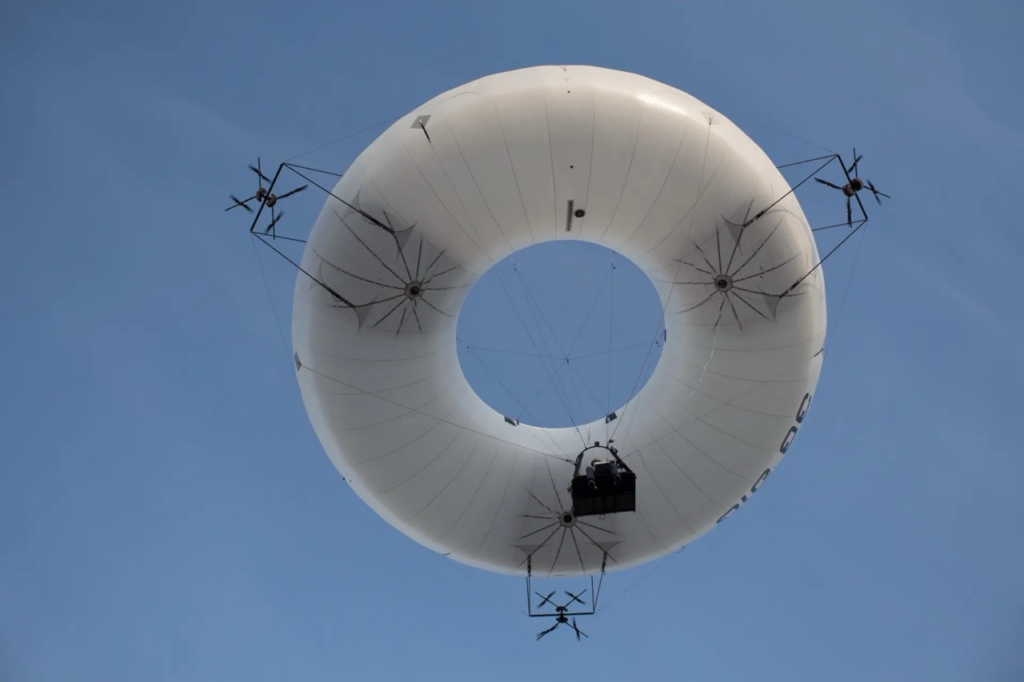
The white ring measures 15 metres (49 feet) in diameter and contains approximately 400 cubic metres of helium, generating more than 400 kilograms of lift. Suspended beneath the ring is an open ‘cockpit,’ which is really little more than an open plank on which up to two occupants can sit with equipment fitted in a bin behind them. It is designed for the intrepid; the sole allowance for passenger safety is a lap belt.
Electric propulsion with helicopter-like capabilities
Rather than relying on large rotors, the aircraft uses three steerable propulsion units. Each unit contains four electric motors, giving the aircraft a total of 12 motors that allow it to move in any direction and hold a precise position in the air.
The design enables vertical take-off and landing while maintaining the energy efficiency advantages of a lighter-than-air vehicle.
l’aérOnde reports that the aircraft can:
- Carry a payload of up to 200 kilograms
- Cruise at approximately 20 km/h (12 mph)
- Operate for around four hours on battery power
- Fly at altitudes of up to 2,500 metres
- Hover precisely for inspection and maintenance work
The company says energy consumption is roughly 1.2 kWh per hour, significantly lower than the fuel burn of a helicopter performing similar low-altitude work.
Designed for precision work rather than speed
L’aérOnde is not attempting to compete with aircraft or helicopters in terms of speed. Instead, the startup is targeting missions where stability, precision and endurance are more important than travel time.
Potential applications include:
- Power line inspections
- Railway and infrastructure monitoring
- Roof and building maintenance
- Agricultural observation
- Telecommunications support
- Event operations
- Search and rescue activities
- Tourism and sightseeing flights
Because the aircraft can remain stationary in the air with minimal energy consumption, l’Aéronde could provide a more sustainable platform for aerial work that currently relies on helicopters.
From research project to commercial aircraft
The flying doughnut concept originated from work conducted at Grenoble’s Electrical Engineering Laboratory (G2Elab) under the leadership of founder Jérôme Delamare. The project won recognition through France’s i-Lab innovation programme and has attracted investment to accelerate development.
The company has already conducted flight demonstrations and is offering public experience flights near Grenoble as it continues testing and development. Recent demonstrations have included manned flights and public appearances across France.
Could airships be making a comeback?
L’aérOnde capitalizes on renewed interest in lighter-than-air aviation, as operators seek lower-emission alternatives to conventional aircraft.
While large cargo airships attract investment, l’aérOnde is pursuing a different market niche: replacing some helicopter operations with a quieter, slower and significantly more energy-efficient platform.
The unusual doughnut shape may raise some eyebrows, and the aircraft may have a few other safety holes in its design, but its real test will be whether operators embrace a new category of aircraft designed specifically for sustainable low-altitude work.
In the meantime, like many other blimps, the flying doughnut is available for advertising.
Featured Image: l’aérOnde
Sign up for our newsletter and get our latest content in your inbox.



More from


October 11, 20263 min read