


Should you drink tea and coffee on a flight? Study finds airline water quality varies widely

4 min read
A new independent study has reignited a debate about the quality of drinking water carried on commercial aircraft, finding significant disparities between US airlines.
The 2026 Airline Water Study, published by the Center for Food as Medicine and Longevity, assessed the drinking water practices of 21 airlines in the United States, including both major network carriers and regional operators.
The study evaluated water quality data over three years from October 2022 to September 2025, ranking airlines using a composite “Water Safety Score” that reflects bacterial testing results, reported violations, and maintenance practices.
The analysis is based on compliance data submitted by airlines to the US Environmental Protection Agency under the Aircraft Drinking Water Rule, combining sampling results, violation records and maintenance activity into a fleet-normalised scorecard intended to highlight comparative performance rather than conditions on any individual flight.
Airline water quality is a mixed bag
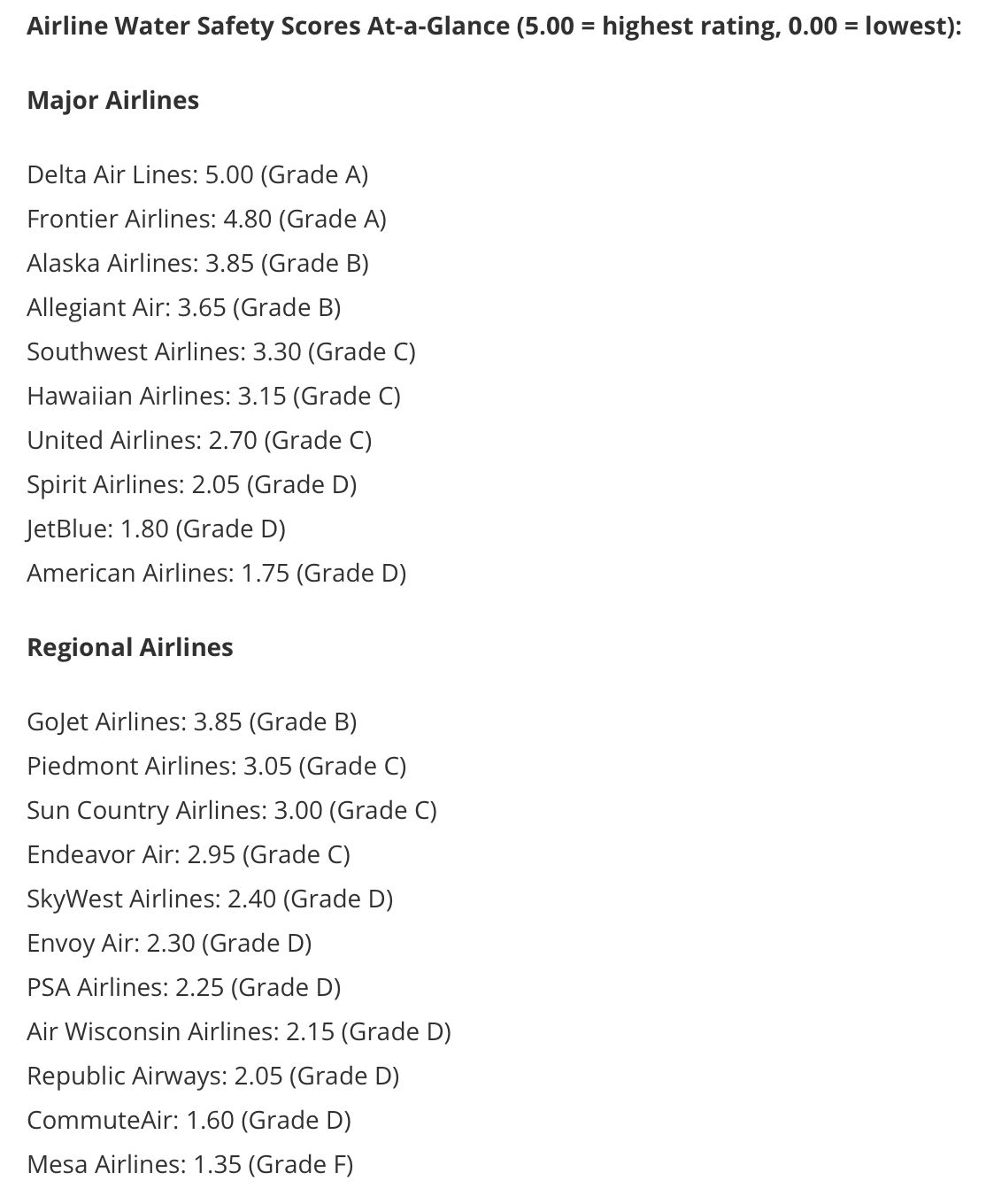
At the top of the rankings, Delta Air Lines and Frontier Airlines emerged as the strongest performers, both achieving high scores that indicate relatively robust water safety management. Alaska Airlines followed closely behind, placing third among the major carriers assessed.
Among regional operators, GoJet Airlines stood out as the only carrier to receive a score comparable to the better-performing mainline airlines. Most other regional airlines clustered toward the lower end of the rankings, reflecting what the study characterises as persistent weaknesses in water management practices across the regional sector.
At the opposite end of the scale, American Airlines and JetBlue recorded the lowest scores among major carriers, while Mesa Airlines and CommuteAir ranked at the bottom of the regional category. The study notes particularly high rates of positive bacterial indicators in samples associated with some regional fleets.
How do airlines keep drinking water safe?
Aircraft drinking water in the US is regulated under the Aircraft Drinking Water Rule (ADWR), introduced in 2011. The rule requires airlines to regularly test onboard water systems for total coliform bacteria and Escherichia coli, and to disinfect and flush aircraft water tanks at defined intervals.
Airlines can comply either by disinfecting and flushing water systems four times per year, or by carrying out annual flushing combined with monthly testing. When contamination is detected, the rule mandates corrective action ranging from repeat sampling to the immediate shutdown of the affected water system.
Despite this regulatory framework, the study argues that compliance does not always translate into consistently safe onboard water. The presence of total coliform bacteria, while not necessarily harmful on its own, is treated as an indicator that other, potentially pathogenic organisms may be present within an aircraft’s water system.
Across the three-year study period, more than 35,000 individual water sample locations were analysed across the 21 airlines assessed. Around 2.7% of samples tested positive for total coliform bacteria, while E. coli was detected far less frequently.
The authors identify Maximum Contaminant Level violations for E. coli as the most serious risk factor influencing airline scores, with more than 30 such violations recorded across the dataset.
Table: Study-wide aircraft drinking water testing and violations
| Category | Metric | Count | Percentage / Notes |
|---|---|---|---|
| Water sampling | Total sample locations tested (total coliform) | 35,674 | 100% of samples |
| Locations with total coliform present | 949 | 2.66% | |
| Locations with total coliform present and E. coli absent | 897 | 2.51% | |
| Locations with E. coli present | 50 | 0.14% | |
| Locations where E. coli did not speciate | 2 | 0.01% | |
| Coliform-positive breakdown | Total coliform-positive locations | 949 | Reference total |
| E. coli absent | 897 | Majority of positives | |
| E. coli present | 50 | Subset of positives | |
| E. coli not speciated | 2 | Reporting limitation | |
| Regulatory violations | Total Aircraft Drinking Water Rule violations | 931 | Overlap method |
| MCL violations for E. coli | 32 | Subset of violations |
Lack of enforcement of airline water regulations
One of the study’s most critical findings concerns enforcement. The Environmental Protection Agency (EPA), which is responsible for oversight of aircraft drinking water compliance, is criticised for what the authors describe as a lack of meaningful penalties when violations occur.
The report goes as far as to award the EPA a “Shame on You” designation, arguing that civil penalties for Aircraft Drinking Water Rule breaches are “extremely rare”, and that the researchers were unable to obtain a clear answer on penalty activity.

Aircraft water supply chains present complex challenges
Unlike municipal water systems, aircraft drinking water tanks are refilled from multiple sources across a wide range of airports, often using ground equipment such as water cabinets, trucks, carts and hoses.
The study argues that this fragmented supply chain can make consistent quality control difficult, because contamination can be introduced during servicing and then persist in onboard tanks and plumbing if disinfection and flushing practices are not rigorously maintained, particularly on aircraft operating intensive short-haul schedules.
Advice for passengers
The authors stress that the scorecard reflects compliance and monitoring signals rather than conditions on any single flight, but they still urge passengers who want to reduce risk to be cautious.
Their guidance includes choosing sealed bottled drinks, avoiding coffee and tea made with aircraft tap water, and using alcohol-based hand sanitiser instead of relying on onboard tap water.
Featured image: American Airlines


