British Royal Navy F-35Bs arrive in Florida for corrosion treatment

4 min read

The first Royal Navy F-35B Lightning II stealth fighters have arrived in Florida, where they will undergo intensive depot-level corrosion inspections at a US Navy maintenance facility, according to the US Department of Defense.
The aircraft, jointly operated by the Royal Navy and Royal Air Force, are being processed at Fleet Readiness Center Southeast (FRCSE) in Jacksonville, marking the first time British F-35Bs have entered the US Navy’s PAIR II corrosion-mitigation programme.
British F-35Bs arrive for corrosion-mitigation inspections
The first Royal Navy (also shared with the Royal Air Force) arrived at the Fleet Readiness Centre Southeast (FRCSE) on 3 December. It is unclear how many jets have arrived, although at least three are confirmed to be on site. The UK has now received a total of 38 (one lost) of the 48 F-35s it has ordered.
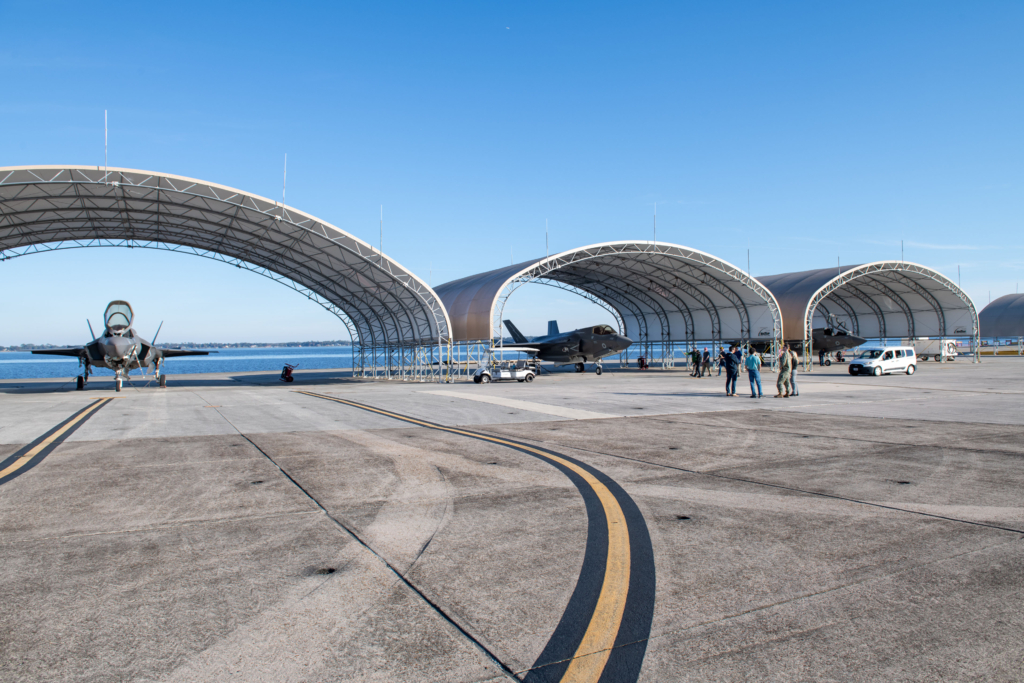
Capt. Mike Windom, commanding officer of FRCSE, said, “We are proud to extend our expertise to support our Royal Navy allies, ensuring their F-35 aircraft maintain peak mission readiness.”
There, they will undergo the PAIR II process that will see the aircraft’s underlying structure thoroughly inspected. Any corrosion will then be removed and repaired to prevent future damage.
DVIDS reports that the process has been reduced from a turnaround of 180 days to around 60 days, “significantly improving the availability of F-35 aircraft for operational service.” F-35 corrosion prevention best practices are also being shared with the Royal Navy maintainers.

The FRCSE is located in northeast Florida. It is an integral part of the larger US Navy, Naval Air Systems Command and Commander, Fleet Readiness Centers, and helps maintain US fighter jets.
The UK does not currently carry out PAIR II-level structural corrosion inspections for the F-35 domestically, making the US Navy’s Florida facility the only available option for this phase of the aircraft’s lifecycle.
Get the latest aerospace defence news here on AGN.
Why Royal Navy F-35Bs face higher corrosion risks at sea
Operating out at sea is nasty for any machinery. In the days of sail, worms would eat through wooden ships on long voyages, while the salty air corrodes metal aircraft and warships alike.

In military aviation, corrosion is often called the “hidden enemy” and can account for over 25% of all maintenance costs for naval aviation.
There are different levels of intensity for corrosion inspections. Visual checks for surface bubbling or “white powder” are carried out daily or in pre-flight checks.
Most Navy fighter jets undergo Planned Maintenance Intervals (PMI) every few years (roughly four years for the F/A-18). The highest intensity inspection is the depot-level inspections, like the PAIR II inspections these Royal Navy F-35s are getting. PAIR II includes deep structural inspections.
‘Engine corrosion’ grounds large numbers of Japan’s home-grown P-1 patrol aircraft https://t.co/kRljmeV2cN
— The Straits Times (@straits_times) June 30, 2025
These are typically carried out once a certain threshold of flight hours is reached or after a given amount of time has passed. The environment the aircraft is in influences the amount of time.
The first British F-35Bs arrived in the UK in mid-2018, with them achieving Initial Operational Capability (IOC) in December 2018, or eight years ago.
Why corrosion is harder to detect and repair on the F-35B
Old non-stealthy fighter jets could just have their rust ground off and their metal primed. But this is not possible for the F-35. The F-35 does incorporate lessons learned from the earlier stealth F-22 and is built with sealants and drainage paths designed to lessen the corrosion burden.

The F-35 uses a large amount of composite materials. While composites don’t “rust”, the underlying metal fasteners and aluminum frames do.
The precision the F-35 requires is intense, with almost zero tolerance. Its skin must be perfectly flush to maintain its stealth profile.
The F-35’s advanced Radar Absorbent material comes with its own set of issues, making inspections more difficult. If moisture jets are trapped under the stealth skin, it can corrode the airframe without being visible.
Making a milestone 🎖️
— F-35 Lightning II Joint Program Office (@theF35JPO) September 12, 2024
The Fleet Readiness Center Southeast in Jacksonville, Florida, welcomes its first F-35B Lightning II aircraft and F135 engine for depot-level maintenance, paving the way for next-generation products. pic.twitter.com/0vWvDSnnX9
During PAIR II, some Radar Absorbent Material (RAM) is removed, although artisans use non-invasive ultrasound, X-rays, and eddy current testing where possible to find non-visible cracks and corrosion.
Featured Image: DVIDS
Sign up for our newsletter and get our latest content in your inbox.


More from


October 17, 20264 min read