


Rolls-Royce boosts forecasts as aerospace, defence and AI markets accelerate

3 min read
Buoyed by large defence spending, advancements with its commercial engines, and a growing AI infrastructure boom, Rolls-Royce has recorded better-than-expected half-year financial results.
Rolls-Royce reports strong half-year performance
Yesterday, Rolls-Royce reported its underlying operating profit had risen by 46% to £2.5 billion year-on-year. The underlying operating margin stood at 22.5% with higher profitability in all divisions.
It added that the full year 2026 guidance has been raised: “We now expect £4.7bn-£4.9bn underlying operating profit and £3.8bn-£4.0bn free cash flow.”
Tufan Erginbilgic, CEO, said: “Our transformation continues to deliver, and we are demonstrating that Rolls-Royce is now a very different company to that of the past.”
He noted that in Civil Aerospace, RR has continued to improve its aftermarket profitability and “effectively eliminated aircraft on the ground.”
In one notable glimmer of hope, 2026 has seen three airlines, including LATAM Airlines, select Rolls-Royce’s new Trent 1000 XE engine for their Boeing 787 Dreamliners. It added, “more campaigns are underway.”
Today represents another important milestone on our journey to transform Rolls-Royce into a high performing, competitive, resilient and growing business.
— Rolls-Royce (@RollsRoyce) July 30, 2026
We made significant strategic progress, alongside delivering improved operational effectiveness and strong financial… pic.twitter.com/ZpRVvlcnoc
The Trent 1000 had enjoyed around a third of the share of the Dreamliner’s engine sales, but it has generated practically no new orders following durability issues with the engines. Some analysts had assessed that it was too late for Rolls-Royce to regain market share and expected the Trent 1000 to go out of production around 2030.
This time last year, Rolls-Royce credited increasing engine reliability for its soaring stock prices.
Set to benefit from large defence spending boom
Rolls-Royce is poised to benefit from the large defence spending boom underway in Europe as well as in the United States and beyond.
AGN has previously reported how Rolls-Royce is optimistic that its AE 3007 engine and new Orpheus engine families can benefit from the upcoming Increment 2 of the US Air Force’s CCA programme.
In the earnings call, Erginbilgic said it has continued to establish a “leading position in autonomous propulsion with several key milestones achieved in the period.”
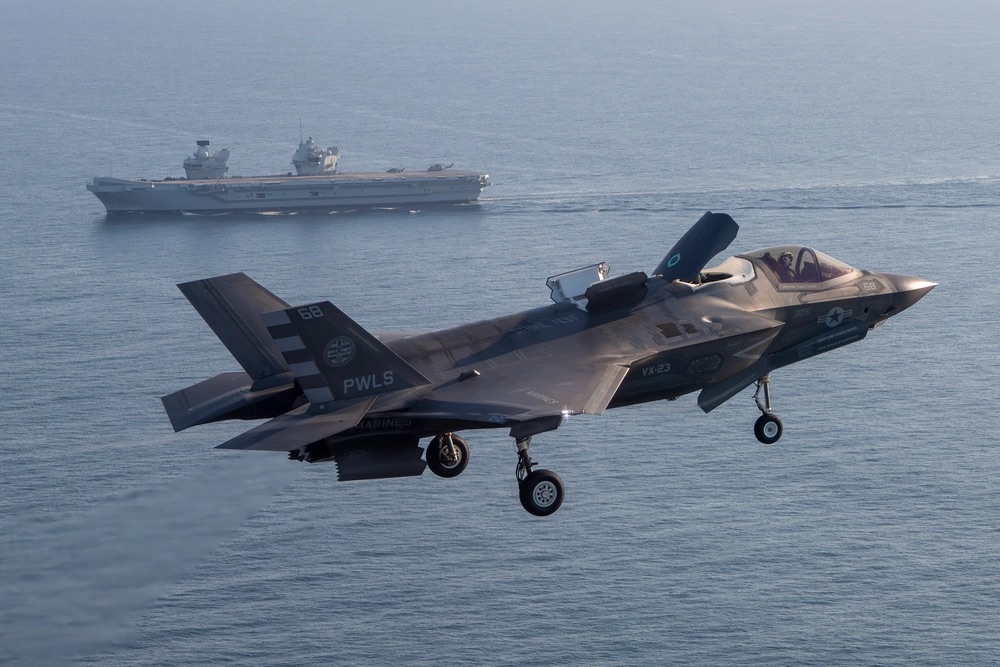
Rolls-Royce DNA can be found in a large share of Western military aircraft, from the new engines to be installed on the upgraded B-52J bombers to the LiftSystem powering the F-35B fighter jet to the GCAP/Tempest fighter jet.
In the Rolls-Royce 2025 year-end figures, Defence represented about one-third of its aerospace business (£4,772 billion), while Civil Aerospace was two-thirds (£10,382 billion). The company’s third major division is Power Systems, which is largely non-aerospace.
Rolls-Royce set to ride a large AI infrastructure boom
CNBC reported that Rolls-Royce is deepening its exposure to the AI infrastructure boom. It wrote, “the British engineering group is forecasting that continuous power systems could account for as much as one-fifth of its power-generation business by 2030 as data centers struggle to secure grid connections.”
Rolls-Royce’s Erginbilgic said this week that the company is discussing power systems and small modular reactors with hyperscaler data centre operators.
He said that the company expects to sign another “big hyperscaler sort of deal,” adding, “We are already taking orders for data centres for [2028].”
In October 2022, Rolls-Royce’s market capitalization fell to $7 billion, and as of the time of writing, it stands at $163 billion. That currently gives the company a much greater market capitalization than Britain’s leading defence contractor BAE Systems ($81 billion).
For reference, Airbus is currently valued at $185 billion, Boeing at $174 billion, and Lockheed Martin at $132 billion. Its rival, General Electric, is at $368 billion, RTX (includes Pratt & Whitney) is $289 billion, and France’s Safran is $162 billion.


