What will aircraft look like in the future? These NASA studies give us a clue

4 min read
For decades, commercial aircraft have followed a familiar formula: a cylindrical tube, swept wings, two engines under the wings, and a tail at the back. NASA believes that formula may no longer be enough to meet aviation’s ambitious environmental targets.
Through its Advanced Aircraft Concepts for Environmental Sustainability (AACES) 2050 initiative, NASA commissioned aerospace companies and universities to imagine what airliners entering service around 2050 might look like. Rather than producing a single “aircraft of the future,” the program explored multiple radical concepts designed to cut fuel burn, emissions, and noise beyond what incremental improvements can achieve.
The results suggest tomorrow’s aircraft could look dramatically different from today’s Boeing 737s and Airbus A320s.
Why future aircraft need a radical redesign
Conventional improvements—more efficient engines, lighter materials, and better aerodynamics—will continue to reduce emissions. But NASA believes those advances alone are unlikely to achieve long-term sustainability targets.
Researchers have concluded that meeting 2050 environmental goals requires not just refining existing designs but changing the aircraft’s overall configuration.
Nearly every concept emerging from the AACES program abandons the traditional tube-and-wing layout.
Double-bubble fuselages could make the aircraft itself generate lift
One striking proposal comes from Electra. Instead of relying almost entirely on its wings to create lift, the aircraft uses a wide “double-bubble” fuselage. The body itself generates a significant portion of the lift, reducing drag while creating space for a twin-aisle cabin in an aircraft roughly the size of today’s narrowbody jets.
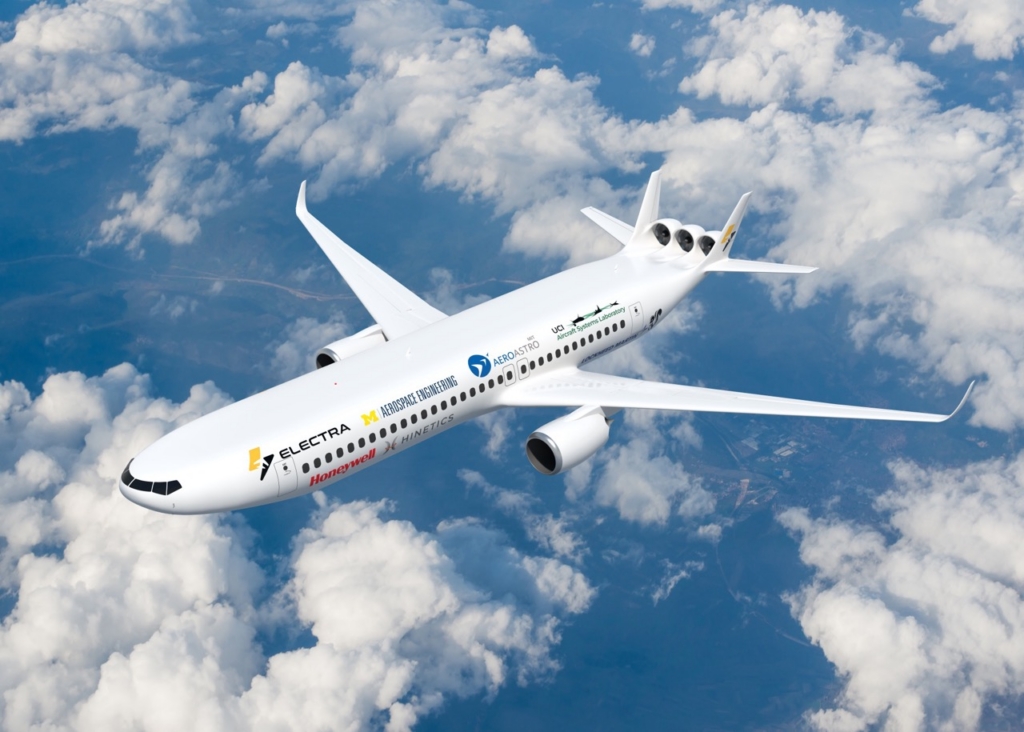
The design also places electrically powered fans at the rear of the aircraft. These fans ingest slower-moving air flowing over the fuselage—a technique known as boundary-layer ingestion—thereby improving propulsion efficiency.
Electra estimates the concept could deliver up to a 17% efficiency improvement beyond the gains already expected from future engines, lightweight materials and aerodynamic refinements.
Hybrid blended wing and tube and wing aircraft
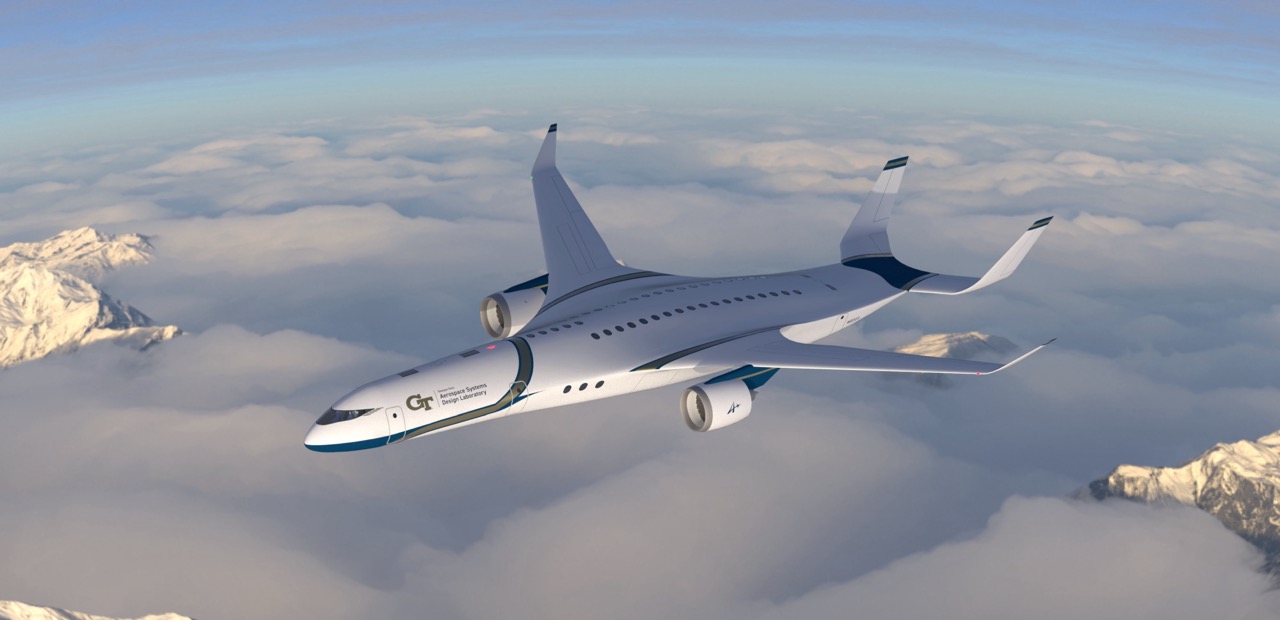
Georgia Tech’s Athena Concept Aircraft also features a unique fuselage—a hybrid between a conventional tube-and-wing and a blended-wing-body airframe. It would operate on cryogenic fuels such as liquefied natural gas without compromising aerodynamic performance.
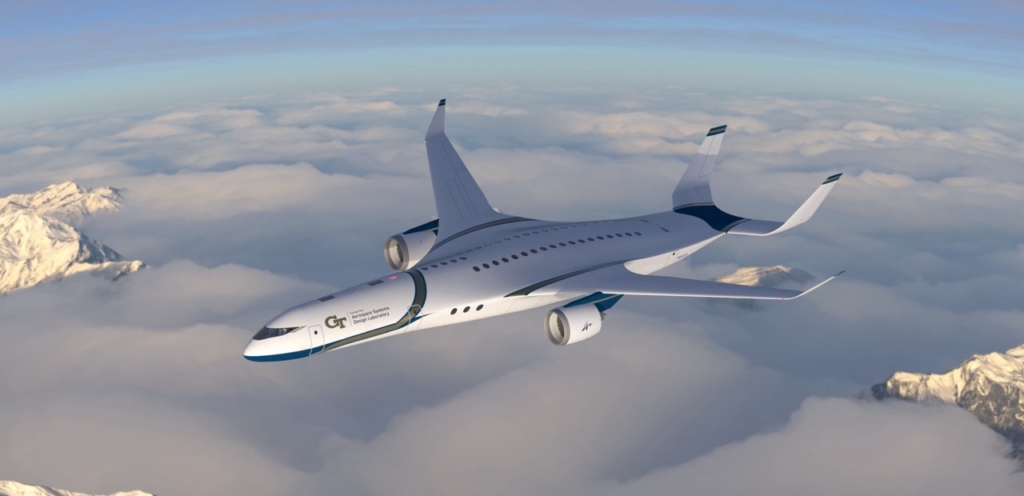
Athena could carry up to 178 passengers with a range of 3,500 nautical miles.
Blended wing bodies may become mainstream
An arguably more radical future aircraft concept is the blended wing body (BWB). Instead of a distinct fuselage attached to the wings, the aircraft forms a single continuous lifting surface.
NASA and Boeing have been exploring blended wing bodies for years, but AACES participants examined how they could become practical commercial airliners by mid-century.
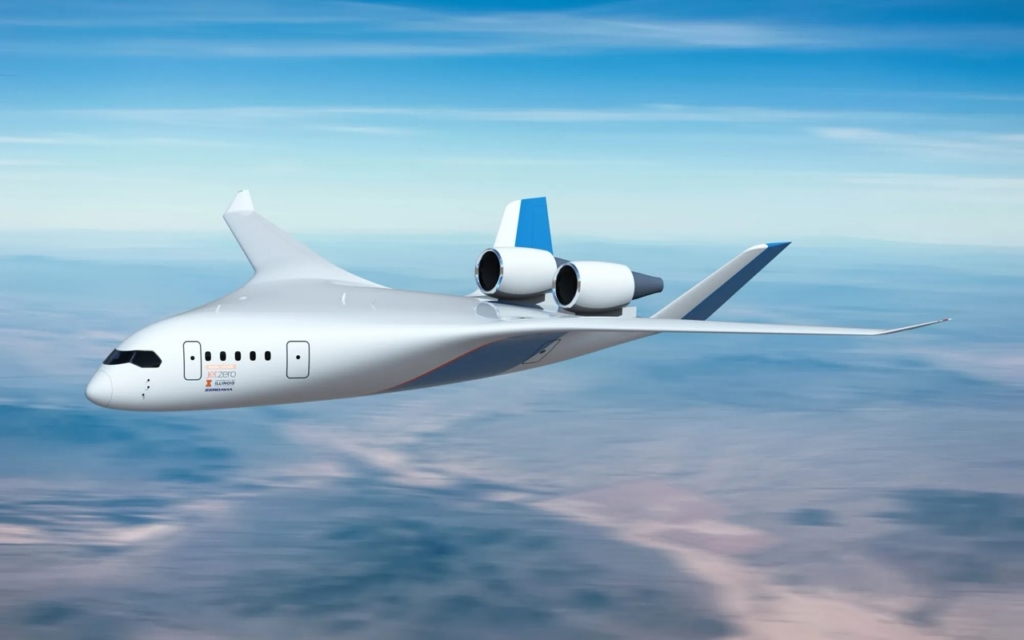
Potential benefits include:
- Lower aerodynamic drag
- Higher lift-to-drag ratio
- Greater internal volume
- Reduced fuel consumption
- Better compatibility with future hydrogen storage
JetZero’s NASA-funded study focused on how blended-wing aircraft might use cryogenic liquid hydrogen as fuel while remaining commercially viable.
Due to their irregular shape, these aircraft would open a new horizon for aircraft cabin design, and the industry is already pondering how best to divide the cabin triangle.

Last year, Natilus unveiled its three-class cabin BWB concept with room for 196 passengers, which promises generous 20”-wide economy seats.
Future aircraft could use multiple fuel types
NASA deliberately avoided betting everything on one fuel. The studies examined aircraft capable of operating with Sustainable Aviation Fuel (SAF), conventional Jet A during the transition period, liquid hydrogen, hybrid-electric propulsion systems, and future cryogenic fuels.
Many concepts that would rely on hydrogen infrastructure are compatible with today’s fuel supply while offering pathways for cleaner propulsion later in the century.
How soon could these aircraft enter service?
None of the AACES concepts is production-ready yet. NASA expects the studies to guide research priorities over the next two decades rather than lead directly to certification.
If development proceeds as hoped, the first of these commercial aircraft concepts could enter airline fleets around 2050. Some technologies—such as hybrid-electric propulsion, advanced composites, and new aerodynamic features—could appear sooner.
Science, not science fiction
The majority of futuristic aircraft concepts never make it past the drawing board. NASA’s efforts, however, are aimed at developing the science necessary to bring the future to life. Earlier research programmes have yielded technology we now take for granted, such as high-bypass turbofan engines and advanced composite structures.
The AACES initiative follows the same philosophy: identify promising technologies decades before manufacturers commit to designing the next generation of commercial airliners.
Whether future passengers board a blended-wing aircraft, a double-bubble jet, or another configuration entirely, many airliners of 2050 may look quite different from those flying today.
Featured Image: Georgia Tech | NASA
Sign up for our newsletter and get our latest content in your inbox.


More from

October 11, 20263 min read