Fargo Jet Center showcases growing demand for air ambulance aircraft conversions at Farnborough Airshow

3 min read

As operators look for faster and more cost-effective ways to expand aeromedical capabilities, aircraft conversion specialists are playing an increasingly important role by transforming established business aircraft into dedicated air ambulance platforms.
That market is on display at the Farnborough International Airshow, where US-based Fargo Jet Center (FJC) is presenting its special mission aircraft conversion capabilities, demonstrating how business jets and turboprops can be adapted for emergency medical transport through engineering, certification and customised cabin installations.
While much of Farnborough is centred on new aircraft programmes, the special mission sector has continued to grow as healthcare providers, governments and specialist operators seek proven aircraft that can be configured for critical care transport while retaining the performance, reliability and operational flexibility of existing airframes.
According to Fargo Jet Center, the company provides an end-to-end conversion service covering aircraft consultation, concept design, avionics upgrades, structural modification, FAA certification and final delivery, allowing operators to receive aircraft configured for specific mission requirements.
Business aircraft continue to form the backbone of dedicated aeromedical fleets
Rather than relying on purpose-built medical aircraft, many operators continue to adapt established business aviation platforms for emergency medical services.
According to the company, Fargo Jet Center has completed air medical conversions on aircraft including the Bombardier Learjet 45, Bombardier Learjet 75, Beechcraft King Air series, Pilatus PC-12, Cessna Citation family and Cessna Caravan, with each interior designed around an individual operator’s clini/cal and operational requirements.

The aircraft showcased in the company’s published portfolio illustrate the breadth of those modifications. A Bombardier Learjet 75 has been configured as a dual-patient air ambulance with integrated oxygen, air, vacuum and electrical outlets, dedicated medical power systems, removable cabin bulkheads, patient loading facilities and customised medical storage.
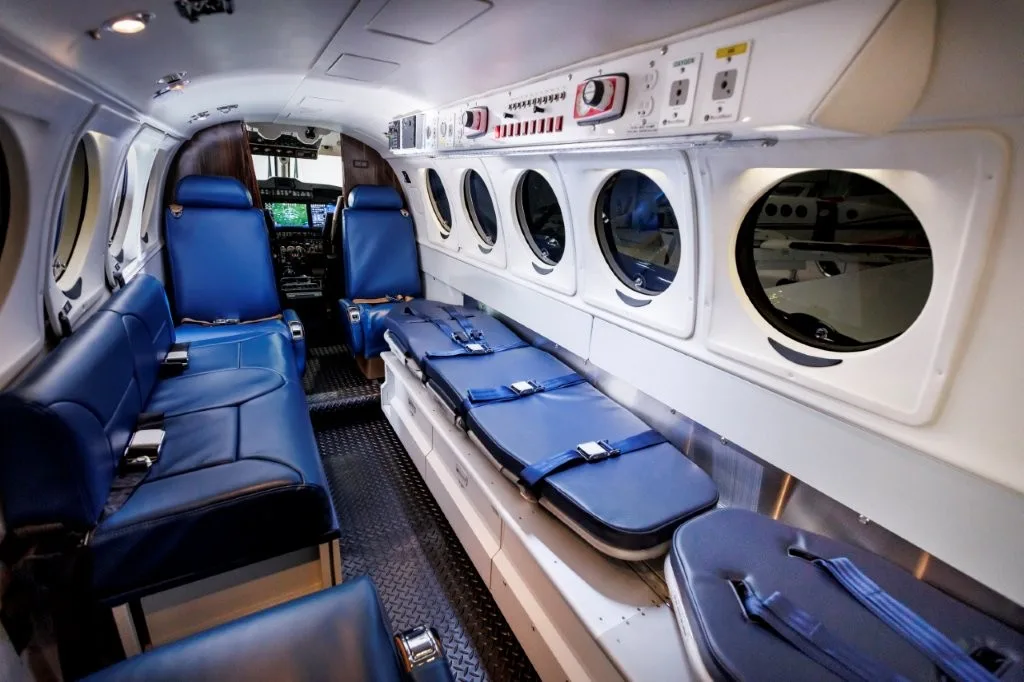
Its Beechcraft King Air 360C conversion also features a dual-patient configuration, while a King Air 350/360 variant has been equipped with a single-patient layout capable of carrying up to six medical personnel, enhanced vision systems, satellite communications and integrated cabin communications linking flight crews, medical teams and ground-based emergency services.

The company’s portfolio also includes a Beechcraft King Air 250 configured with dual Spectrum Aeromed patient systems, integrated oxygen storage, satellite communications and flight-following capability, together with a Cessna Citation CJ4 configured for single-patient and neonatal transport.
A Pilatus PC-12 single-patient configuration completes the range of aircraft currently featured in its aeromedical conversion portfolio.
Recent milestone reflects expanding demand for specialised mission aircraft
Fargo Jet Center’s appearance at Farnborough follows a recent milestone for its Special Missions division.
Earlier this year, the company announced the completion of its 150th special mission aircraft modification, delivering a customised Beechcraft King Air 250 to US healthcare provider Intermountain Health.
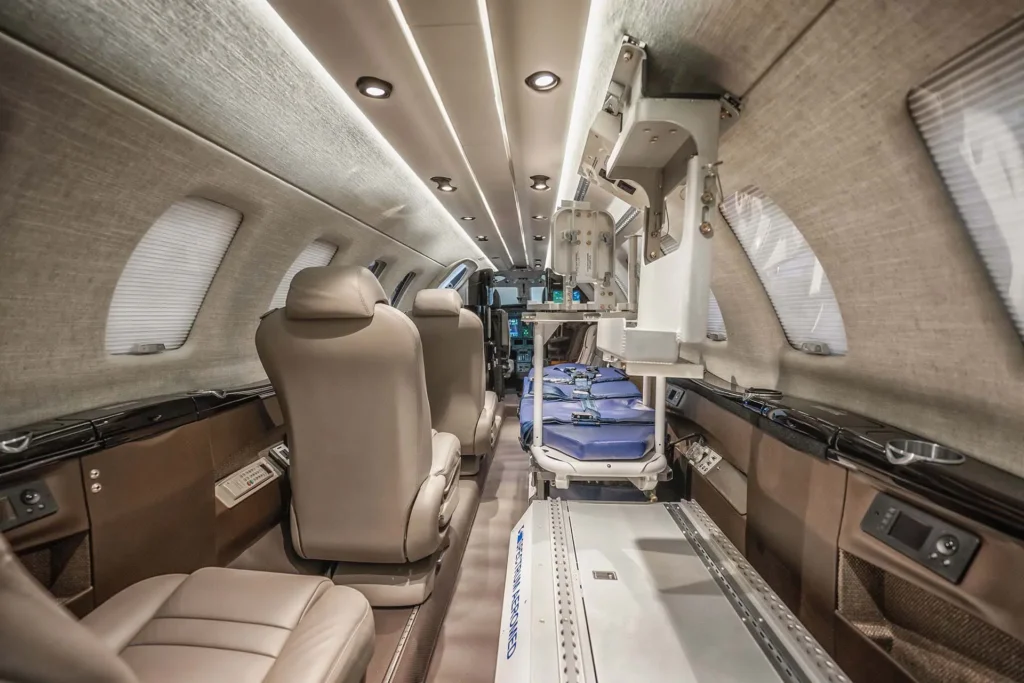
According to the company, the aircraft was configured for complex patient transport and incorporated a dual-patient medical system, integrated oxygen installations, satellite communications and equipment designed to support intensive aeromedical operations.
According to Fargo Jet Center, special mission aircraft modifications have formed part of its business since 1995 and now extend beyond air ambulance programmes to atmospheric research, cloud seeding, airborne law enforcement and reconnaissance platforms.
The company also holds multiple FAA Supplemental Type Certificates (STCs), with selected approvals validated by the European Union Aviation Safety Agency (EASA) and through China’s Validation of Supplemental Type Certificate (VSTC) process.
Aircraft modification is becoming a growing part of the aerospace services market
Although aircraft conversions represent a specialist segment of the aerospace industry, demand has continued to grow as operators seek mission-specific capabilities without procuring entirely new aircraft.
Converting an in-service business aircraft allows medical operators to tailor cabin layouts, patient loading systems, communications equipment and life-support installations to meet individual operational requirements while taking advantage of aircraft that are already well established in service.
For aircraft modification companies, that demand is creating opportunities well beyond traditional maintenance and refurbishment work.
As emergency medical services, government agencies and specialist operators continue investing in dedicated mission aircraft, conversion and completion work is becoming an increasingly important part of the wider aerospace services sector.