


ESA’s Hera reaches asteroid struck by NASA in historic planetary defence test

8 min read
More than four years after NASA deliberately crashed a spacecraft into an asteroid to change its course, the European Space Agency’s (ESA) Hera spacecraft has has arrived at the Didymos asteroid system to investigate the full extent of the damage caused by the collision.
ESA will unveil Hera’s first close-up images of the asteroid Dimorphos later today (25 November), following the spacecraft’s two-year journey through deep space.
The mission will establish how much the asteroid was physically altered by the impact, measure its mass and examine its internal structure. And the findings could help scientists determine how to deflect an asteroid should one ever be discovered on a collision course with Earth.
NASA’s Double Asteroid Redirection Test (DART) demonstrated in September 2022 that a spacecraft could deliberately change the motion of a celestial body. Subsequent research revealed that the collision had also altered the asteroid’s shape and even changed its path around the Sun.
Neither Dimorphos nor its larger companion, Didymos, poses a threat to Earth.
Hera’s first images of Dimorphos will be presented at Berlin’s Museum für Naturkunde, with a live broadcast beginning at 19:45 CET (18:45 GMT).
ESA has chosen the museum’s dinosaur hall as the venue for the event. Some 66 million years ago, an asteroid impact caused a mass extinction that wiped out the non-avian dinosaurs.
“‘We’re here to put a dent in the Universe,’ is what Steve Jobs famously declared,” said Hera mission manager Ian Carnelli.
“Through many years of hard work our international collaboration managed to do just that, and for the very highest of intentions: to help make Earth safer.”
Carnelli said the event would also recognise the work of the mission team, which overcame initial difficulties securing funding, the COVID-19 pandemic and an approaching hurricane shortly before launch.
What happened when NASA crashed DART into an asteroid?
Launched aboard a SpaceX Falcon 9 rocket in November 2021, DART was the first space mission specifically designed to test whether an asteroid could be deflected by deliberately striking it with a spacecraft.
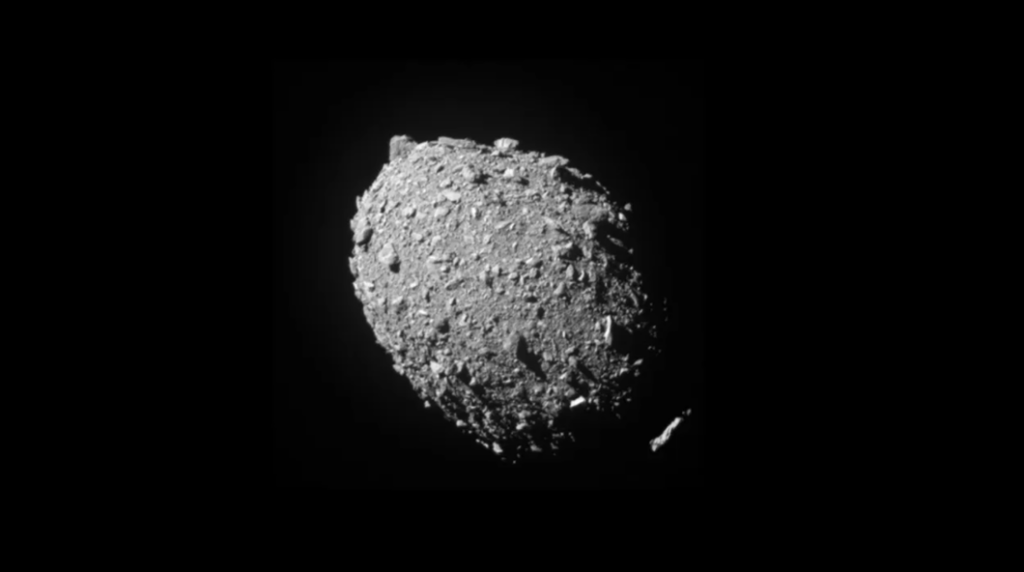
The target was Dimorphos, a roughly 151-metre-wide asteroid orbiting the much larger, 730-metre-wide Didymos. The two objects form what astronomers call a binary asteroid system.
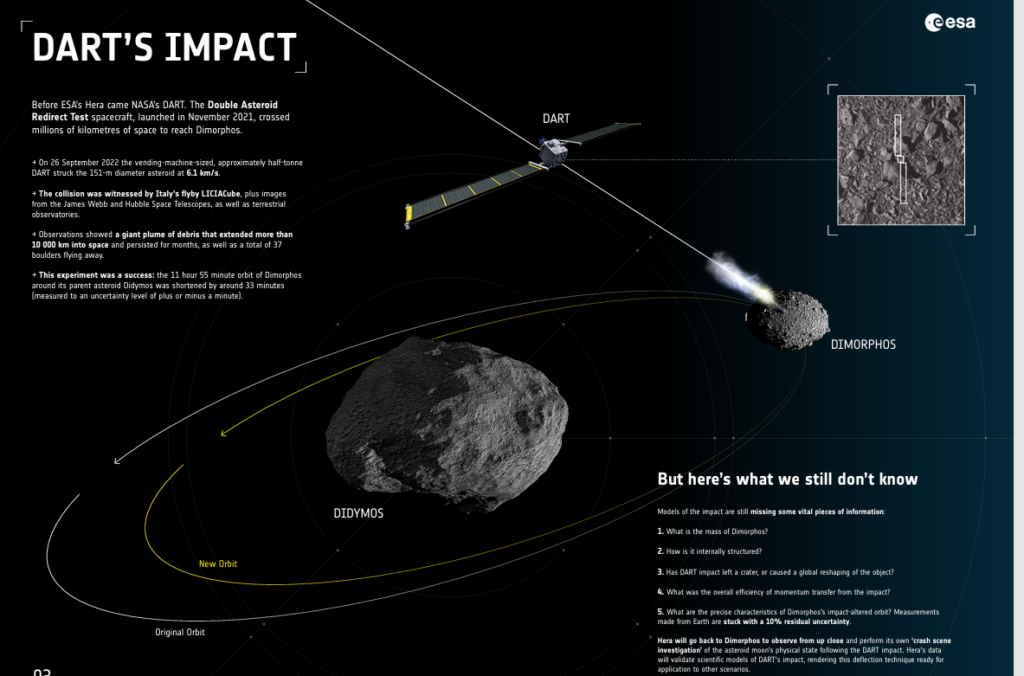
On 26 September 2022, the approximately half-tonne DART spacecraft struck Dimorphos at 6.1 kilometres per second, or nearly 22,000 kilometres per hour.
The collision was observed by the Italian Space Agency’s LICIACube satellite, the James Webb and Hubble space telescopes and ground-based observatories.
It sent millions of kilograms of rocky material into space, creating a trail of debris extending more than 10,000 kilometres. The debris remained visible for months.
Before the collision, Dimorphos took approximately 11 hours and 55 minutes to orbit Didymos. The impact shortened that period by around 33 minutes, substantially exceeding NASA’s minimum expectations.
However, scientists subsequently discovered that the collision had done far more than change the asteroid’s orbit.
DART changed the shape of Dimorphos
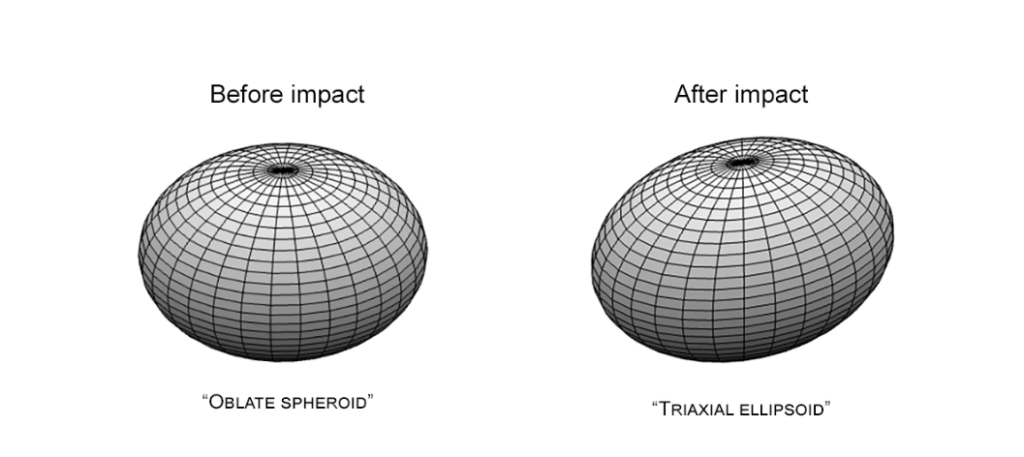
A study led by NASA’s Jet Propulsion Laboratory (JPL), published in March 2024, found that Dimorphos had undergone a significant change in shape.
Before the impact, the asteroid resembled a flattened ball and followed a circular orbit around Didymos. Computer models developed using spacecraft imagery, radar measurements and telescope observations indicated that it had become more elongated.
“When DART made impact, things got very interesting,” said Shantanu Naidu, a navigation engineer at JPL who led the study.
The researchers calculated that the orbital period had shortened by 33 minutes and 15 seconds, settling at 11 hours, 22 minutes and three seconds.
Dimorphos was also orbiting approximately 37 metres closer to Didymos than before the collision.
The findings supported the theory that Dimorphos is a rubble-pile asteroid, essentially a collection of rocks and dust held together by weak gravitational forces rather than a single solid mass.
Hera will now allow scientists to examine those changes directly and establish whether DART left a distinct impact crater or reshaped the entire asteroid.
How flying debris helped move an asteroid
In August 2025, NASA published further research based on images captured by LICIACube, which had separated from DART 15 days before the collision.
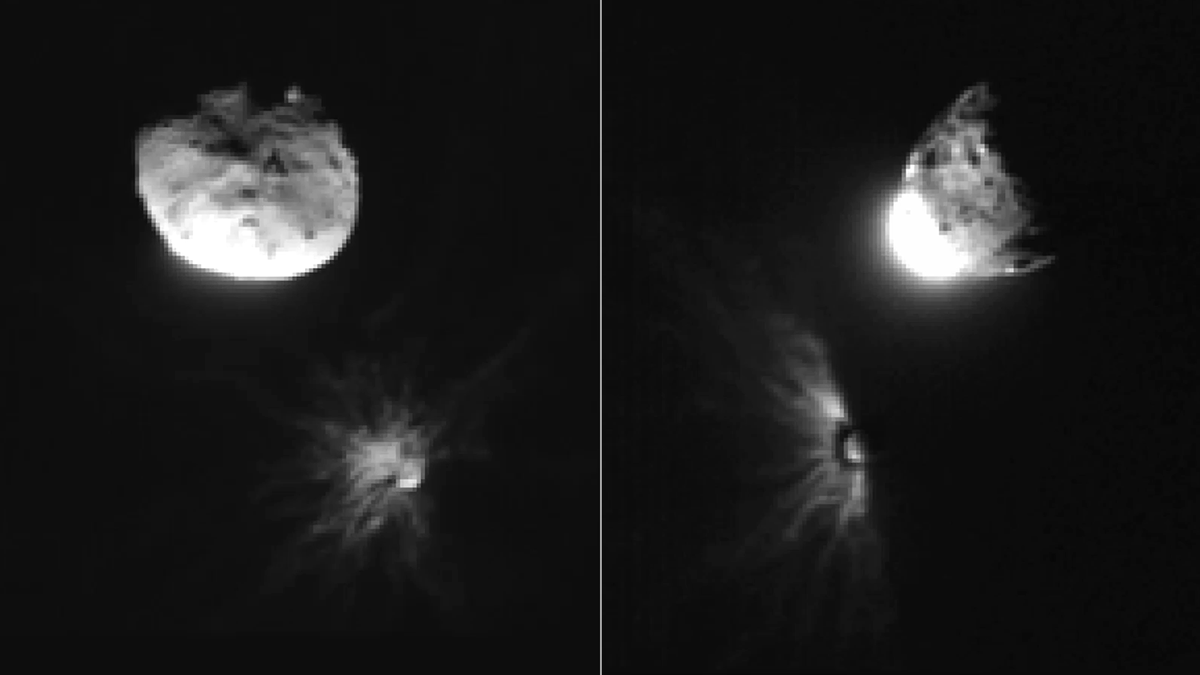
The small Italian spacecraft photographed the impact debris from several angles, capturing its closest image from just 85.3 kilometres above the asteroid’s surface.
Researchers estimated that the collision had dislodged around 16 million kilograms of dust and rock. Although this represented less than 0.5% of Dimorphos’s total mass, it was approximately 30,000 times the mass of DART itself.
The material thrown into space provided an additional push, making the deflection more effective than the spacecraft’s impact alone.
“The plume of material released from the asteroid was like a short burst from a rocket engine,” said Ramin Lolachi, a research scientist at NASA’s Goddard Space Flight Center who led the study.
Dave Glenar, a planetary scientist at the University of Maryland, Baltimore County, who participated in the research, said many near-Earth asteroids were expected to have a structure similar to Dimorphos.
“So, this extra push from the debris plume is critical to consider when building future spacecraft to deflect asteroids from Earth.”
Understanding how different types of asteroids respond to an impact will be important when designing future planetary defence missions.
NASA also changed an asteroid’s orbit around the Sun
Another discovery, announced by NASA in March 2026, revealed that DART had altered the path of the entire Didymos-Dimorphos system around the Sun.
Research published in the journal Science Advances found that the collision had changed the binary asteroid system’s 770-day solar orbital period by 0.15 seconds.
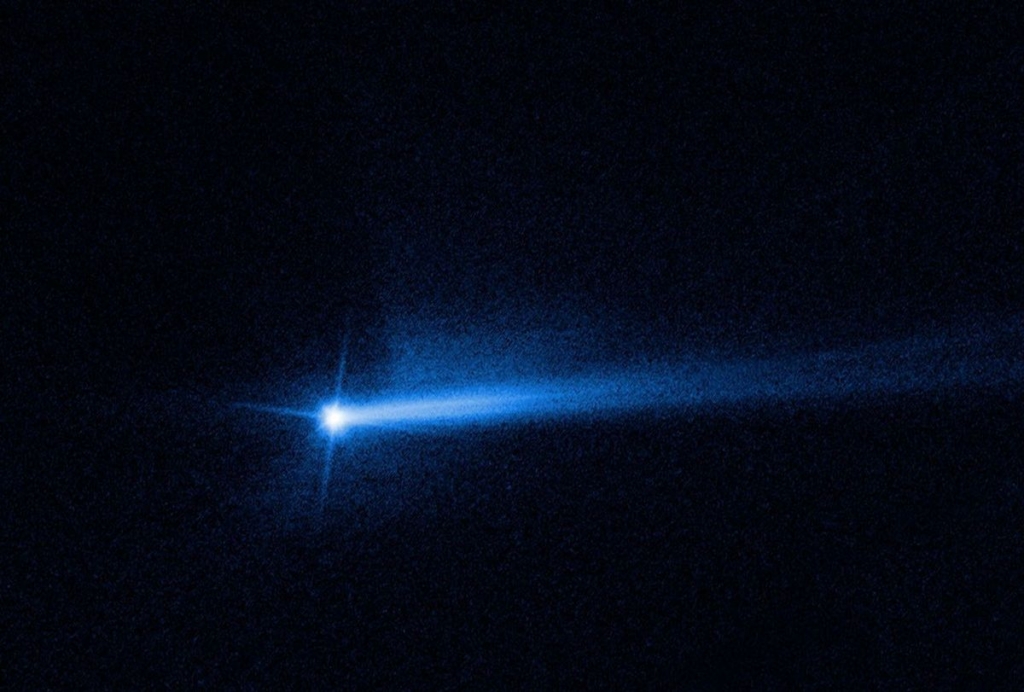
It was the first measurable alteration of a celestial body’s path around the Sun caused by a human-made object.
Researchers used radar measurements and observations from volunteer astronomers who recorded 22 occasions between October 2022 and March 2025 when the asteroid passed in front of distant stars.
“This is a tiny change to the orbit, but given enough time, even a tiny change can grow to a significant deflection,” said Thomas Statler, lead scientist for solar system small bodies at NASA Headquarters.
The discovery is particularly relevant to planetary defence. An asteroid detected sufficiently early could potentially be diverted away from Earth through a relatively small change in its velocity.
What will ESA’s Hera spacecraft investigate?
Hera, Europe’s first planetary defence mission, was launched aboard a SpaceX Falcon 9 rocket from Cape Canaveral Space Force Station in Florida on 7 October 2024.
The spacecraft flew past Mars on 12 March 2025, using the planet’s gravity to adjust its trajectory while also photographing its smaller moon, Deimos.
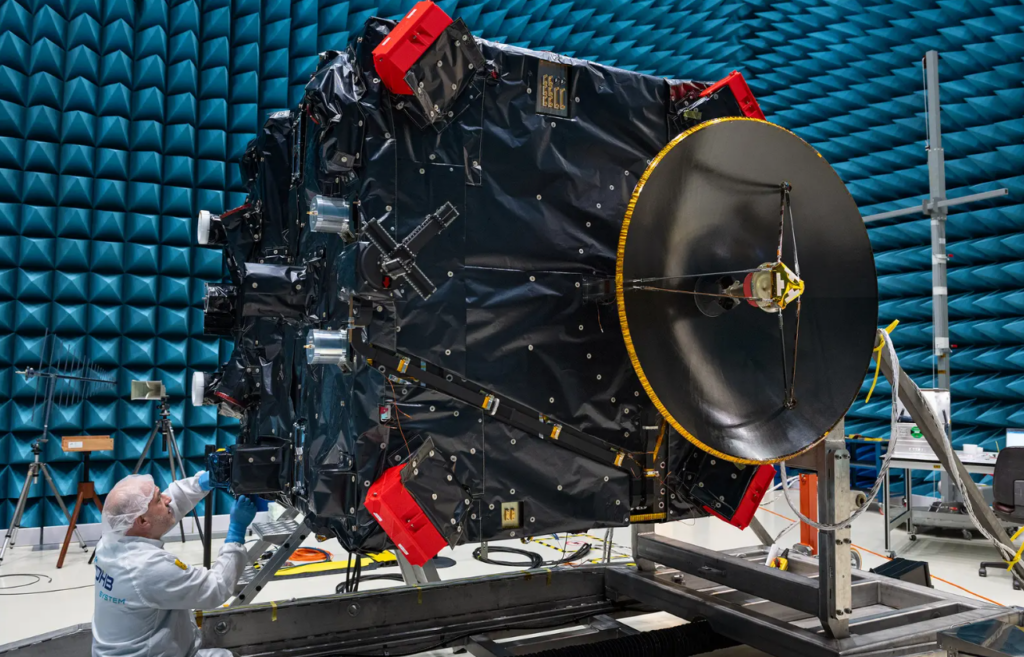
A further manoeuvre in February 2026 placed Hera on course for Didymos. Braking manoeuvres in October reduced its speed relative to the asteroids ahead of its rendezvous.
At the time of arrival, the asteroid system was approximately 195 million kilometres from Earth.
Built by a European industrial consortium led by Germany’s OHB, Hera weighs approximately 1,081 kilograms when fully fuelled. Its solar panels span 11.5 metres when deployed.
Together with its two smaller companion spacecraft, Hera carries 11 scientific instruments and a radio science experiment.
One of the mission’s most important objectives is to establish the precise mass of Dimorphos. Without that information, scientists cannot accurately determine how efficiently DART transferred momentum to the asteroid.
Hera will also investigate the asteroid’s internal structure, surface composition and altered orbit.
“How did the impact change Dimorphos? What is the mass of the asteroid and which of its properties explain its response to DART impact?” said Hera principal investigator Patrick Michel, Director of Research at CNRS and the Observatoire de la Cote d’Azur.
During the initial six-week survey, Hera will fly at distances of between 20 and 30 kilometres from the asteroids. Subsequent operations will bring the spacecraft within eight to 10 kilometres, allowing scientists to map their surfaces in greater detail.
Later phases will include 12 close flybys covering much of Dimorphos’s surface, including the DART impact site.
Two miniature spacecraft will investigate Dimorphos
Hera is also carrying two shoebox-sized satellites, Juventas and Milani, which are scheduled to be deployed in early 2027.
Juventas carries a low-frequency radar designed to examine the asteroid’s interior. The measurements could establish how rocks and other material are distributed beneath its surface.
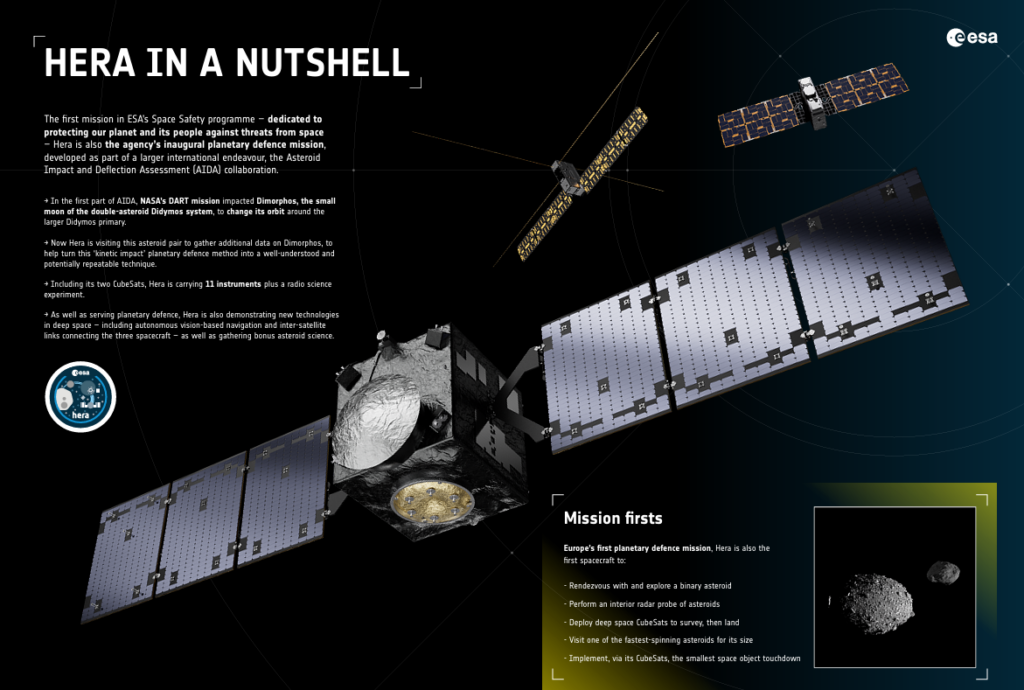
Towards the end of its mission, Juventas will attempt to land on Dimorphos and use a miniature gravimeter to measure the asteroid’s extremely weak gravitational field.
Milani will examine the surface composition of both asteroids and study dust in their surroundings. It may also attempt a landing at the end of its mission.
The two CubeSats will communicate with Hera through inter-satellite radio links, allowing the main spacecraft to relay their scientific data to Earth.
The 25 Nov unveiling is only the start of Hera’s exploration, ESA’s Hera mission scientist Michael Kueppers said ahead of Wednesday’s event.
“In the next few months we will be flying closer to the asteroids, and early in the new year will deploy a pair of shoebox-sized CubeSats to take extra risks and venture even nearer than the main spacecraft,” Kueppers said.
Could humanity prevent a future asteroid impact?
Although major asteroid impacts are rare, relatively small objects can cause considerable damage.
The 2013 Chelyabinsk event in Russia involved an asteroid measuring approximately 20 metres across. Its explosion in the atmosphere generated a shockwave that struck six cities.
ESA’s Near-Earth Object Coordination Centre in Italy works alongside NASA’s Center for Near-Earth Object Studies to identify potentially hazardous asteroids, calculate their trajectories and assess the risks they pose.
NASA is also developing its Near-Earth Object Surveyor space telescope to detect asteroids and comets that are difficult to identify using visible-light observations.
Early detection remains central to any attempt to divert a hazardous asteroid. The more time scientists have before a predicted collision, the smaller the change in its trajectory may need to be.
DART demonstrated that humans could deliberately alter an asteroid’s motion. Hera’s task over the coming months is to establish precisely how that happened and whether the results can be reproduced when Earth’s safety depends on it.





