ATR sees strong turboprop demand over the next 20 years

3 min read
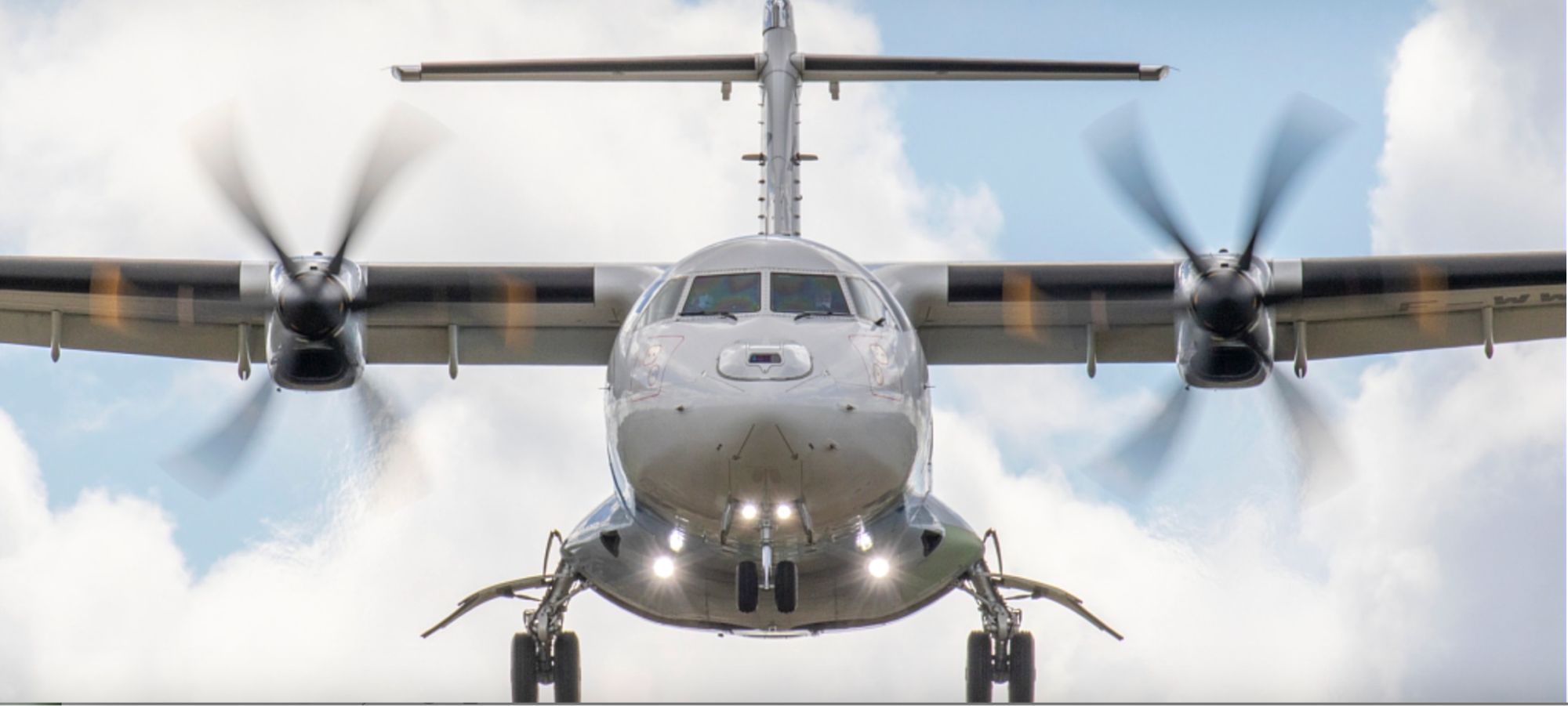
Despite not announcing any orders at this year’s Farnborough International Airshow, regional aircraft manufacturer ATR is experiencing a period of strong market momentum.
French airframe manufacturer ATR is seeing growing momentum for its turboprop aircraft, according to Chief Commercial Officer, Alexis Vidal.
Explaining that the company has sold more than 50 aircraft annually over the past two years while producing around 35 a year, he told Aerospace Global News, “Our book-to-bill ratio is above one, and we have a growing order backlog.”

Speaking about the outlook for regional aviation, Vidal said ATR anticipates demand for around 2,100 turboprop aircraft over the next 20 years, a segment in which he expects the business to play a leading role.
ATR’s Mobility Monitor tool reveals untapped potential in emerging markets
Going beyond aircraft sales to promote the wider benefits of regional aviation is at the core of ATR’s strategy. It has developed an innovative software tool – the Mobility Monitor, which Vidal said is “unique to the market”. The tool draws on millions of GPS-based datasets from smartphones and other devices to analyse domestic travel patterns between cities, identifying whether journeys are made by road, rail, air or sea.
In India, Vidal explained, the analysis estimates around 4.6 billion intercity trips take place each year, of which only about 3% are made by air, with the remaining 97% carried out by road or rail. ATR said this points to substantial untapped opportunities in developing markets.

Asia remains the fastest-growing aviation region, said Vidal. He also noted that in the regional aviation sector, ATR aircraft are often the first many families or children fly on, particularly in developing economies where the aircraft enables new direct routes. “A journey that might typically take eight to 18 hours by road can be completed in around 1.5 hours by air, opening up new possibilities for connecting families and businesses, the company said.
Two-thirds of future demand tied to repeat customers
Of the 2,100 turboprops ATR expects to be needed globally over the next two decades, roughly two-thirds is allocated to the replacement of existing aircraft, explained Vidal. The remaining third is linked to new routes and networks. “We are not basing our projections on fantasy; we know the majority of our market is based on routes already operating today.”

He also noted that many existing ATR operators have already begun replacing older ATR 600-series aircraft with newer 600-series models fitted with the latest Pratt & Whitney Canada PW127XT engine, which the company said cuts fuel burn by up to 5% compared with the previous generation.
Hybrid propulsion demonstrator targeted for 2029 and new cabin configurations
Looking ahead to the longer term Vidal pointed to ATR’s investment in new propulsion technology, including a hybrid-electric version of the ATR 72-600, which it aims to flight-test by 2029. The programme has been backed by funding from the European Union’s Clean Aviation research initiative. With around 200 operators in 100 countries, ATR, said Vidal, is “prioritising a credible development roadmap by integrating hybrid propulsion into an aircraft platform that is already certified and in production, rather than pursuing unproven technology.”
In the shorter term, ATR is diversifying its product line with new cabin options. An all-business-class configuration named HighLine, featuring one-by-one seating instead of the standard two-by-two layout, was delivered to Berjaya Air in Malaysia earlier this year, with deliveries to Air Tahiti scheduled for 2027 and 2028.

The company is also introducing a “corporate shuttle” configuration aimed at businesses transporting groups of employees. The quick-change cabin allows an ATR 42-600, normally configured for 46 seats, to be reconfigured within minutes into a layout of 34 seats with a single column of worktables, or 23 seats with two columns of alternating seats and tables.
“We want to create possibilities,” said Vidal. “We want to create new routes and enable those first flights for children and families in developing regions so they can realise the benefits of aviation. That’s what keeps me motivated.”