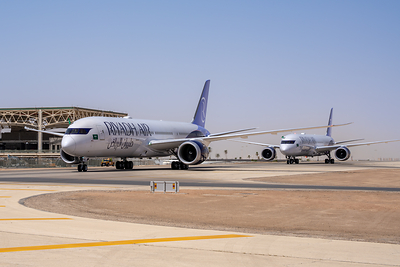
Airbus profits plunge as delivery slowdown hits Q1 earnings

7 min read

Airbus reported a sharp drop in first-quarter profit as aircraft delivery delays hit revenue and cash flow.
Airbus delivered 114 commercial aircraft in Q1 2026, down from 136 a year earlier. Revenue fell 7% to €12.7 billion, while consolidated EBIT Adjusted dropped 52% to €300 million. The commercial aircraft business was hit hardest, with EBIT Adjusted falling 84% to €81 million.
| Airbus Q1 2026 results | Q1 2026 | Q1 2025 | Change |
|---|---|---|---|
| Aircraft deliveries | 114 | 136 | -16% |
| Revenue | €12.7bn | €13.7bn | -7% |
| Adjusted EBIT | €300m | €630m | -52% |
| Commercial aircraft EBIT | €81m | €500m+ | -84% |
| Free cash flow | -€2.5bn | Positive | Down sharply |
“The Q1 results reflect the lower level of commercial aircraft deliveries,” said CEO Guillaume Faury in the company’s Q1 earnings announcement.
On the earnings call, Faury described the main issue facing the planemaker as a “desynchronization between production and delivery.”
Airbus has demand, but it has a delivery problem
| Commercial aircraft orders | Q1 2026 |
|---|---|
| Gross orders | 408 |
| Net orders | 398 |
| Total backlog | 9,037 aircraft |
Despite the weak financials, demand remains strong. Airbus booked 408 gross orders and 398 net orders in the quarter, bringing its backlog to 9,037 aircraft.
The market is still favourable. “Passenger traffic expanded, and air cargo demand showed sustained momentum,” Faury said. “We remain confident in the fundamentals of the industry.”
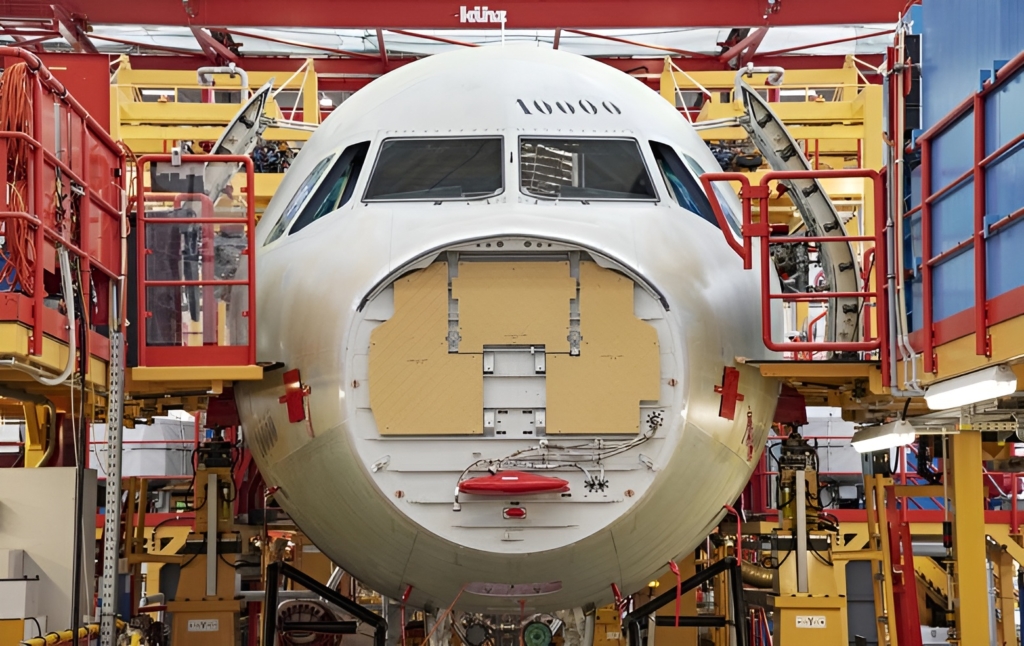
Airbus is selling aircraft but struggling to deliver them on time, resulting in a significant financial impact.
“Revenues decreased… mainly reflecting the lower commercial aircraft deliveries in the quarter,” Airbus CFO Thomas Toepfer said during the earnings call.
Boeing regains short-term delivery lead
| Manufacturer | Q1 2026 deliveries |
|---|---|
| Airbus | 114 |
| Boeing | 143 |
The weak Q1 performance also meant Airbus fell behind its main rival, Boeing, on quarterly deliveries.
Boeing delivered 143 aircraft in Q1 2026, compared with Airbus’ 114, giving the US manufacturer a rare quarterly lead.
While Airbus still holds a far larger backlog and long-term production advantage, the European planemaker’s execution issues have shifted momentum in the duopoly, at least in the short term.
Multiple bottlenecks are slowing Airbus deliveries
Faury stressed that Airbus’s factories are operating largely as planned, but a series of bottlenecks is preventing aircraft from being handed over to customers.
“Production is moving forward on plan… [but] that doesn’t translate into on-plan deliveries,” Faury said.
He attributed the disruption to several overlapping factors.
| Bottleneck | Impact |
|---|---|
| China delivery delays | ~20 aircraft delayed |
| Fuselage panel issue | Resource-intensive rework slowing deliveries |
| Supply chain (interiors, seats) | Delays to aircraft completion |
| Engines (Pratt & Whitney) | Primary constraint on A320 deliveries |
Administrative delay in China impacts 20 aircraft
One of the most immediate issues in Q1 was an administrative delay affecting deliveries to China, which delayed nearly 20 aircraft already built.
“The origin of the issue is behind us, and the corresponding deliveries have resumed,” Faury said.
The fuselage panel quality issue is resource-intensive
At the same time, Airbus is dealing with a fuselage panel quality issue affecting some A320-family aircraft. While not a structural safety concern, it requires inspection and, in some cases, replacement before delivery.
Of the panel quality issue, Faury said, “We’re progressing well, and we confirm the operational impact will be limited.”
However, he also added that fixing the panel issue is resource-intensive, which slows delivery throughput.

“The resources required to replace the panel on an aircraft are quite significant,” Faury said. “We have spread the work to the extent we can, trying to find a good balance between being as fast as we can to deliver to customers, but also managing those resources so that we can repair a number of aircraft at the same time, which is compatible with this availability of resources.”
Airbus has pushed the timeline to resolve the panel issue further into the year.
“We had said mostly by the end of Q1, and now we say mostly by the end of H1,” Faury said. “We have spread the work over two quarters.”
Supply chain friction in aircraft interiors and aerostructures
Beyond panels, Faury pointed to ongoing supply chain friction.
“We continue to have the same areas of concern… interiors, seats, aerostructures,” Faury said, later adding, “We are entitled to deliver aircraft without the seats when the seats are buyer-furnished equipment, and they are late or very late. We won’t like to be doing this. We’d like to find a solution with customers, but that’s something sometimes we have to do.”
Engines remain the biggest delivery constraint
The most structural bottleneck remains engines from Pratt & Whitney.
“Pratt and Whitney remains the key pacer of our A320 ramp-up trajectory and deliveries for this year and for next year,” Faury said.
That constraint is expected to affect both 2026 and 2027, limiting how quickly Airbus can increase deliveries. The manufacturer has previously held an inventory of completed “gliders”, which helped boost its end-of-year deliveries for 2025.
On the earnings call, Faury said, “We are not producing gliders at this moment.”

Answering a reporter’s question on whether CFM might help address the Pratt & Whitney engine shortfall, Faury said,
“We have worked with CFM to the maximum extent possible. They’ve supported us to the extent they can to offset part of the missing engines, but we have to deal with the mix of engines and the flow in the contract, so it’s something we have to leverage as much as we can.”
Aircraft production targets are stable
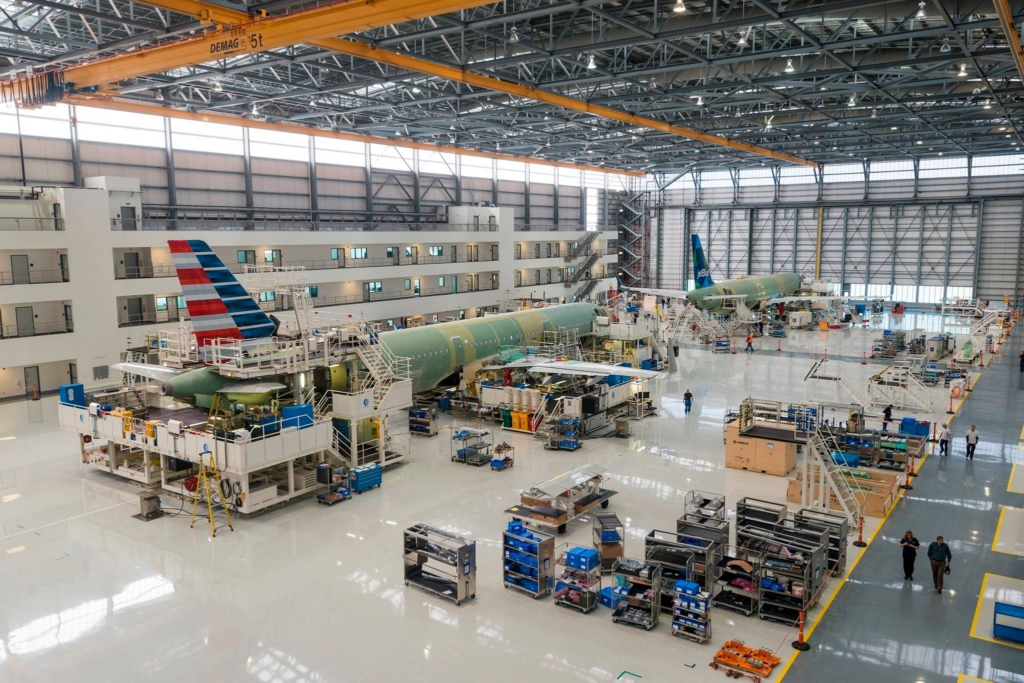
Of narrowbody production targets, Faury said, “We expect to reach a rate of between 70 and 75 aircraft a month by the end of next year, 2027 and stabilising at a rate of 75 thereafter.”
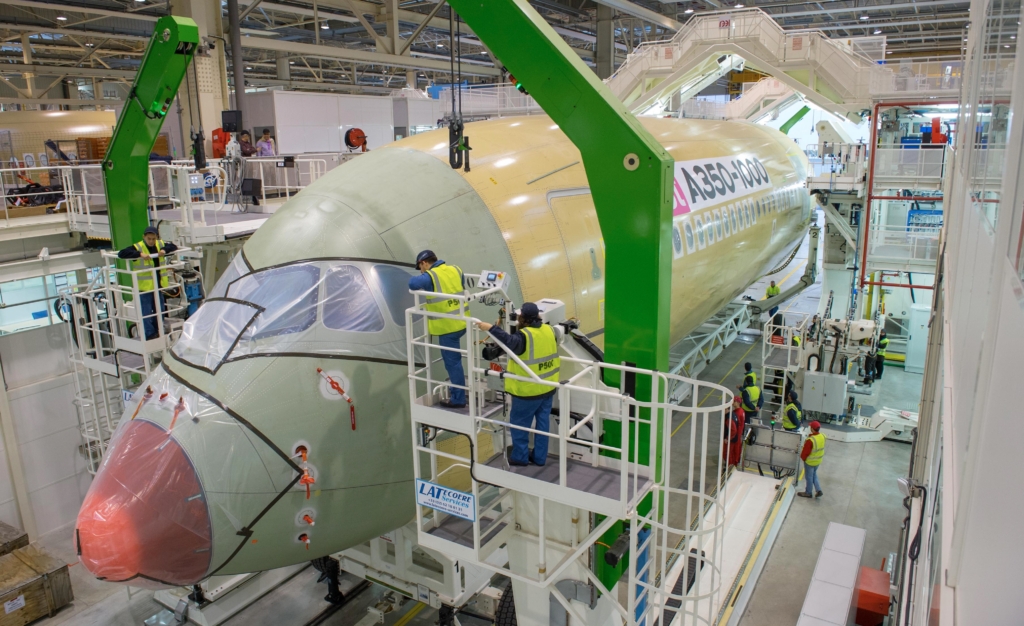
Regarding widebody production targets, Faury said, “On the A330, no change. We target to reach the rate of five in 2029 to meet customer demand. And on the A350, no change either. We continue to target the rate of 12 in 2028.”
Faury added a remark on the new A350 freighter, saying: “The ground testing program is on track, paving the way for the first test flight later this year.”
Airbus cash flow hit by inventory buildup
Lower deliveries also pushed Airbus into negative free cash flow, at –€2.5 billion, which Toepfer attributed primarily to inventory.
“The low level of commercial deliveries… leads to a further inventory increase,” Toepfer said.
He added that he expects a reversal in the second quarter.
“In Q2… cash flow should be positive… because we will release some of the inventory that we’ve built in Q1,” Toepfer said.
Defence helps offset the decline in commercial aircraft
| Airbus Defence and Space results | Q1 2026 | Change |
|---|---|---|
| Revenue | €2.8bn | Up 7% |
| Adjusted EBIT | €130m | Up 69% |
Airbus Defence and Space provided some relief, with revenue up 7% to €2.8 billion and Adjusted EBIT up 69% to €130 million.
“We finished Q1 with a very strong order intake… reflecting the need from our customers for military aircraft and services,” Faury said.
Airbus guidance unchanged as pressure builds
| 2026 delivery target | Delivered in Q1 | Still required |
|---|---|---|
| ~870 aircraft | 114 | ~756 |
Airbus is maintaining its full-year targets of around 870 aircraft deliveries, €7.5 billion in Adjusted EBIT, and €4.5 billion in free cash flow.
But after a weak first quarter, the company must accelerate deliveries significantly through the rest of the year.
“What has not been delivered in Q1 will be delivered in Q2 on top of the Q2 deliveries,” Faury said.
He summed up Airbus’ immediate priorities by emphatically repeating two words: “Ramp up, ramp up, ramp up.”
“We remain focused on ramping up across all our programs,” Faury said.
Airbus’ bottom line for Q1
Airbus has strong demand, a record backlog, and production ramping up. But panel rework, China-related delivery delays, engine shortages and supply chain friction have created a bottleneck at the point that matters most to the manufacturer’s financials: delivery.
That Boeing briefly pulled ahead on deliveries shows the significant challenge Airbus faced during the first quarter of 2026. Until Airbus can clear delivery bottlenecks, its commercial profits will remain under pressure.
Featured Image: Airbus