


AC-130J Ghostrider could launch one-way attack drones under new SOCOM plan

8 min read

The AC-130J Ghostrider could soon gain an entirely new class of weapon, with the US Special Operations Command (USSOCOM) looking to equip the aircraft with tube-launched loitering munitions capable of locating and striking targets far beyond the reach of the gunship’s traditional side-firing weapons.
The requirement, outlined in a recently issued Request for Information (RFI), reflects a broader shift in how crewed aircraft are expected to operate in future conflicts.
Recent programmes have explored using autonomous unmanned aircraft to detect, track and relay target information back to fighter aircraft. USSOCOM is now examining how similar autonomous systems could enable one of the world’s most heavily armed military aircraft to deliver precision strikes at significantly greater distances without immediately committing the aircraft itself to the engagement.
If realised, the concept would represent another significant evolution for an aircraft whose combat history stretches back more than half a century.
Rather than relying solely on cannons, guided bombs and missiles, the Ghostrider could also deploy autonomous one-way attack drones able to search designated areas before selecting and engaging targets.
Extending the Ghostrider’s striking reach
The RFI is not a procurement programme but an early market survey intended to understand industry’s ability to design, manufacture and integrate what USSOCOM describes as an Air Loitering Munition (ALM) capable of providing stand-off precision strike beyond its existing portfolio of weapons.
The command is seeking innovative concepts rather than mature production proposals, with responses expected to help shape a future acquisition strategy.
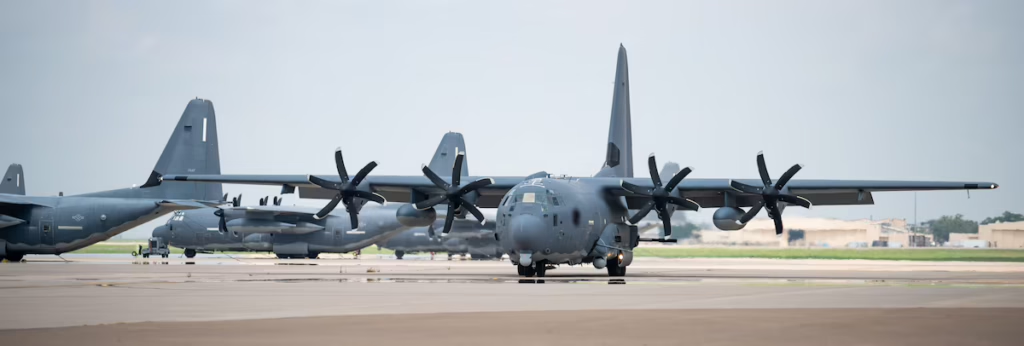
The capability being sought is considerably more sophisticated than a conventional expendable drone.
USSOCOM wants a munition that can be released from Special Operations fixed-wing aircraft using Common Launch Tubes (CLTs), existing lugged weapon stations or other release mechanisms, although launch tube compatibility is identified as the preferred option.
The weapon must weigh no more than 95lb and, if configured for CLT launch, fit within a 5.9-inch diameter tube measuring no more than 42 inches in length.
The operational requirements are equally demanding.
According to the RFI, the munition should travel at least 75 nautical miles from its launch point before reaching its assigned loiter area, operating from aircraft flying between 5,000ft and 30,000ft.
Once on station, it should remain airborne for a minimum of 40 minutes, loitering between 500ft and 3,000ft above ground level before conducting its attack. Cruise speed is expected to range between 50 and 100 knots, while the terminal attack profile should exceed 100 knots.
Rather than depending on continuous operator control, USSOCOM is seeking systems capable of functioning in contested and non-contested environments with integrated automatic target recognition, limited radio-frequency emissions and intra-missile communications.
The proposed munition must also be capable of integrating with the government’s mission autonomy software through machine-to-machine interfaces or battle management systems, reflecting the growing emphasis on autonomous operations across US defence programmes.
The command has also made clear that affordability will play an important role.
Rather than requesting pricing for a handful of demonstrators, industry has been asked to provide rough-order-of-magnitude cost estimates based on production runs of 500, 1,000 and 3,000 weapons, indicating that scalability is already being considered as part of the concept.
Building on an already formidable aircraft
The proposal would expand the role of an aircraft that already occupies a unique place in military aviation.
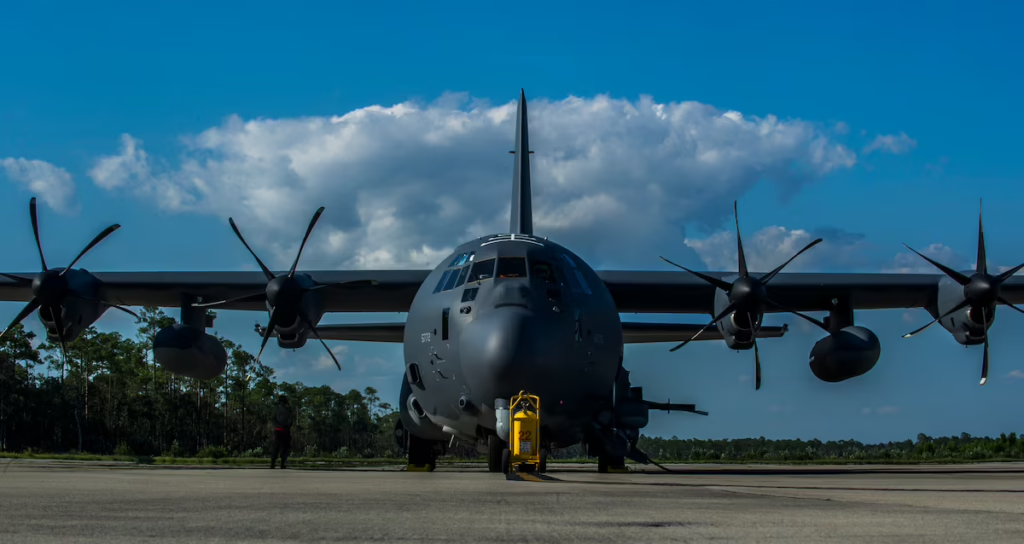
The AC-130J is the fifth-generation successor to the AC-130U and AC-130W gunships, continuing a lineage that began during the Vietnam War.
Early AC-130s became synonymous with close air support and interdiction missions, destroying thousands of enemy vehicles while providing sustained fire support to troops on the ground.
Since then, successive generations have operated across South America, Africa, Europe and the Middle East, supporting both special operations and conventional forces.
Today’s Ghostrider remains one of the most heavily armed aircraft in operational service.
Built around the C-130J airframe, it is designed primarily for close air support, armed reconnaissance and air interdiction, while also undertaking convoy escort, strike coordination, overwatch and point air defence missions.
Unlike fast jets that typically deliver weapons before departing the target area, the AC-130J is designed to remain overhead, providing persistent support to forces operating on the ground.
Its Precision Strike Package combines advanced sensors, mission management systems and precision-guided weapons into a single platform. The aircraft features a fully digital two-pilot cockpit, integrated navigation systems, a mission management console, a robust communications suite, dual electro-optical/infrared sensors, advanced fire-control equipment and trainable 30mm and 105mm cannons.
The aircraft’s existing arsenal already extends well beyond those iconic side-firing guns.
Its stand-off precision weapons include GBU-39 Small Diameter Bombs, GBU-69 Small Glide Munitions, AGM-114 Hellfire missiles and AGM-176 Griffin missiles.
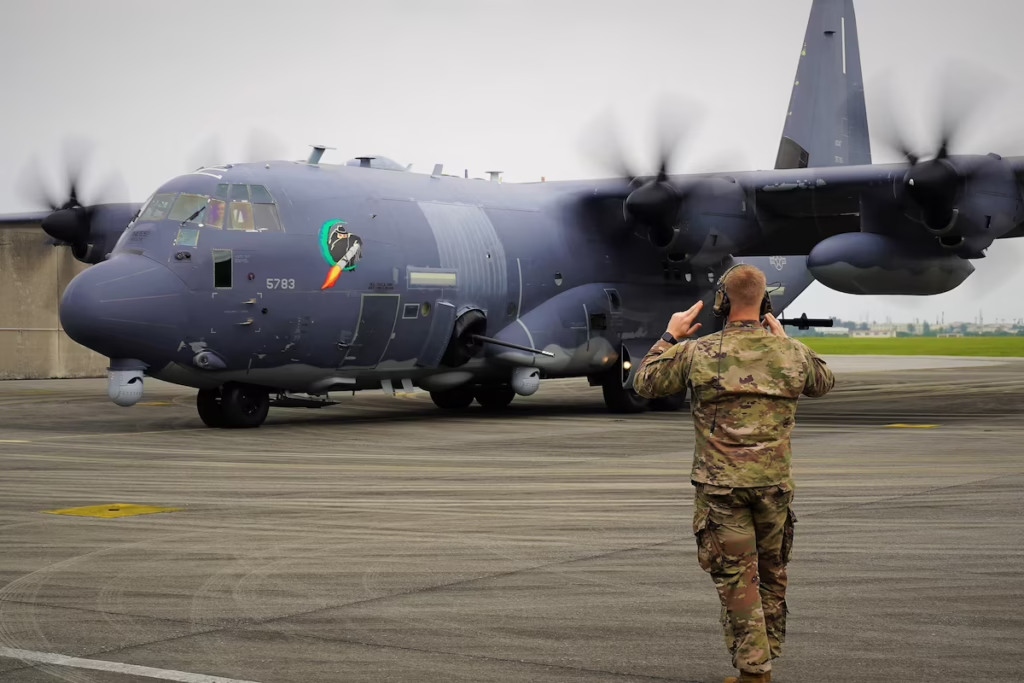
A series of launch tubes integrated into the aircraft also enables precision-guided munitions to be deployed from the rear of the aircraft, providing an existing foundation for the type of tube-launched capability now being explored under the ALM requirement.
From gunship to drone carrier
If the programme moves forward, the AC-130J would become the latest military aircraft to extend its combat reach through autonomous systems rather than larger conventional weapons.
Over the past two years, the US military has accelerated efforts to integrate unmanned systems with crewed aircraft. Early work largely centred on drones acting as forward sensors, locating and tracking targets before passing information back to combat aircraft.
The new Air Loitering Munition requirement takes that concept a step further by giving the Ghostrider the ability to launch autonomous weapons that can independently search for and engage targets once released.
The distinction is significant.
Instead of flying closer to a target area to employ its guns or precision-guided munitions, the aircraft could remain at greater stand-off distances while its loitering munitions continue towards the objective.
Operators would gain additional time to identify targets, assess the tactical situation and, if required, prosecute the attack after the aircraft has already moved away from the immediate threat area.
The concept also mirrors wider developments across allied air forces.
The US Department of War has already demonstrated its Rapid Dragon capability, using palletised launch systems that enable cargo aircraft to deploy cruise missiles through standard aerial delivery procedures. Rather than modifying aircraft permanently, the system allows weapons to be rolled on and off as mission requirements change.
Europe is pursuing a parallel approach.
Airbus is developing concepts that would allow the A400M Atlas to support collaborative combat operations by deploying and controlling autonomous systems alongside its traditional airlift missions. Embraer has also announced plans to study the integration of Anduril’s pallet-launched Barracuda-500M stand-off weapon on the C-390 Millennium, highlighting growing interest in expanding the role of transport aircraft beyond logistics and tactical airlift.
While each programme addresses different operational requirements, they all point towards the same trend: using existing aircraft as flexible launch platforms for autonomous systems without fundamentally changing their primary missions.
Designed for special operations
The AC-130J is particularly well suited to that approach because of its existing mission profile.
Powered by four Rolls-Royce AE2100D3 turboprop engines, the aircraft has a maximum take-off weight of 164,000lb, a range of around 3,000 miles, extendable through aerial refuelling, and is operated by a crew of eight comprising two pilots, two combat systems officers and four special mission aviators.
Its ability to remain on station for extended periods has long made it one of the most valuable aircraft in the US Air Force Special Operations Command inventory.
The Ghostrider was officially named in 2012 and completed developmental testing in 2015 before reaching initial operational capability in 2017.
The first operational squadron, the 73rd Special Operations Squadron, was activated at Hurlburt Field, Florida, in February 2018. The type entered operational service in July 2019, while the final production aircraft was delivered in November 2022.
By the end of fiscal year 2024, the US Air Force inventory stood at 37 AC-130J Ghostriders, each valued at approximately $165 million.
Throughout its development, the aircraft has been designed to support expeditionary operations from austere locations, combining precision strike capability with advanced communications, surveillance sensors and digital mission management systems. Those characteristics also make it a suitable candidate for integrating increasingly autonomous weapons and mission systems.
Industry is being asked for more than a drone
The RFI shows that USSOCOM is not simply seeking another loitering munition.
It is asking industry to propose a complete capability that combines autonomy, networking, precision strike and affordability into a single package.
Among the key requirements are operation in GPS-denied environments, automatic target recognition, encrypted communications, collaborative autonomy and compatibility with government mission-management software. Respondents are also being asked to identify manufacturing capacity, technology maturity, development timelines and opportunities to reduce costs through scalable production.
USSOCOM has indicated that it expects technologies to be sufficiently mature for flight demonstrations aboard the AC-130J or other special operations aircraft before any future acquisition programme is launched.
That approach reflects the command’s emphasis on rapidly integrating technologies that can transition from demonstration to operational use without lengthy development cycles.
For the Ghostrider, the proposed capability would represent another chapter in the evolution of an aircraft that has continuously adapted to changing operational requirements since its origins in the Vietnam War.
Its side-firing cannons are likely to remain central to its mission for years to come. But if USSOCOM’s plans progress beyond the current market survey, future Ghostrider crews could also launch autonomous loitering munitions capable of travelling dozens of miles ahead of the aircraft, searching for targets and striking them with minimal operator input.


