Rapid Dragon: Inside the US Air Force plan to launch cruise missiles from cargo aircraft

8 min read
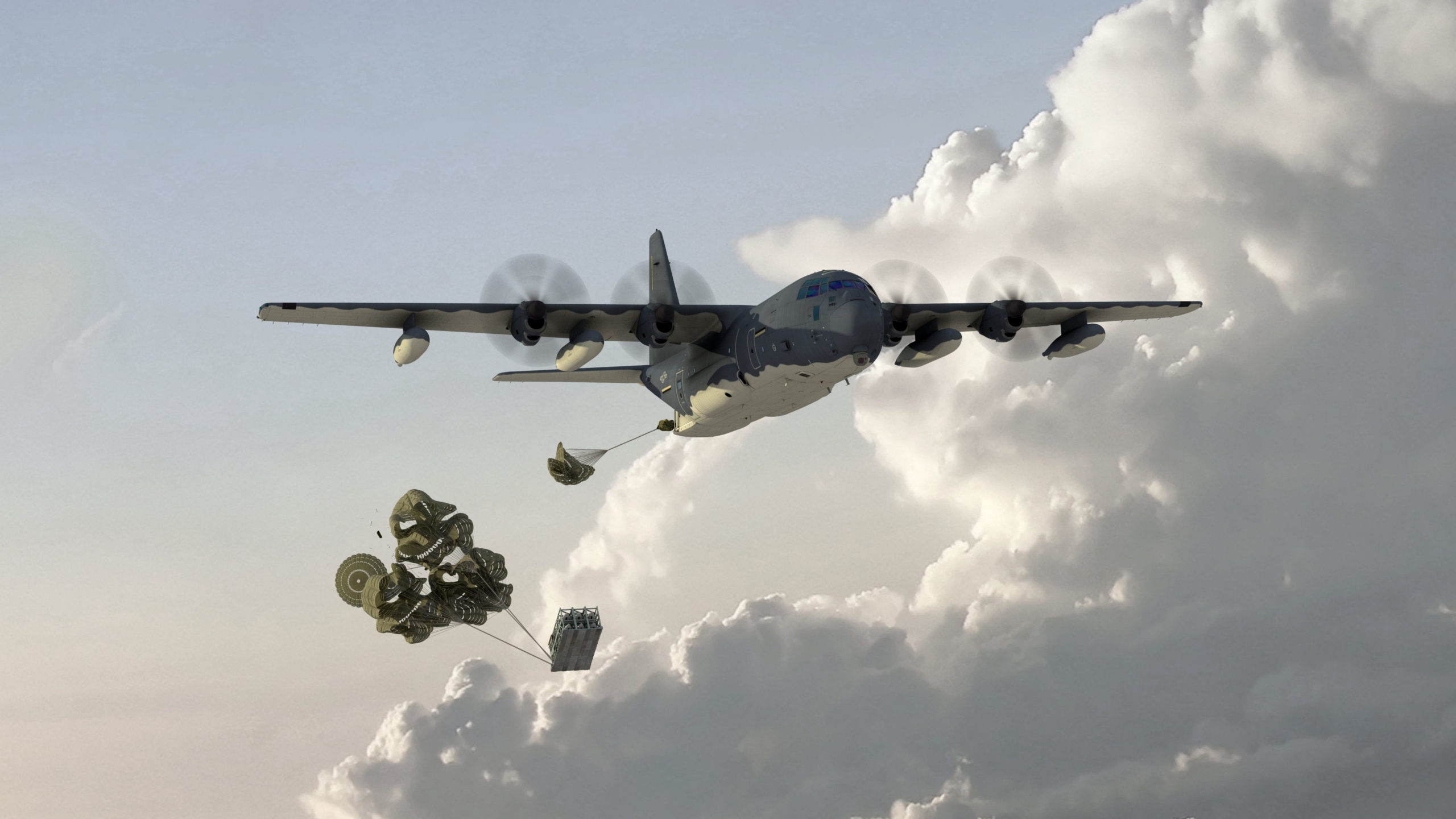
The US Air Force is moving ahead with plans to arm cargo aircraft with palletised cruise missiles under a programme now expected to enter service by 2027, marking a major shift in how the service could deliver long-range strike capability in future conflicts.
What began as an Air Force Research Laboratory (AFRL) experiment known as Rapid Dragon has now transitioned into a formal programme of record called Dragon Cart.
The system is designed to allow aircraft such as the C-17 Globemaster III and C-130 Hercules family to deploy large numbers of cruise missiles directly from their cargo bays using standard airdrop procedures.
How the Rapid Dragon system launches cruise missiles from cargo aircraft
So the palletised munitions concept essentially turns a military transport aircraft into a temporary missile launcher without permanently modifying the aircraft.
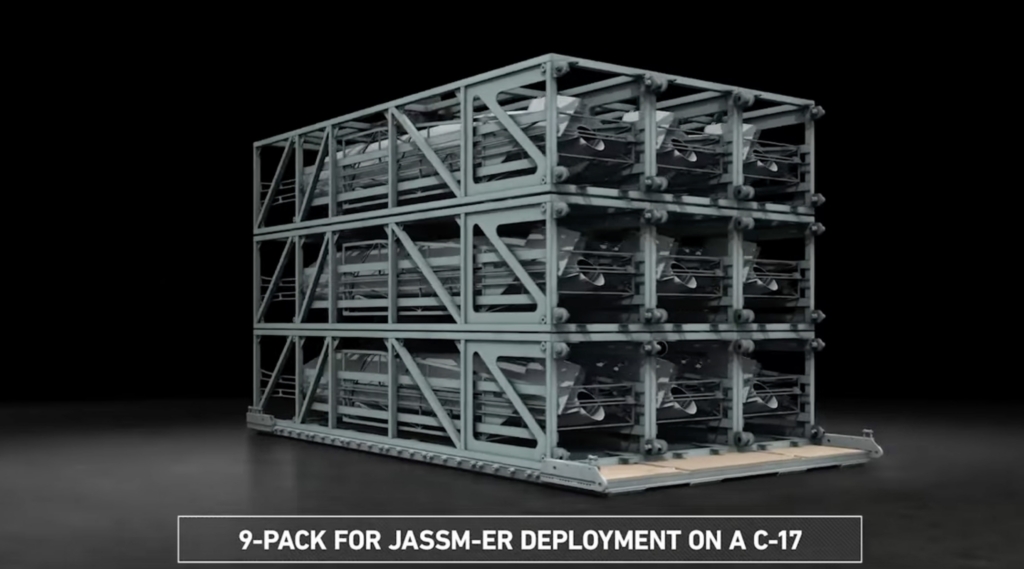
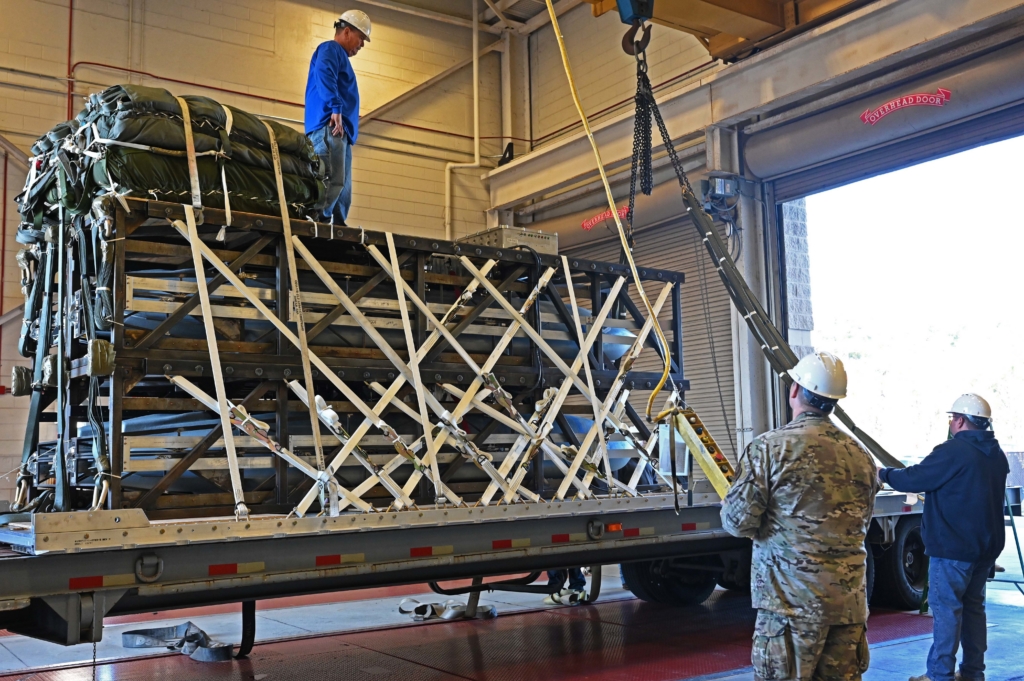
In Rapid Dragon, cruise missiles are packed inside a specially designed launch module or container. That container is then mounted on a standard cargo pallet, the same type normally used to transport military supplies or vehicles inside cargo aircraft such as the C-130 or C-17.
The pallet is rolled into the aircraft through the rear cargo ramp just like ordinary freight.
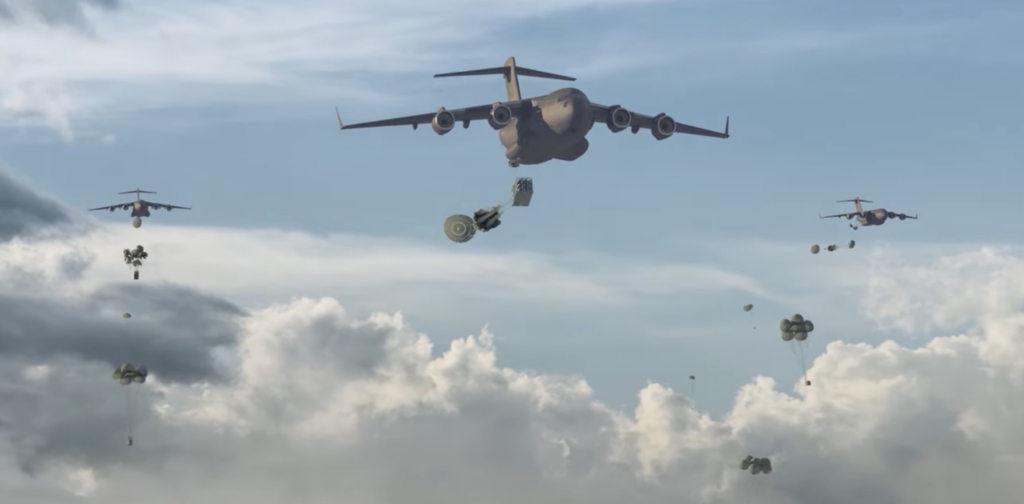
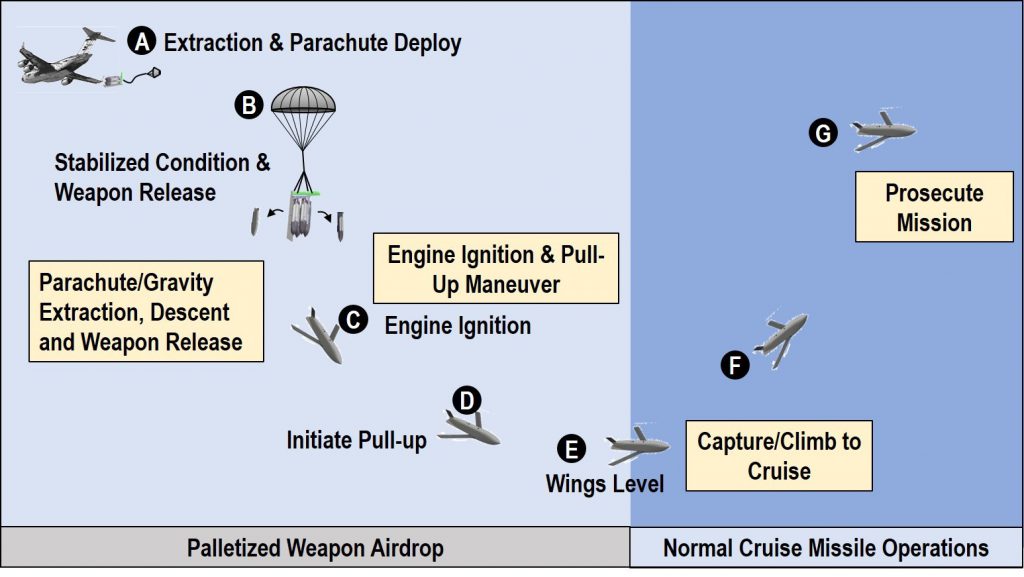
Once the aircraft reaches the launch area, the entire pallet is pushed out of the rear ramp using standard airdrop procedures. A parachute attached to the pallet stabilises it after release.
After the pallet descends and reaches the correct position, the missiles are released one by one from the container. As each missile drops clear, its wings unfold, the engine ignites, and it flies towards its target independently.
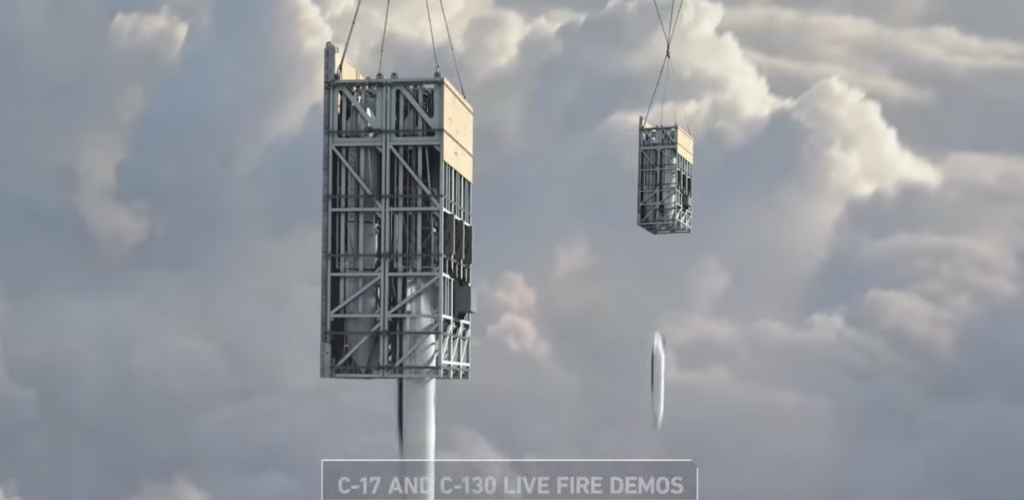
The key advantage is that the aircraft itself does not need to be redesigned into a bomber.
Why the Air Force wants cargo aircraft to carry cruise missiles
The Air Force believes the system could dramatically increase the number of launch platforms available during a conflict without requiring additional bombers or fighter aircraft.
“This program provides the operational ambiguity, adversary deterrence, and additional command options to maximise operational effects,” said JiaJia Lee, Dragon Cart programme manager, in an Air Force Life Cycle Management Center release.
“It gives us the option to transform mobility aircraft into powerful strike platforms, unlocking capabilities we wouldn’t normally have in how we employ our airlift fleet.”
How Rapid Dragon evolved from experiment to operational programme
Rapid Dragon began in late 2019 as an AFRL-led experimentation effort exploring whether long-range stand-off missiles could be deployed from existing cargo aircraft without structural modifications.
The programme brought together nearly 30 organisations across the Department of Defense, Air Force major commands, operational units and industry partners.
Within two years, the programme had already achieved powered flight and live-fire demonstrations using an MC-130J Commando II special operations aircraft.
One of the most closely watched tests took place in December 2021 at Eglin Air Force Base in Florida, when an MC-130J successfully deployed a four-cell Rapid Dragon pallet containing a live AGM-158B Joint Air-to-Surface Standoff Missile-Extended Range (JASSM-ER).
Footage released by the Air Force showed the pallet extraction sequence in detail. After leaving the aircraft under parachute, the deployment box stabilised before sequentially releasing the missiles.
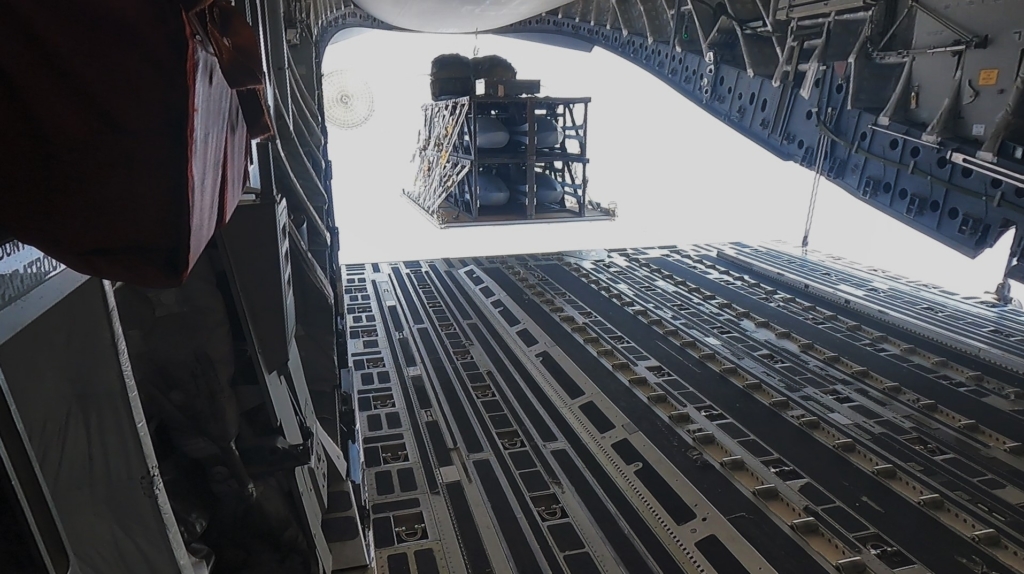
The JASSM-ER then unfolded its wings, ignited its engine and transitioned into powered flight.
“Rapid Dragon is a fantastic example of the speed at which technologists and warfighters can work,” said AFRL commander Maj Gen Heather Pringle after the live-fire demonstration. “The design, development, prototyping and experimentation of new capabilities can get to the field on operationally relevant timelines.”
The programme later expanded into operational exercises in Europe. In November 2022, an MC-130J from the 352nd Special Operations Wing deployed a Rapid Dragon pallet over the Norwegian Sea during the ATREUS 22 exercise near the Arctic Circle.
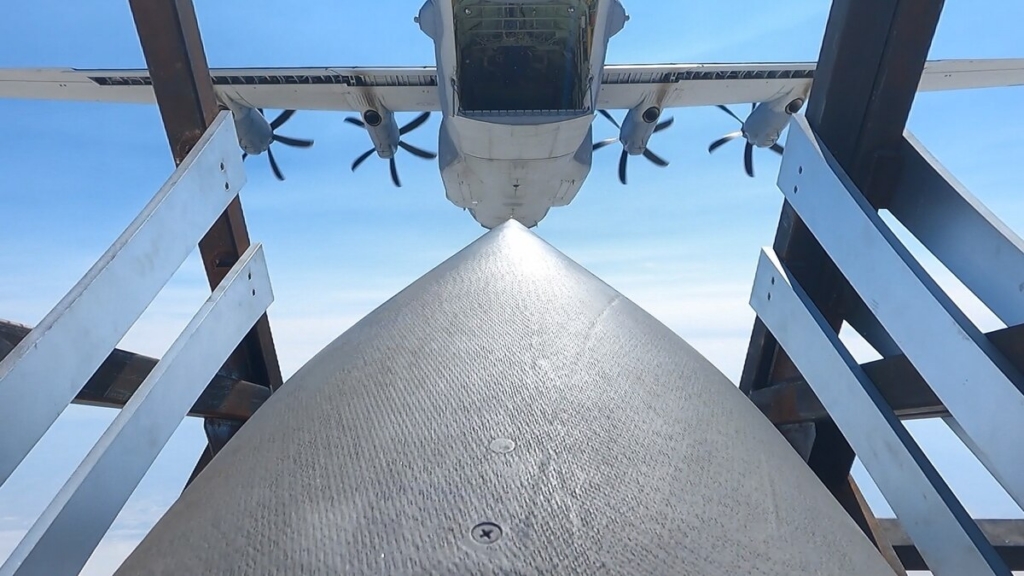
The test marked the first operational employment of the system within the US European Command theatre. The exercise involved NATO allies, including Norway, Poland, Romania and the United Kingdom, alongside US Special Operations and Air Force units.
Cargo aircraft provide affordable mass over new bombers
The attraction of Rapid Dragon lies less in the missile itself and more in the launch concept.
Traditional long-range strike missions depend heavily on bombers and fighter aircraft. Dragon Cart instead uses existing airlift fleets as missile carriers, potentially multiplying the number of available launch platforms during a major conflict.
The Air Force says the approach could “saturate the airspace with multiple weapons and effects, complicate adversary targeting solutions, help open access for critical target prosecution, and deplete an adversary’s air defence munitions stockpile”.
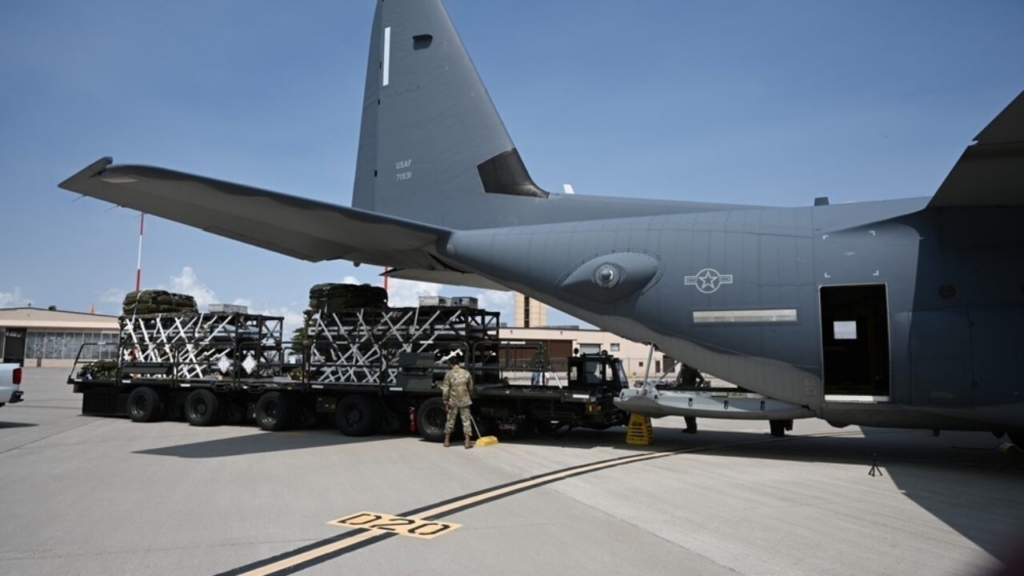
Operationally, the concept also frees up bombers and fighters for other missions. Any compatible cargo aircraft theoretically becomes a potential missile launcher.
Current configurations under development include six-weapon loads for the C-130 and nine-weapon configurations for the larger C-17.
The Air Force has also examined broader uses beyond cruise missile attacks.
AFRL documents note the same palletised architecture could eventually support sea-mining missions, ISR payloads, cargo delivery, humanitarian assistance or non-kinetic effects using the same deployment framework.
Dragon Cart becomes part of the USAF’s affordable cruise missile strategy
The transition from Rapid Dragon to Dragon Cart also comes alongside a much larger USAF push towards affordable long-range munitions.
Budget documents released earlier this year showed the Air Force intends to spend roughly $12.6 billion over the next five years to procure nearly 28,000 weapons under its Family of Affordable Mass Munitions (FAMM) programme.
Dragon Cart is expected to become one of the major delivery methods for those weapons.
The Air Force is increasingly looking for lower-cost cruise missiles that can be produced at scale and launched from multiple aircraft types.
An April 2026 Request for Information issued by the Air Force Life Cycle Management Center sought industry proposals for cruise missiles capable of ranges exceeding 1,200 miles under the new FAMM-Beyond Adversary Reach (BAR) effort.
The service wants those weapons capable of both conventional fighter carriage and palletised deployment from cargo aircraft.
The requirement also called for potential production rates between 1,000 and 2,000 missiles annually for both US and foreign customers.
Among the weapons already linked to the effort are Zone 5 Technologies’ Rusty Dagger and CoAspire’s Rapidly Adaptable Affordable Cruise Missile (RAACM).
Other companies are pursuing similar concepts, including Leidos with the AGM-190A Black Arrow and Lockheed Martin with its Common Multi-Mission Truck family.
Cargo aircraft could soon launch cruise missiles for the US Air Force
One reason Dragon Cart has moved rapidly towards operational status is its reliance on existing infrastructure.
The Air Force says the programme benefits from government ownership of the system architecture and engineering data, allowing faster modifications and integration of future weapons.
“Dragon Cart is literally the ‘born digital’ dream come true,” said Kent Mueller, the programme’s systems engineering manager and architect. “Because we own the engineering, if a new payload needs a launch module that is slightly longer, we just model it, do the load path analysis, and send that model to our production vendors.”
Program officials expect prototype contracts to be awarded later this month, with operational fielding targeted for 2027.
If fielded at scale, Dragon Cart would give the Air Force something it has never previously possessed in large numbers, that is the ability to rapidly convert transport aircraft into stand-off missile carriers capable of launching massed cruise missile attacks from outside heavily defended airspace.
Arms control experts warn cargo aircraft cruise missiles could reshape deterrence
The growing interest around Rapid Dragon is also drawing attention from arms control and non-proliferation analysts, particularly over the long-term implications of turning cargo aircraft into stand-off strike platforms.
In an August 4, 2023 analysis published by the Bulletin of the Atomic Scientists, George M. Moore, a scientist-in-residence at the James Martin Center for Nonproliferation Studies (CNS) at the Middlebury Institute of International Studies at Monterey (MIIS), argued that the system could eventually affect both conventional military balances and future nuclear arms control negotiations.
Moore, who had earlier served as a senior analyst in the Office of Nuclear Security at the International Atomic Energy Agency (IAEA), added that Rapid Dragon effectively “converts cargo aircraft into weapons carriers” and since “cargo aircraft have far longer ranges than many of the current attack aircraft of most adversary states; a system like Rapid Dragon may result in significantly expanding the threat envelope posed by a hostile state.”
Also, “should the cargo aircraft fly at very low altitudes, detection and the ability to engage them may not be easy,” he noted.

He warned that while the programme is currently centred on conventional weapons, the technology itself could create wider strategic complications in the future.
“The genie is now out of the bottle and will never return,” Moore wrote while discussing the likelihood of other technologically advanced states eventually developing similar systems.
Moore also noted that existing nuclear-capable cruise missiles such as the AGM-86 Air Launched Cruise Missile could theoretically be integrated into palletised deployment concepts, potentially turning transport aircraft into nuclear delivery platforms.
According to Moore, that possibility could complicate future arms limitation negotiations because cargo aircraft are widely operated across the world and are far more difficult to regulate than dedicated bomber fleets.
He further argued that widespread adoption of Rapid Dragon-like systems could alter regional military balances by significantly extending the strike reach of conventional air forces using standard transport aircraft.
“Rapid Dragon will be a game-changing concept for conventional and, possibly, nuclear weapons use,” Moore wrote, adding that the development would require close monitoring as rival states inevitably pursue comparable capabilities.
Featured image: AFRL