


Repeated warnings and a go-around attempt: New details emerge in fatal Amazon Air 767 overrun

6 min read
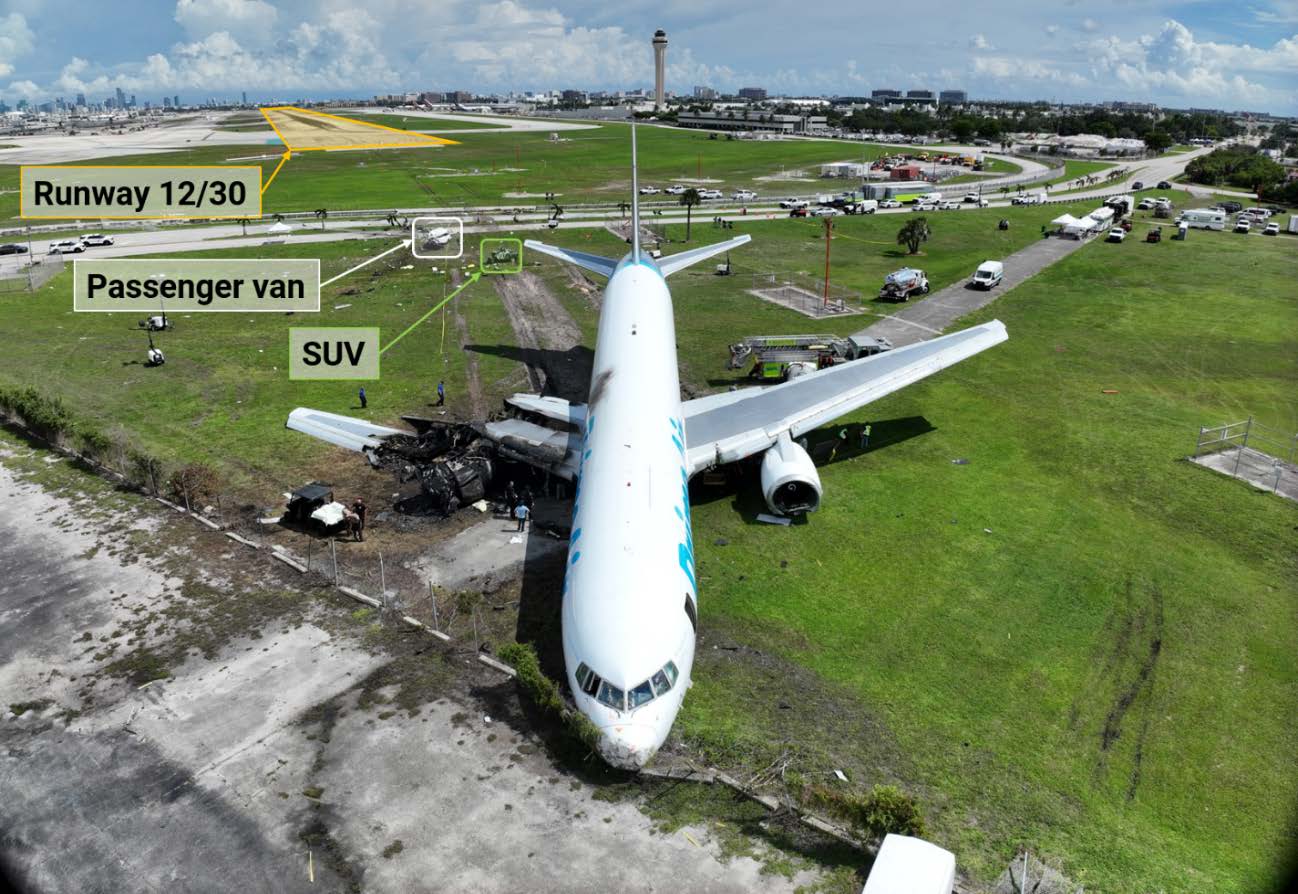
The Boeing 767 involved in last month’s fatal Amazon Air overrun in Miami crossed the threshold at 177 knots and touched down about 3,750ft beyond it, US investigators have found.
The National Transportation Safety Board’s preliminary report into the 6 September accident provides the most detailed account yet of the final minutes of 21 Air Flight 7598 on 6 September.
Investigators found that the first officer repeatedly cautioned that the aircraft was too fast during the approach. The freighter left the end of Runway 30 at 113 knots after the crew attempted a go-around late in the landing roll.
The NTSB has not determined the probable cause of the accident. Its findings remain preliminary and the investigation is continuing.
Flight 7598 was operating from San Juan, Puerto Rico, to Miami on behalf of Amazon.com Services when it overran Runway 30 at about 13:53 local time. The aircraft struck two vehicles after leaving the airport, killing five people and seriously injuring three. The captain and first officer sustained minor injuries.
Crew repeatedly discussed excessive speed
The cockpit voice recorder shows the first officer warned that the aircraft was too fast about one minute and 42 seconds before the recording ended, after the captain called for the flaps to be set to 20 degrees.
The NTSB said the first officer made further comments about the aircraft’s excessive speed for the remainder of the recording and there was not a consistent verbal response to those comments.
The autopilot was disconnected about 19 seconds later. The aircraft then generated two “sink rate” alerts, followed by a “too low terrain” warning that sounded four times. Another “too low terrain” warning followed nine seconds later.
The captain called for flaps 30 about 41 seconds before the recording ended. Sounds consistent with touchdown were recorded 10 seconds later. Fifteen seconds before the recording ended, the captain called for a go-around.
Flight data shows the aircraft was about 105ft above ground level and travelling at a groundspeed of 177 knots as it crossed the displaced threshold of Runway 30.
Initial tyre marks from the main landing gear were found about 3,750ft and 3,820ft from the threshold. The aircraft was travelling at about 160 knots at the first tyre contact, around 13 seconds after crossing the threshold.
The NTSB said the landing gear weight-on-wheels indication switched intermittently between air and ground for about seven seconds. It remained on the ground when about 2,730ft of runway remained.
Go-around thrust selected with 930ft remaining
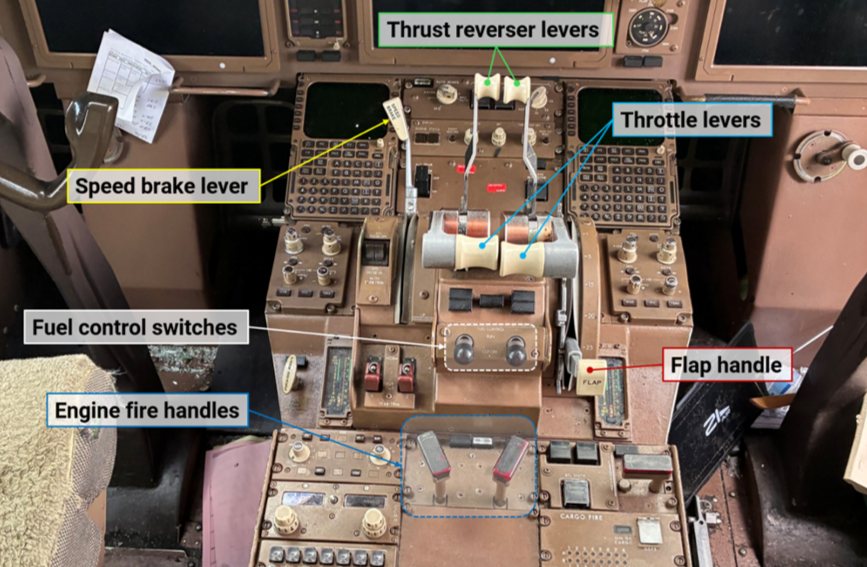
Flight recorder data showed the speed brakes remained stowed and the thrust reversers did not deploy during the landing or subsequent rollout.
The pilots manually applied the wheel brakes at 146 knots. About eight seconds later, at 120 knots, the brakes were released and the throttles were increased to values consistent with go-around thrust. At that point, about 930ft of runway remained.
Four seconds later, with about 415ft of runway left, the throttles were returned to idle and the brakes reapplied. The aircraft was travelling at 117 knots.
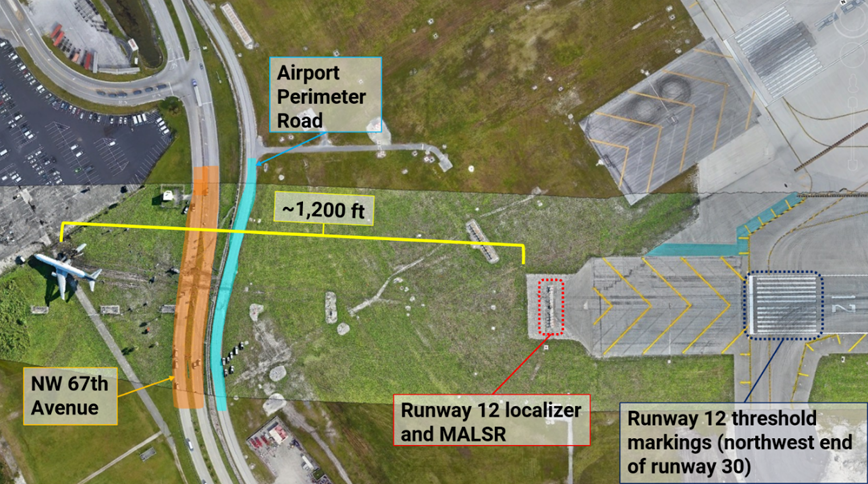
It crossed the end of Runway 30 at 113 knots and struck the runway localiser and approach lighting system at about 100 knots before leaving the paved surface and travelling onto the grass.
The NTSB said the aircraft travelled about 1,200ft beyond the paved surface before coming to rest. Its final recorded groundspeed was 65 knots.
Investigators will use the flight recorder and other engineering data for an aircraft performance study to refine the sequence of events and analyse the physical state of the 767 during its approach and landing.
Tower did not give crew wind information
The preliminary report also provides new information about conditions at Miami and communications between the crew and air traffic control.
At 13:53, around the time of the accident, Miami’s automated weather station reported winds from 190 degrees at 17 knots, gusting to 26 knots. Visibility was at least 10 statute miles, with thunderstorms in the area, scattered cumulonimbus clouds at 2,000ft and a broken ceiling at 4,800ft.
The NTSB said the local controller cleared Flight 7598 to land but did not provide wind information.
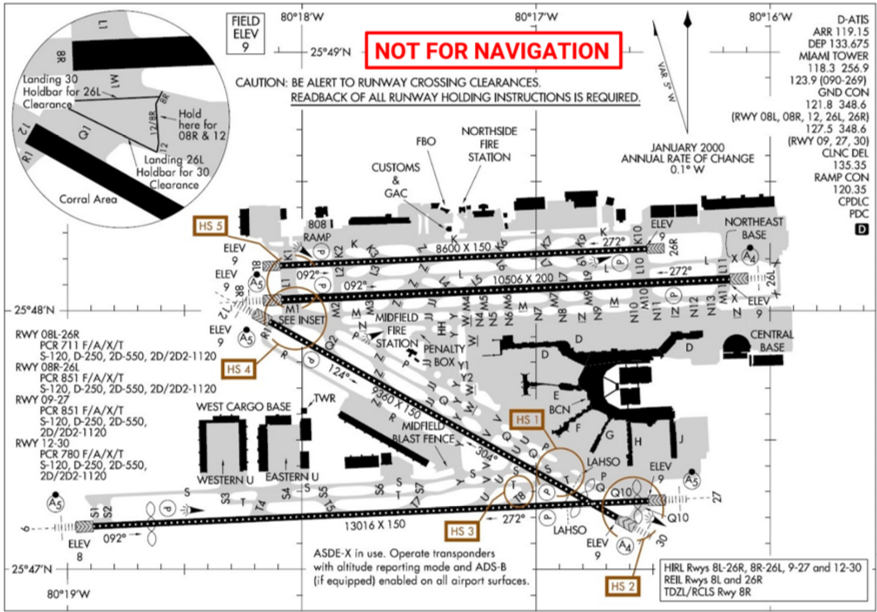
FAA air traffic control procedures require both wind direction and velocity to be stated when authorising use of a runway when a tailwind component exists, according to the report.
About four minutes before clearing Flight 7598 to land, the controller had told another aircraft that winds were from 190 degrees at 19 knots, gusting to 22 knots. Flight 7598 was not on the controller’s frequency when that advisory was issued.
Aircraft struck two vehicles beyond airport
After leaving the runway, the 767 hit a Ford Econoline passenger van travelling on an airport perimeter road. Five of the seven people in the van were killed and the other two were seriously injured.
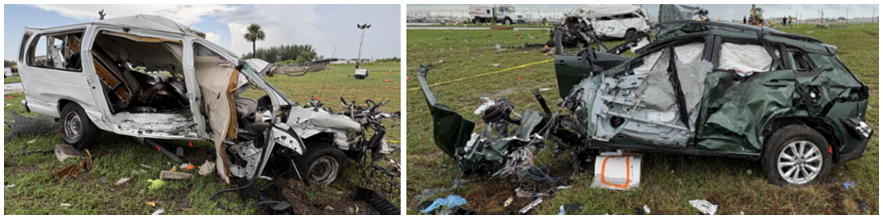
The aircraft then went through the airport perimeter fence and crossed NW 67th Avenue, where it struck a Toyota Corolla Cross. Its sole occupant was seriously injured.
The freighter finally stopped on grass about 1,200ft beyond the paved surface. The captain escaped through the left forward door and the first officer through the right cockpit window.
A post-crash fire damaged the right wing. Investigators found the nose landing gear displaced backwards beneath the fuselage, while both main landing gear assemblies remained extended and locked. Inspection of the brake wear pins found remaining service life on all eight main landing gear wheels.
The right engine suffered thermal damage and was partly separated from its pylon. Investigators found the speed brake lever in the down, or stowed, position. The thrust reverser levers were in the first detent position.
Pilots were flying together for first time
The accident flight was the third flight of the day for the aircraft and the second for the crew.
The captain and first officer had reported for duty at about 05:30 that morning. They first flew the same 767 from Miami to San Juan as Flight 7521, departing at about 06:35 and arriving at 08:58.
That was the first time the two pilots had flown together. On the outbound sector the first officer was the pilot flying and the captain was monitoring. For the return Flight 7598, the captain was flying and the first officer was monitoring.
The captain had about 7,267 hours of total flight experience, including 150 hours on the Boeing 767. He had received his 767 type rating in May 2026 and joined 21 Air the previous month. He also had about 2,700 hours on the Boeing 737.
The first officer had about 2,800 total flight hours, including 800 on the 767. He joined 21 Air in February 2025 and received his 767 type rating two months later.
Amazon paused 21 Air operations after crash
The aircraft, registration N1997A, was manufactured in June 1994 as a passenger jet and converted into a freighter in 2016.
It was powered by GE CF6 engines and had accumulated about 110,077 flight hours and 24,505 cycles. At the time of the accident, 21 Air operated 22 Boeing 757 and 767 aircraft.
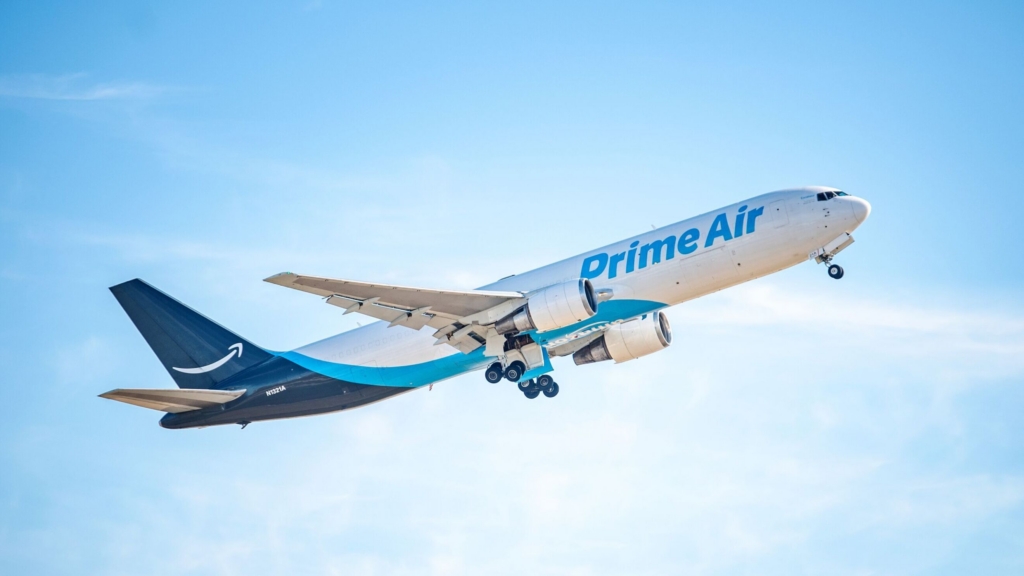
Amazon subsequently paused operations with 21 Air while the investigation continued. The company did not say how long the suspension would remain in place. Amazon Air uses independent carriers to operate its flights and provide crews.
The NTSB investigation includes specialist groups examining the aircraft’s structures, systems and engines, as well as airline operations, human performance, air traffic control, airports, survival factors, hazardous materials and the cockpit voice recorder.
The FAA, Boeing, GE Aerospace, 21 Air, Miami-Dade Aviation Department, the National Air Traffic Controllers Association and the 21 Air Pilots Association are parties to the investigation.
The NTSB stressed that the preliminary report is subject to change as the investigation continues. It has not yet identified a probable cause.
Sign up for our newsletter and get our latest content in your inbox.


More from

October 2, 20263 min read


