


B-2 vs B-21: How America’s stealth bombers compare

4 min read
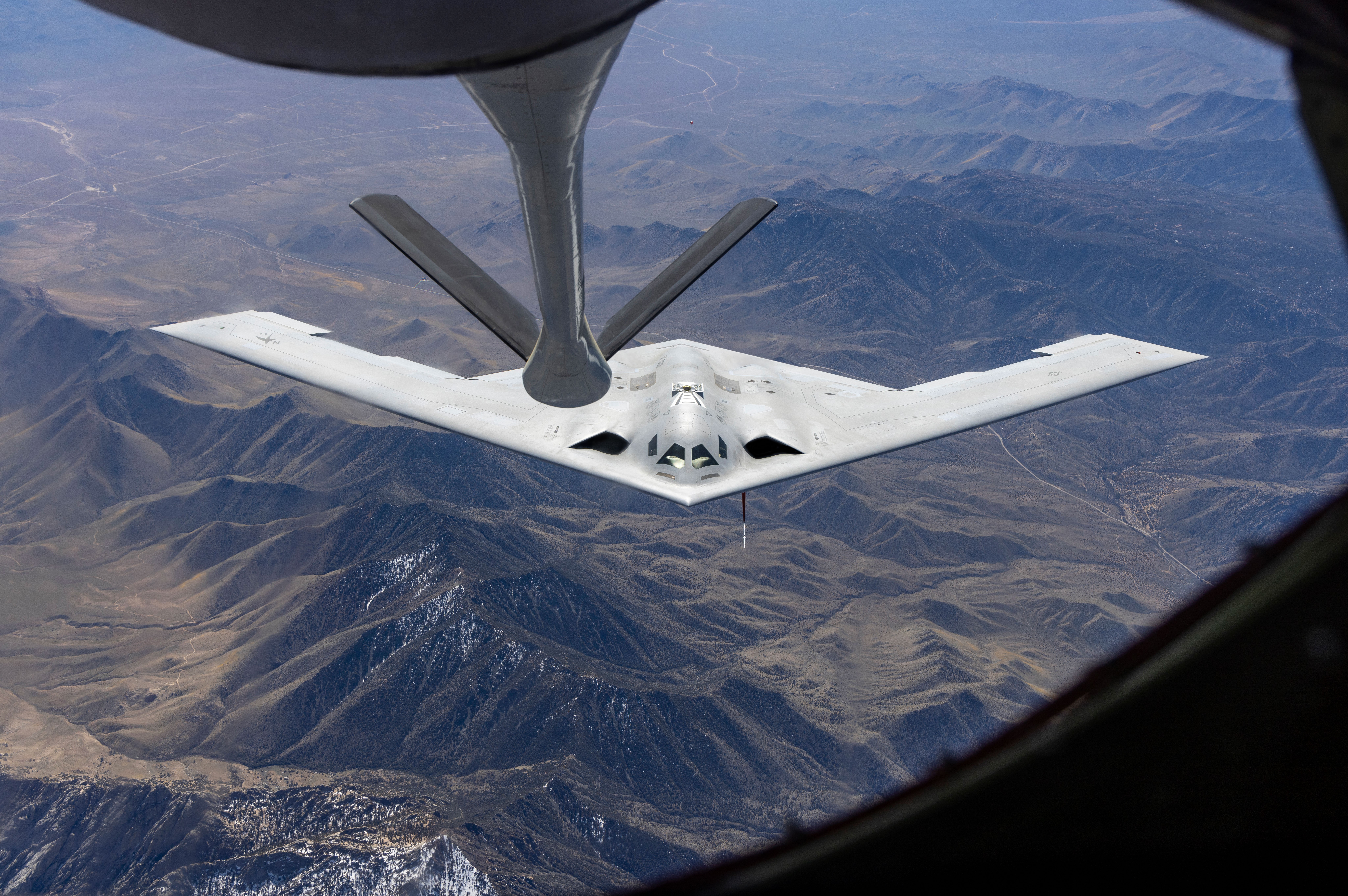
The maxim, “it’s not what’s on the outside, it’s what is on the inside that counts,” may be applied to people and beauty, but it’s also very applicable to next-generation combat aircraft.
Externally, the Northrop Grumman B-21 Raider stealth bomber closely resembles a slightly smaller Northrop B-2 Spirit with a lighter paint job. Trump went so far as to call them “slightly updated B-2s.“
However, the Raider represents around 30 years of technological development.
How the B-21 & B-2 are alike
On the one hand, the B-21 can be viewed as an evolutionary, not revolutionary, low-risk upgrade over the B-2. It retains a similar shape, and its doctrine is broadly comparable, at least when the bombers are compared with non-stealthy bombers like the B-52.
Both are designed with an emphasis on stealth, being able to penetrate contested airspace and be first-day effectors. They are designed to hit protected, valuable, and time-sensitive targets deep behind enemy lines.
The two bombers are designed to be both nuclear and conventional bombers, although the B-2 was designed with more emphasis on the nuclear role, while the B-21 emphasises higher conventional sortie generation.
| Characteristic | B-2 Spirit | B-21 Raider |
| Manufacturer | Northrop Grumman | Northrop Grumman |
| First flight | 17 July 1989 | 2023 |
| IOC / service entry | April 1997 | Expected 2027 |
| Primary role | Multi-role penetrating stealth bomber | Nuclear-capable penetrating strike stealth bomber |
| Secondary roles | Conventional and nuclear strike | Conventional and nuclear strike; designed as part of a broader family of systems |
| Crew | 2 | 2 |
| Planned fleet | 21 produced; 19 remaining | 100+ (perhaps 145+) |
| Wingspan | 172 ft / 52.1 m | ~140 ft / 42.7 m |
| Length | 69 ft / 21.0 m | ~55 ft / 16.8 m |
| Payload | 60,000 lb / 27.2 t (updated USAF figure) | Not publicly disclosed |
| Unrefuelled range | 6,000 nmi / 11,100 km | Not publicly disclosed |
| Engines | 4 × GE F118-GE-100 | 2 × Pratt & Whitney PW800-series-derived engines |
One of the most obvious areas where the two bombers overlap is with their internal weapons bays. Carrying weapons internally dramatically reduces radar cross section.
The B-21 Raider is a continuation of the basic logic of the B-2. A stealthy, subsonic bomber able to penetrate and survive enemy air defence.
Both prioritise low observability and electronic/sensor survivability over the speed, altitude, or massed formations traditionally used to improve bomber survivability.
How the B-21 Raider is a generational leap over the B-2
The B-21 is not an upgraded B-2; it is a fundamentally new aircraft design leveraging the same basic, proven flying stealth wing design as the B-2. Internally, little is the same.
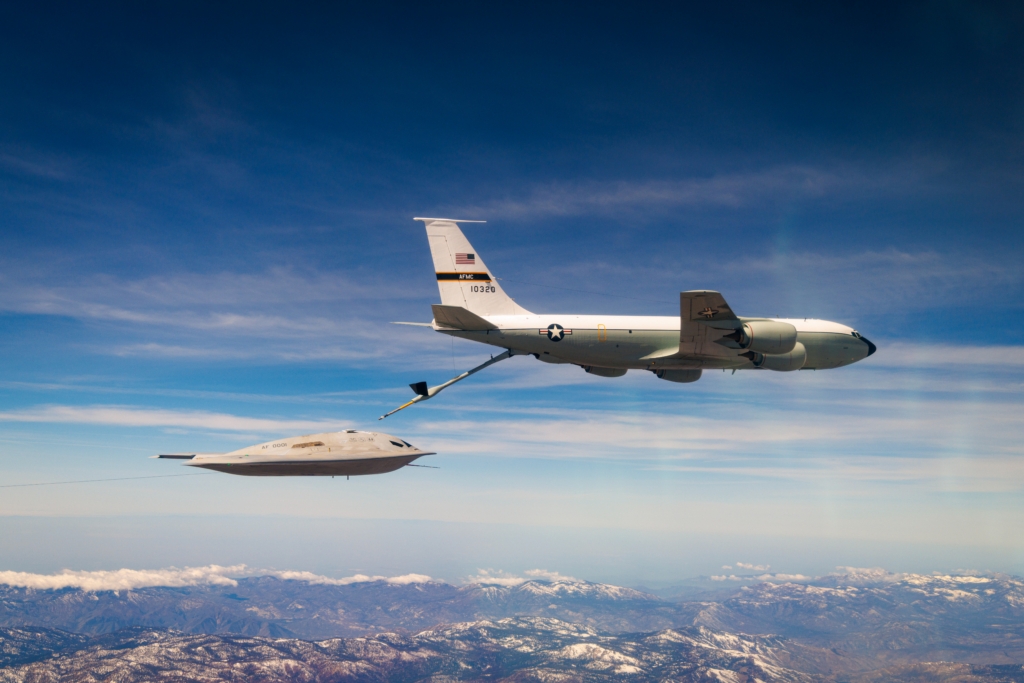
One of the biggest design differences is that the B-21 is designed to be much more cost-effective and to be able to generate a much higher conventional sortie rate.
The ‘hangar queen’ B-2 was designed for nuclear strikes (which require low sortie generation) and to be the first-day effector conventionally. It was designed to pave the way for other bombers to be survivable and deliver mass.
Instead of a relatively niche high-end asset, the Air Force expects the B-21 to be the backbone of the US Air Force’s bomber capability able to operate from forward bases.
The B-21’s survivability is also much more sophisticated than simply minimising frontal radar cross-section. It incorporates next-generation low-observable technologies alongside advanced electronic warfare and other signature-management capabilities.
An important overlooked aspect of stealth is that it is not simply passive. It’s also offensive, with jamming, decoys, and more. Electronic warfare, deception, emissions management, decoys, and networking can all contribute to stealth asymmetry.
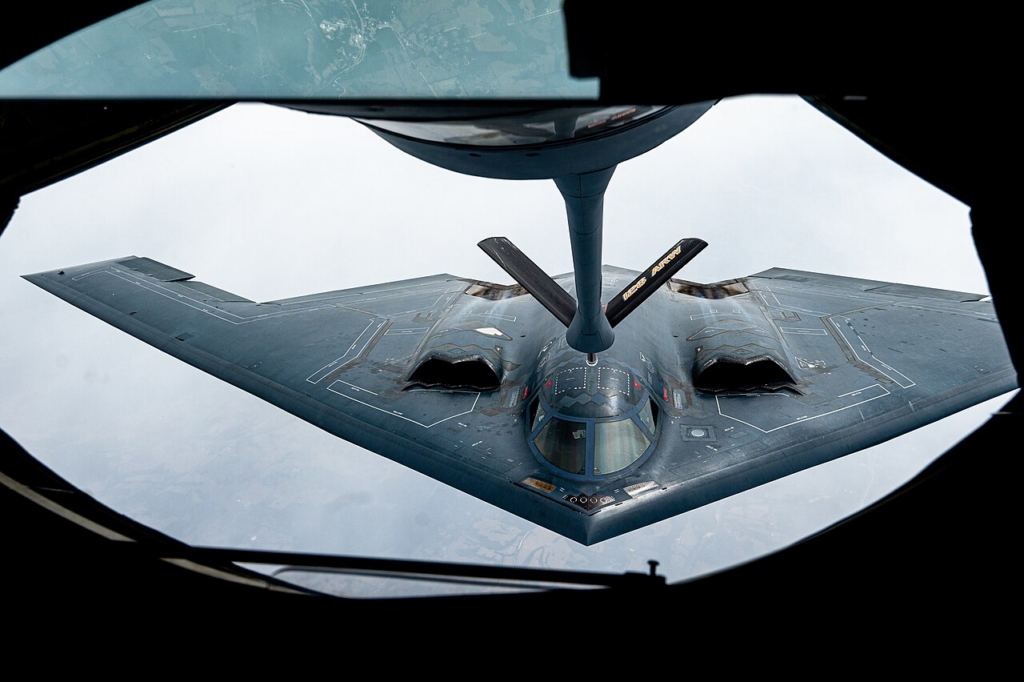
The B-21 likely has advanced thermal management systems, allowing it to operate more power-hungry (and hot) electronics like advanced radars, sensors, and computers.
This can be inferred because of how important thermal management is to the F-35 Block 4 upgrade and the F-47. That said, very little has been disclosed about the B-21’s thermal management.
It can also be inferred that the B-21 will have increased fuel efficiency, giving it a greater range. This would reduce its dependency on vulnerable tankers near contested airspace.
The B-21 Raider is a ‘system of systems’
Perhaps the biggest single difference between the aircraft is that the B-2 can be understood as the last self-contained penetrating bomber, whereas the B-21 is being designed from the outset as a networked node within a much larger combat architecture. It is a ‘system of systems’ combat aircraft.

Northrop Grumman advertises the B-21 as the world’s first operational 6th-generation combat aircraft. It is unclear how much that claim is advertising or a nod to its true networked nature.
The B-21 is designed to be a node within a much larger kill chain. It will network with fighter jets, other bombers, Collaborative Combat Aircraft, satellites, Aegis-equipped destroyers, and other off-board platforms.
This is ultimately why comparing the B-21 and B-2 solely as aircraft can be misleading. The B-2 was revolutionary because of what the aircraft itself could do. The B-21 is intended to be revolutionary not only because of what the aircraft can do, but because of what it can do as part of a connected force, as part of a ‘family of systems.’

Put another way, to understand the B-21, it is critical to also understand its relationship with the US Space Force’s satellites, the Air Force’s future F-47s, etc., and how they all work together.
Even discussing the B-21’s payload vis-à-vis the B-2 becomes problematic, as the B-21 may cue off-board platforms like the B-52J and future CCAs to fire missiles at targets. By contrast, a B-2’s payload can largely be measured by the weapons it physically carries.
Sign up for our newsletter and get our latest content in your inbox.


More from

August 31, 20265 min read


