


Starlink airlines have a speed advantage, Ookla data shows

5 min read

Airlines that have opted for Starlink in-flight connectivity have a measurable lead in the race to offer passengers faster in-flight WiFi, according to new data from Ookla.
The Speedtest company found a widening “LEO divide” between airlines that use low Earth orbit (LEO) satellite connectivity and those that still rely on geostationary (GEO) satellite systems. The difference is showing up in real passenger speed tests.
Ookla notes that airlines with more than 90% speed consistency, including airBaltic at 98.3%, WestJet at 95.8% and Hawaiian Airlines at 95.3%, are “almost exclusively” served by Starlink. The company says airlines below the 50% consistency threshold now face a “distinct competitive disadvantage.”
Starlink’s slowest speeds beat rivals’ average speeds
Ookla’s most striking finding is that Starlink’s slowest users still saw faster internet than the average user on any other satellite network offering in-flight connectivity.
Across more than 50 airlines evaluated, the eight carriers with median download speeds above 100 Mbps were served by Starlink. Half of the airlines with median download speeds exceeding 300 Mbps were also Starlink customers. No Starlink airline fell below 100 Mbps median download speed, while other providers did not approach triple-digit median speeds in the same analysis.
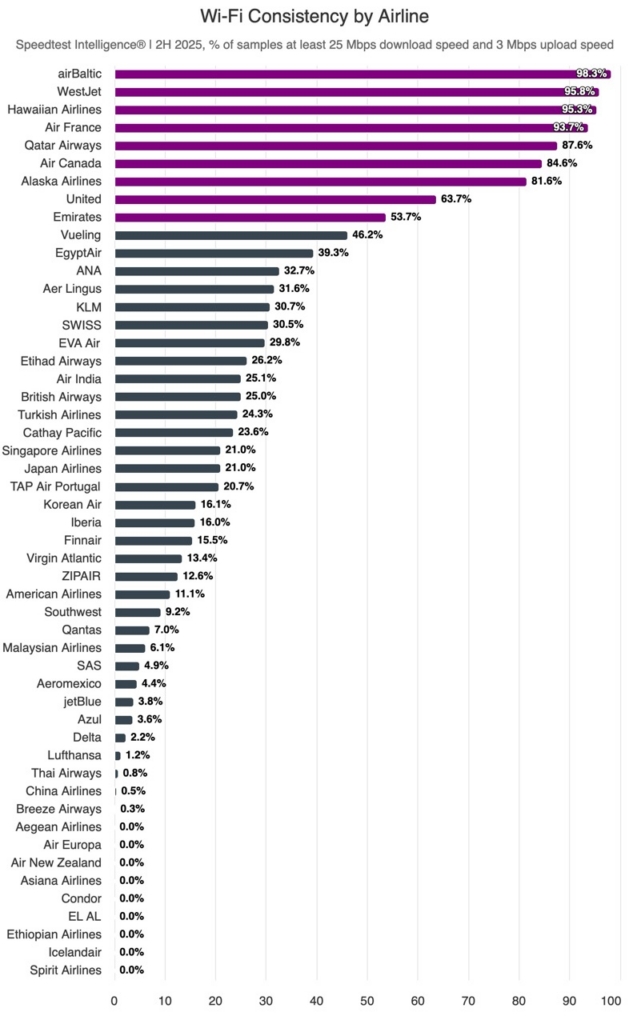
That gives Starlink-equipped airlines a significant advantage in passenger experience. Air travellers want WiFi that can support streaming, cloud work, messaging, and browsing, offering something closer to a home or mobile broadband connection than typical aircraft WiFi.
Starlink captures nearly half of the speedtest samples
Ookla’s Speedtest sample data also points to how quickly Starlink has moved into the airline connectivity market. In Q4 2025, Starlink accounted for 47.8% of commercial airline connectivity Speedtest traffic, ahead of Viasat at 25.1% and Panasonic Avionics at 12.8%.
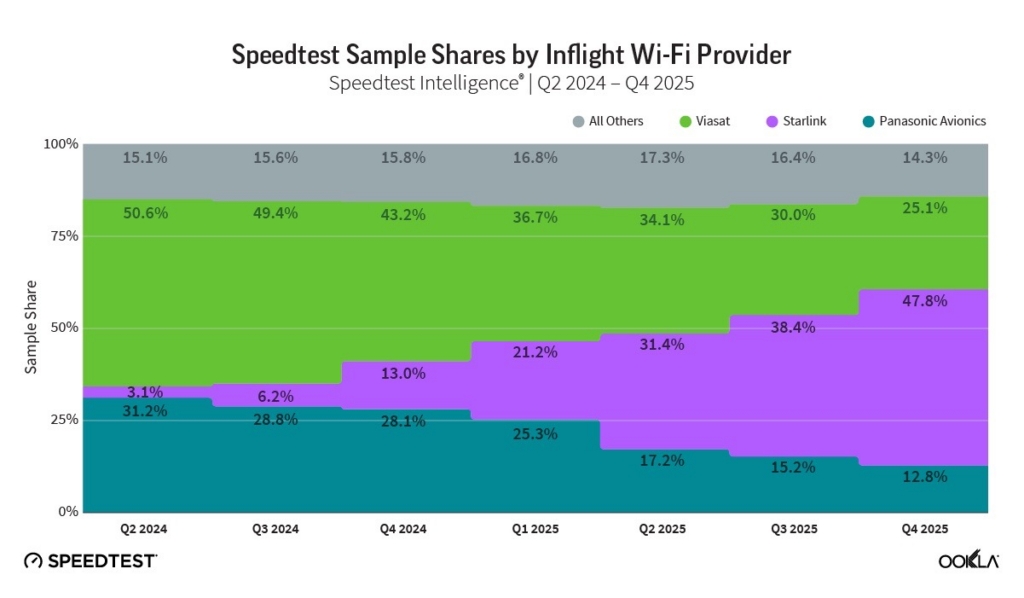
That does not mean Starlink is on nearly half of the world’s aircraft. It means Starlink users are generating a large share of measured in-flight Speedtest activity. So more passengers are using Starlink connections onboard to check their speeds than passengers connected to other satellite services.

Starlink’s lead in this measure may be driven by the novelty of its service, or by technical curiosity—simply a confirmation of the quality of the connection. Still, Ookla finds the trend is significant because passengers are more likely to test and use WiFi when the connection feels fast enough to matter.
The airline WiFi race is accelerating
The speed advantage helps explain why more airlines are lining up for LEO-based systems.
Southwest said Starlink will support next-generation WiFi across its network, with the airline promoting gate-to-gate connectivity that feels like home.
“We know our Customers expect seamless connectivity across all their devices when they travel,” said Tony Roach, Executive Vice President, Chief Customer & Brand Officer at Southwest Airlines, in the airline’s announcement of new Starlink connections this February. “Starlink delivers that at-home experience in the air, giving Customers the ability to stream their favourite shows from any platform, watch live sports, download music, play games, work, and connect with loved ones from takeoff to landing.”

British Airways has already launched its first Starlink-equipped flight, offering free, fast WiFi and allowing voice and video calls via the high-speed service.
Emirates has recently completed the first Starlink installation on an Airbus A380. The airline has more A380s scheduled for accelerated installation through 2026, and has so far installed Starlink on 25 Boeing 777-300ERs. Uptake is good, with Emirates reporting that over 650,000 of its passengers have already used the new Starlink service onboard.
Why LEO Matters
The technical reason for Starlink’s speed advantage is distance. Low-Earth orbit satellites orbit much closer to Earth than geostationary satellites.
As Ookla points out, a LEO satellite is 50 times higher in orbit than an aircraft flying at 35,000 feet, while a GEO satellite is more than 3,000 times higher. That significant altitude difference causes a noticeable delay in data transfer, known as latency. In short, LEO networks can deliver higher data transfer speeds because they are much closer to the end user.
That proximity comes at the expense of the coverage area. A single GEO satellite can cover a much broader zone than a LEO satellite can, which is why LEO satellite constellations require many more satellites in orbit to keep up with moving aircraft. Here too, Starlink has the advantage of having already built a large constellation, currently consisting of 10,327 active satellites, with a planned size of 42,000.

But Ookla cautions that the satellite type is only one part of the connectivity equation. Airlines also need modern onboard routers and aircraft hardware to avoid connectivity bottlenecks.
Two airlines can both advertise “high-speed WiFi” while delivering very different passenger experiences. The best-performing carriers are upgrading the full connectivity stack.
Emirates, for example, added extra wireless access points and a third antenna on the A380 and also optimised inter-deck integration to ensure passengers on both levels of the aircraft would experience the same quality of connectivity.
What the WiFi speed race means for passengers and airlines
For passengers, the practical takeaway of this data is that the airline, aircraft and WiFi provider can determine what you can do with in-flight connectivity. A Starlink-equipped flight is increasingly more likely to support streaming, work calls, cloud documents and social media without the frustration of delays that interrupt data exchange on aircraft WiFi.
For airlines, the stakes are bigger than showing off speed tests. As free, high-speed WiFi becomes more common, in-flight connectivity is turning into a more effective loyalty tool. Most airlines now offering free WiFi do so in exchange for loyalty program membership, which helps shore up airline finances and produces more than enough revenue to cover the cost of those high-speed connections.

Still, the business case for Starlink is harder to make among low-cost airlines, who will expect to recoup installation and service costs sooner and may want to offer the service as an ancillary service for a fee, reducing likely passenger uptake.
Other LEO satellite services, like Amazon’s Kuiper LEO and Eutelsat’s OneWeb are also competing in this space, giving airlines alternatives to provide that fast in-flight WiFi that passengers increasingly expect.
Passengers may not choose to book an airline solely for WiFi yet, but they will remember which flights let them work, stream and stay connected with ease. They will share that experience with friends, colleagues, family and with followers on social media, effectively turning into free advertising for the airline. That metric may be harder to measure, but it helps pay for the costs of connectivity too.
Featured Image: Emirates
Sign up for our newsletter and get our latest content in your inbox.


More from


September 17, 20265 min read

September 17, 20263 min read


September 18, 20263 min read

