DARPA reveals X-76 X-plane designed for jet-speed runway-independent flight

March 10, 2026

The Defense Advanced Research Projects Agency (DARPA) has unveiled the X-76, a high-speed vertical take-off and landing demonstrator designed to combine jet speed with the flexibility of helicopter operations.
The stop-fold tiltrotor aircraft, being developed by Bell Textron under DARPA’s Speed and Runway Independent Technologies (SPRINT) programme, has completed a Critical Design Review (CDR), clearing the way for manufacturing and ground testing of the experimental X-plane.
The X-76 demonstrator is designed to show that an aircraft can combine helicopter-like vertical lift with jet-class cruise speeds, potentially transforming how military forces deploy and operate in contested environments.
DARPA’s X-76 becomes the latest SPRINT experimental X-plane
The X-76 designation places the aircraft within the long tradition of experimental X-planes used to test breakthrough aviation technologies.
The numbering itself is symbolic. DARPA says the designation was chosen as a deliberate nod to the revolutionary spirit of 1776, coinciding with the United States’ approaching 250th anniversary.
The programme is a joint effort between DARPA and US Special Operations Command, reflecting a growing interest within the US military in aircraft capable of operating without runways while maintaining the speed normally associated with fixed-wing platforms.

SPRINT aims to develop technologies that could allow aircraft to cruise at 400 to 450 knots while still retaining the ability to hover and operate from unprepared surfaces.
DARPA’s X-76 aims to bridge the gap between helicopters and fixed-wing aircraft
For decades, military aviation has faced a fundamental compromise. Fixed-wing aircraft offer speed and range but require prepared runways, while helicopters and other vertical-lift platforms can operate from austere locations but are significantly slower.
The SPRINT programme seeks to bridge that gap.

According to DARPA programme manager Cmdr. Ian Higgins, the effort is intended to provide military planners with new operational flexibility.
“For too long, the runway has been both an enabler and a tether, granting speed but creating a critical vulnerability,”
Higgins said. “With SPRINT, we’re building options — the option of surprise, rapid reinforcement and life-saving speed anywhere on the globe without needing a runway.”
Bell’s stop-fold tiltrotor technology powers the X-76 design
At the centre of the X-76 design is Bell’s stop-fold tiltrotor concept, a configuration intended to combine vertical lift with high-speed cruise performance.
The aircraft takes off, hovers and lands like a tiltrotor, similar in concept to the Bell Boeing V‑22 Osprey. However, once the aircraft accelerates in forward flight, its proprotors gradually slow, stop and fold back along the nacelles.
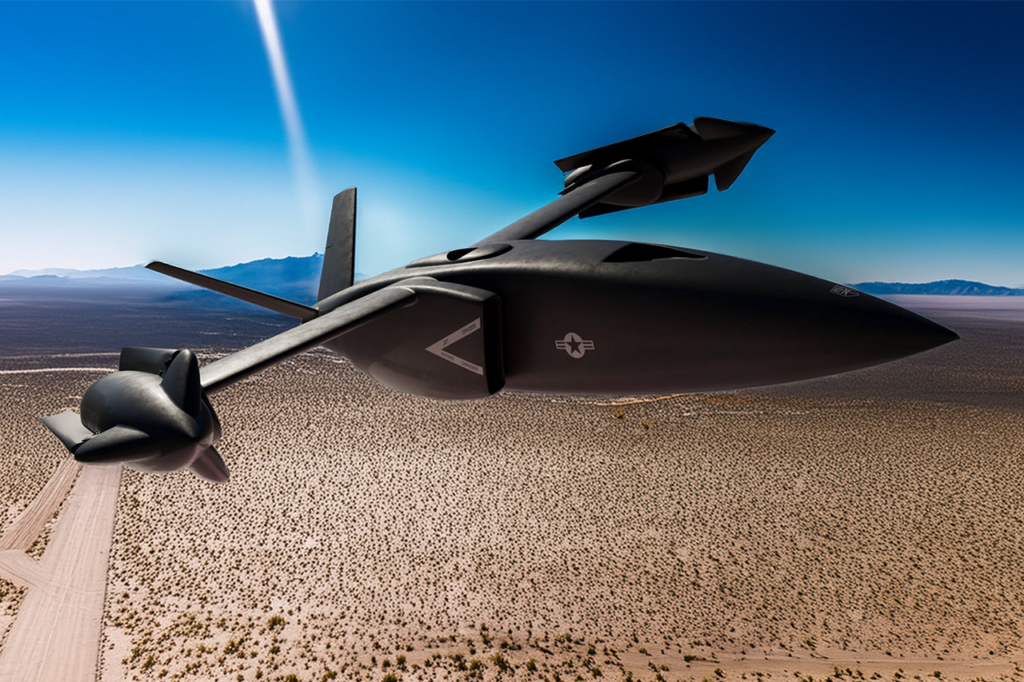
Propulsion then transitions from a turboshaft-driven rotor system to turbofan-based thrust, allowing the aircraft to cruise at speeds far higher than conventional vertical-lift aircraft.
The X-76 demonstrator itself will be uncrewed, designed primarily to validate the stop-fold rotor and propulsion transition in flight.
SPRINT programme testing cleared the way for the X-76 demonstrator
Before moving into the demonstrator phase, Bell carried out extensive risk-reduction testing.
The company demonstrated the stop-fold rotor and propulsion transition using a test sled at Holloman Air Force Base in New Mexico in 2023.

Additional wind-tunnel testing was conducted at the National Institute for Aviation Research (NIAR) at Wichita State University, helping engineers validate flight-control and aerodynamic performance during the transition between hover and high-speed cruise.
These efforts cleared key technical hurdles before the programme entered the next stage of development.
Bell’s experimental aircraft heritage behind the X-76 programme
Bell’s involvement in the programme builds on nearly a century of experimental aircraft development.
The company has experience in building a number of vertical-lift technologies, including experimental aircraft such as the X-14, X-22, XV-3 and XV-15, while also tracing its heritage to the Bell X-1, the first aircraft to break the sound barrier.
Bell was selected for Phase 2 of the SPRINT programme in July 2025, following earlier conceptual and preliminary design work completed during Phase 1.

Phase 2 now focuses on detailed design, construction and ground testing of the X-76 demonstrator. If successful, the programme will move into flight testing under Phase 3, expected to begin around early 2028.
Jason Hurst, Bell SVP, Engineering, said: “This is an important milestone as the Bell and DARPA team advances to a historic first in aviation history and fulfils our mission of developing next-generation vertical-lift aircraft.”
X-76 could lead to a new class of high-speed VTOL military aircraft
If the technology proves viable, the SPRINT demonstrator could pave the way for a new generation of aircraft capable of combining helicopter agility with jet-class speed.
Concept designs have already suggested that the technology could eventually scale to larger crewed aircraft, potentially approaching the size of platforms such as the Lockheed Martin C‑130 Hercules.
For DARPA and the US military, the X-76 is intended not just as an experimental aircraft but as a demonstration of a future capability, one that could allow forces to deploy rapidly, operate from austere locations and reduce reliance on vulnerable runways.
“The Bell team looks forward to seeing X-76 take flight and bring this capability to our warfighters,” added Hurst.
The X-76 follows the earlier X-68 designation announced in February for an air-launched, missile-carrying uncrewed aircraft being developed by General Atomics Aeronautical Systems as part of DARPA’s LongShot programme.