


Indian Air Force grounds Tejas aircraft after alleged crash: HAL denies incident

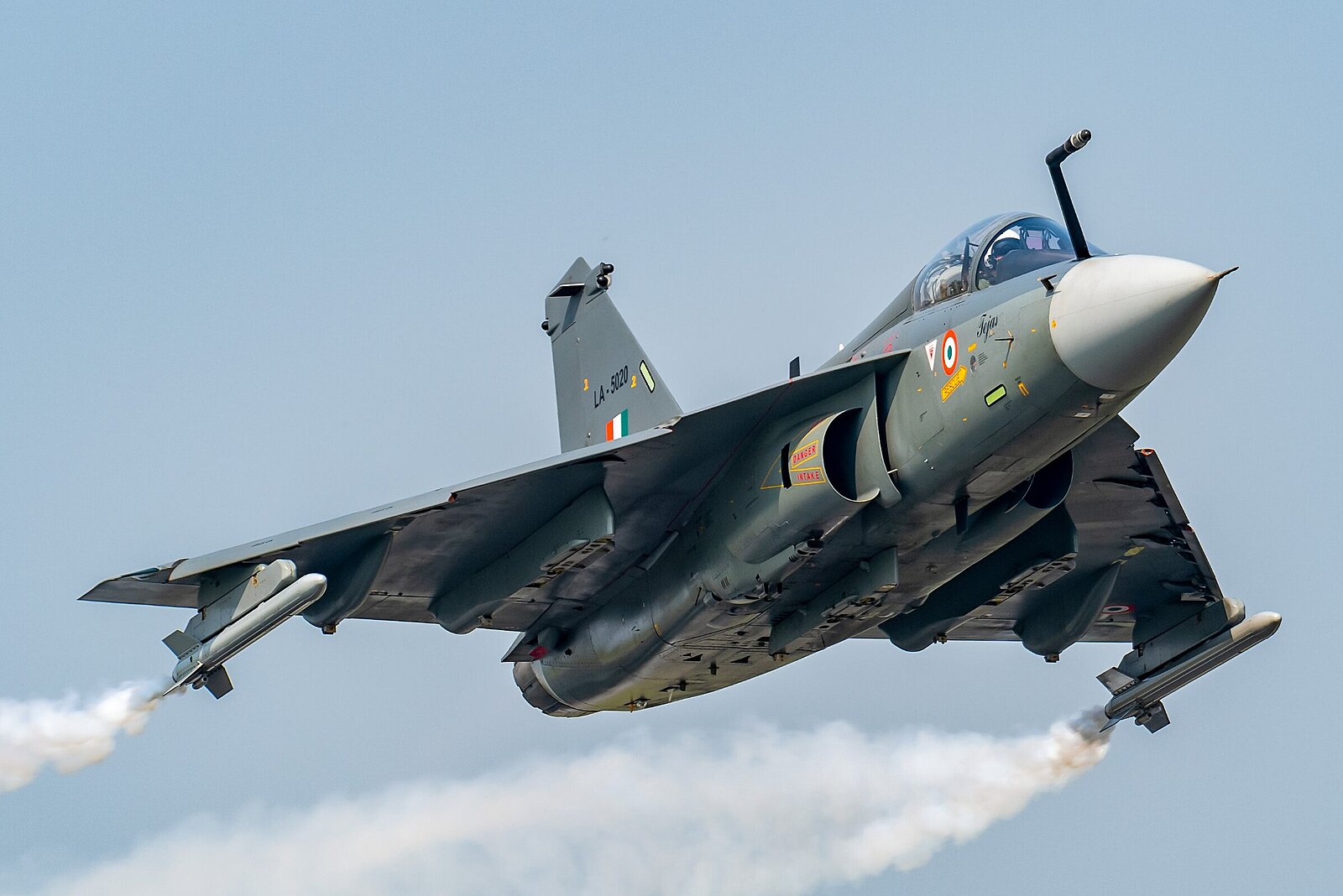
Questions have emerged over the operational status of India’s Tejas fighter fleet after reports suggested that an aircraft was lost earlier this month and that the Indian Air Force had halted flying operations for technical checks.
Manufacturer Hindustan Aeronautics Limited (HAL) has now issued a firm clarification, stating that no crash occurred and describing the episode as a minor technical incident on the ground.
The Indian Air Force has not yet issued any public statement on the matter.
Did a Tejas fighter jet crash?
The initial report, first carried by PTI and subsequently amplified by several media outlets, stated that a Tejas Light Combat Aircraft suffered severe damage while landing at a frontline airbase after a routine training sortie.
According to those reports, the aircraft overshot the runway and sustained heavy structural damage, with the pilot ejected safely. Some accounts pointed to a suspected braking malfunction, though no official confirmation has been provided.
Reports further suggested that the IAF had grounded its single-seat Tejas fleet, numbering around 30 aircraft, pending an intensive technical probe.
HAL has strongly disputed the characterisation of the event as a crash.

“HAL acknowledges the recent media reports on the LCA Tejas incident and wishes to provide factual clarification,” a spokesperson of HAL told AGN.
“There has been no reported crash of the LCA Tejas. The event in question was a minor technical incident on ground. LCA Tejas maintains one of the world’s best safety records among contemporary fighter aircraft. As a standard operating procedure, the issue is being analysed in depth and HAL is working closely with the Indian Air Force for a speedy resolution.”
The absence of an official Air Force statement leaves the operational picture unclear.
Tejas runway incident raises questions over IAF fleet grounding and aircraft damage
In military aviation, the distinction between a crash and a ground technical event is not semantic.
A crash implies the loss of an aircraft following loss of control or impact. A runway overshoot, while potentially serious, may not result in the aircraft being categorised as destroyed.
Sources familiar with the episode indicate that the airframe suffered significant structural damage. The airframe comprises the fuselage, wings, landing gear and tail assembly, the structural backbone of the aircraft.

Fighter airframes are engineered for high-speed aerodynamics and heavy manoeuvre loads, but landing incidents can still impose severe stresses, particularly on the landing gear and lower fuselage.
Whether the aircraft will be repaired or written off will depend on technical and economic evaluation.
Temporary checks across a fleet following an incident are standard practice. However, without official confirmation from the IAF, it remains uncertain whether a full grounding has been imposed or whether limited inspections are underway.
Third Tejas incident since induction puts HAL and IAF safety record under scrutiny
The Tejas has suffered two confirmed losses since induction into IAF service.
In March 2024, a Tejas crashed near Jaisalmer during a training sortie. The pilot ejected safely.
In November 2025, a Tejas performing at the Dubai Airshow crashed during an aerobatic manoeuvre, killing the pilot. That accident, witnessed by thousands, led to a formal court of inquiry, which is still ongoing.
Rest in Peace Brother 🙏🙏🙏#Tejas Crash @ Dubai Air Show pic.twitter.com/7TruDGSuIh
— Professor (@Masterji_UPWale) November 21, 2025
If the latest episode were formally classified as a crash, it would mark the third airframe loss. HAL’s statement makes clear that the company does not view the event in that light.
The timing is particularly sensitive. The Tejas programme sits at the centre of India’s fighter modernisation effort, as the IAF struggles with declining squadron strength well below its authorised level of 42.5 squadrons.
Tejas Mk1A delays and GE F404 engine supply issues add pressure on HAL and IAF
The upgraded Tejas Mk1A variant is critical to reversing that decline. The IAF has placed orders for 180 Mk1A aircraft in two tranches — 83 under a ₹480 billion ($5.3 billion) contract signed in 2021 and a further 97 under a ₹624 billion ($6.9 billion) agreement concluded last year.
Deliveries have slipped behind schedule, largely due to disruptions in engine supplies from GE Aerospace.
The F404-IN20 engines powering the Mk1A faced production delays following pandemic-era supply chain challenges.

In January, HAL told AGN that five Mk1A aircraft were fully ready for delivery and that nine additional aircraft had already flown, pending engine integration. HAL also stated that the engine supply outlook had improved and that discussions with the IAF were ongoing to align deliveries.
The IAF has indicated that it will conduct another comprehensive review of the Mk1A programme in May before confirming induction timelines.
The Mk1A introduces a series of enhancements over the original Tejas Mk1, including an Active Electronically Scanned Array radar, upgraded electronic warfare systems, improved maintainability features and higher indigenous content.
For the Air Force, the aircraft is not merely a symbolic programme but an operational necessity intended to replace ageing MiG-21 fighters while complementing heavier platforms such as the Su-30MKI and Rafale.
Tejas programme remains central to India’s defence ambitions
The Tejas is the product of decades of indigenous design effort led by the Aeronautical Development Agency and built by HAL. It has been positioned as a cornerstone of India’s push for defence self-reliance.
HAL’s assertion that the Tejas maintains “one of the world’s best safety records among contemporary fighter aircraft” reflects confidence in the platform’s operational history.

Modern combat aviation, however, is unforgiving. Even relatively minor technical anomalies can draw intense scrutiny when programmes carry strategic and political weight.
For now, the confirmed facts remain limited. An incident occurred during landing. The pilot ejected safely. Structural damage was sustained. HAL denies that a crash took place. The IAF has not issued a public statement.
Until official findings are released, the Tejas programme finds itself navigating another episode in the demanding lifecycle of any frontline fighter fleet, where operational urgency, industrial ambition and safety oversight intersect.
Featured image: Government of India


