Czech firm Zuri reveals ITAR-free hybrid-electric cargo tiltrotor drone

3 min read
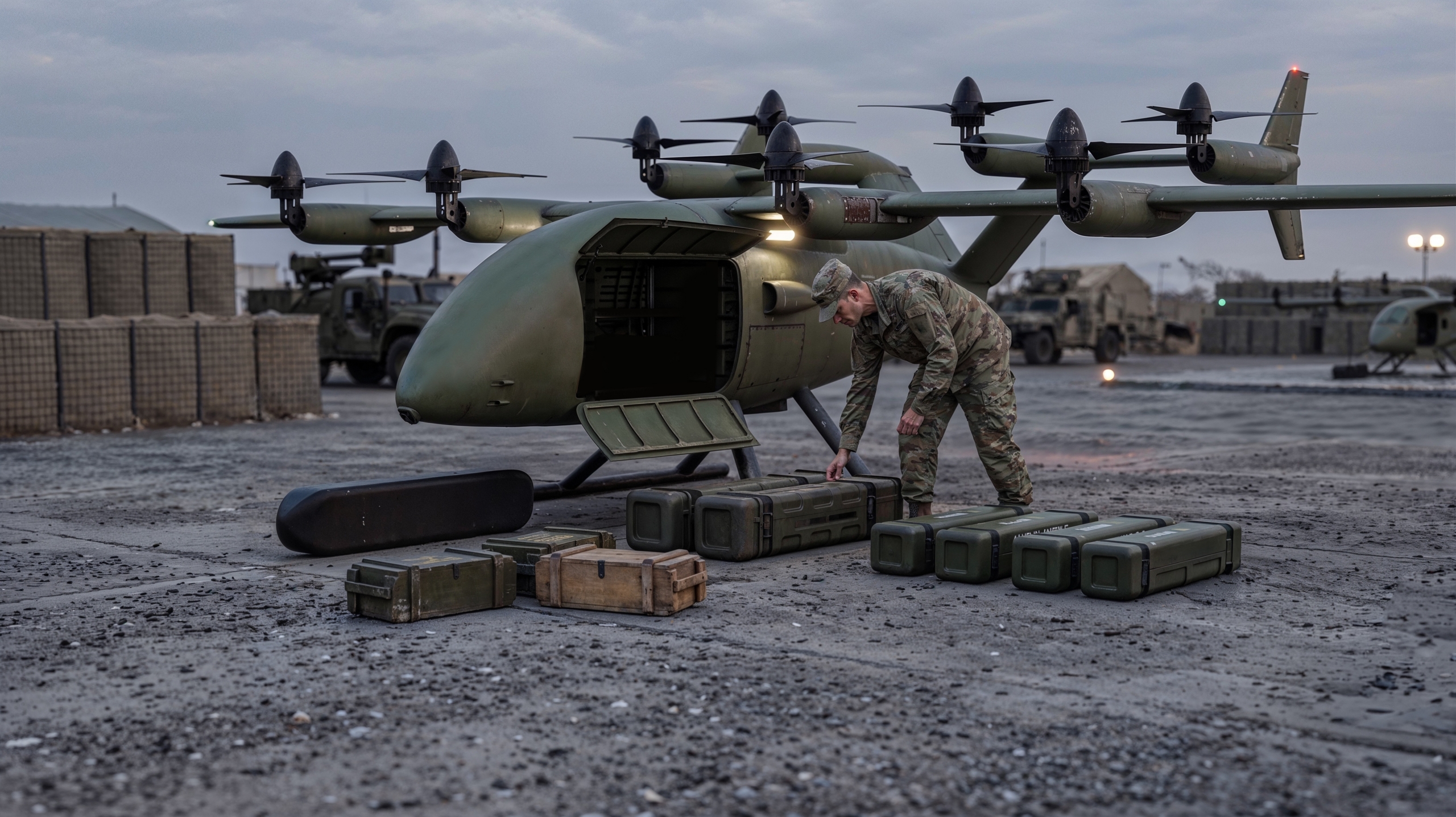
As part of its longer-term ambition of developing a six-seater passenger aircraft, the Czech Republic’s Zuri has developed an uncrewed hybrid-electric cargo VTOL as its first commercial product. The dual military and commercial aircraft is seen as a faster path to revenue for the start-up company.
Zuri unveils hybrid-electric VTOL tiltrotor drone
On 27 August, the Czech aerospace company Zuri unveiled its new uncrewed cargo VTOL hybrid-electric tiltrotor demonstrator. The aircraft is built on the earlier Technology Demonstrator 2.0 and is designed for both civil and defence operations.
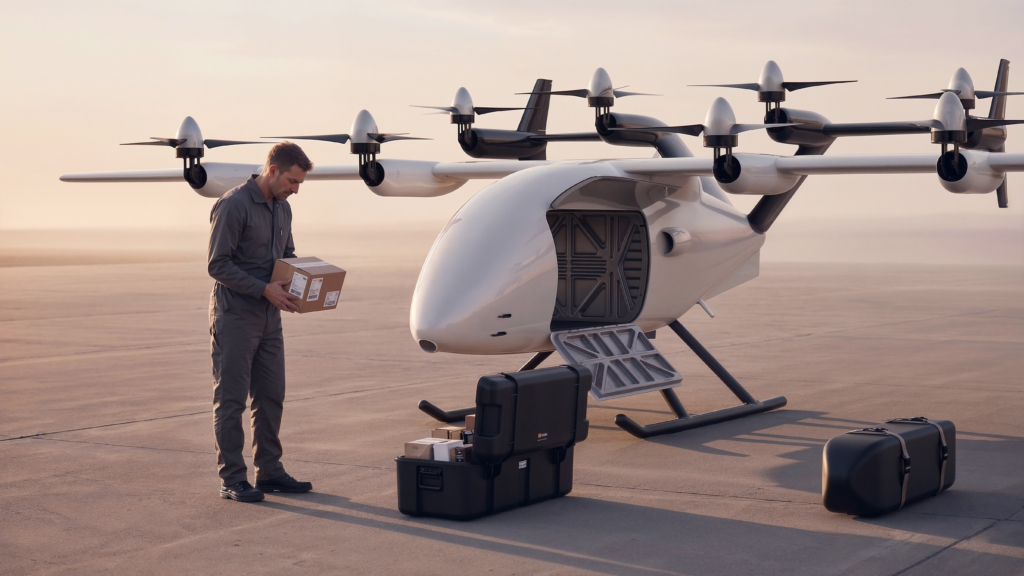
Like other aircraft, range is influenced by payload. Carrying 100+ kg, it can fly over 679 kilometres without reserve or 569 km with a 30-minute reserve.
Zuri’s hybrid tiltrotor cruises at 220 km/h and has a useful load of 165 kg. It is able to land on a deck, open ground, or a pad.
Zuri claims the cargo drone will be better able to supply oil rigs in the North Sea, islands, and reach other places (e.g., the Baltic states) more efficiently than today’s helicopters, supply vessels, or trucks in several use cases and niches.
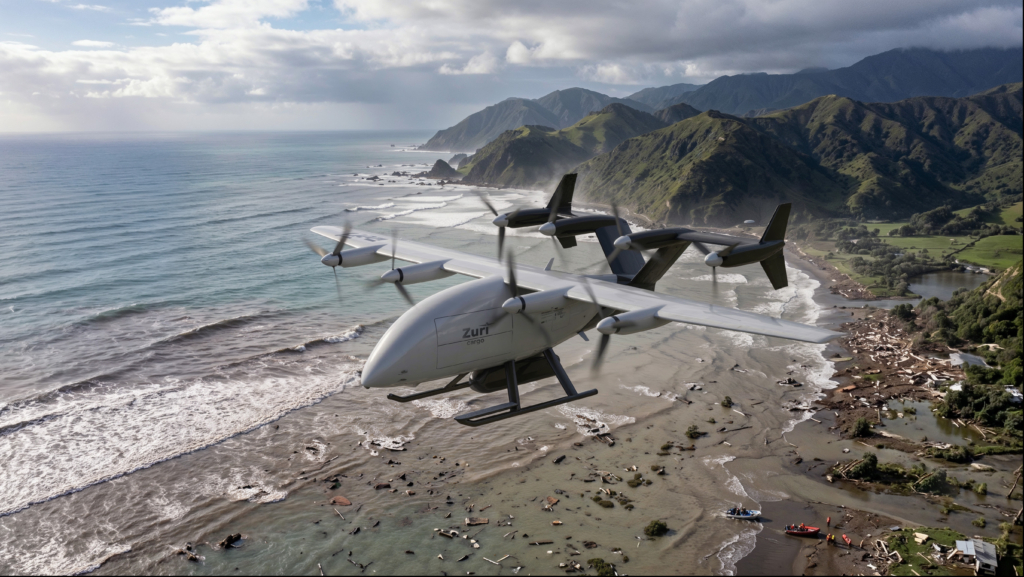
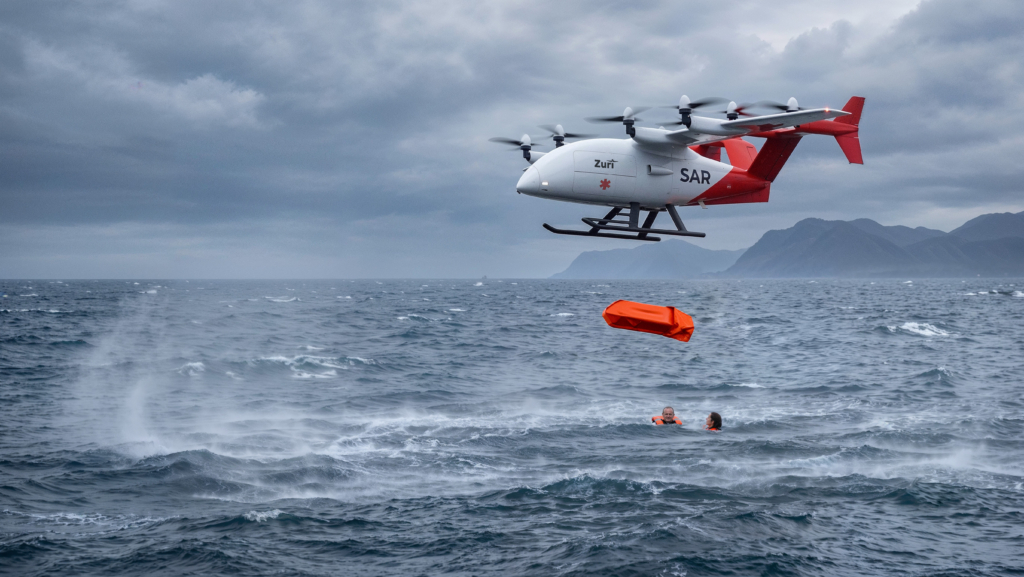
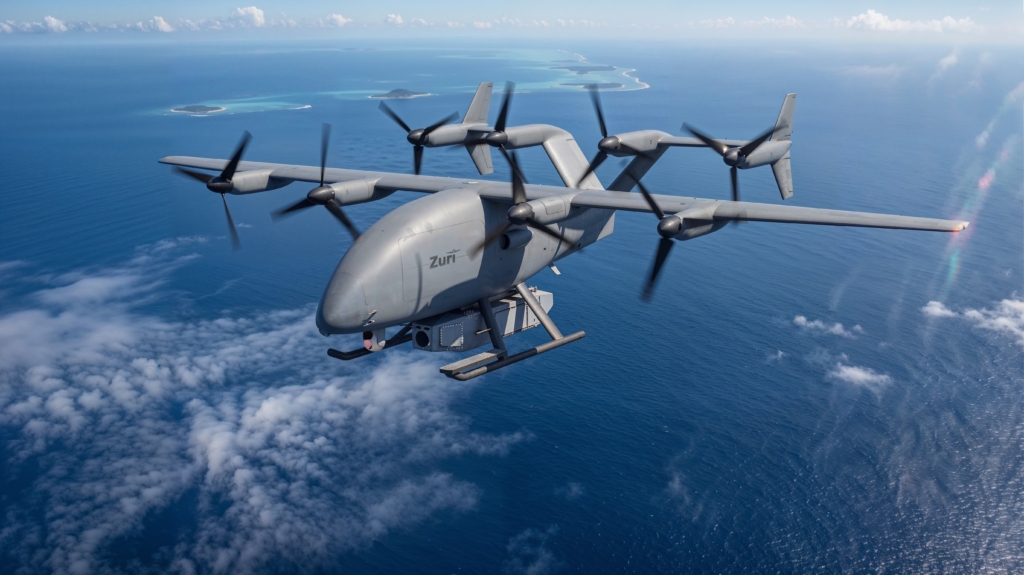
The three roles Zuri identifies for the aircraft are cargo up to 145 kg (at 679 km) or 115 kg (at over 272 km), ISR & sensing, and serving as a communications relay, providing radio and satellite links at altitude. In the ISR role, “sensors trade payload for distance: up to 1,908 km on extra tanks, sensors only.”
A sovereign European cargo drone solution
The world’s MALE cargo drone market is currently being dominated by China and, to a lesser extent, the United States. But there are European companies in the field, although Zuri’s aircraft seems smaller than the MALE category.
A common theme of cargo drones is a military or dual-use focus. Importantly from the point of view of European defence procurement, Zuri claims the aircraft is ITAR-free and built using a “sovereign European supply base.”
With Zuri’s cargo drone, cargo is carried in a sealed bay within the airframe, although it also carries a pod underneath with sensors, a communications relay, or more cargo, depending on the mission.
The aircraft’s eight rotors provide distributed propulsion without a single point of failure. If a rotor is lost, the aircraft is still controllable. If the generator fails, the battery is able to land the aircraft, providing the redundancy of a second engine of a helicopter.
Its combustion engine powers the generator to produce in-flight electricity, and it can run on AVGAS, petrol, and bioethanol.
First commercial deliveries expected between 2027 and 2029
Zuri says, “Technology Demonstrator 2.0 carries the whole architecture in one full-scale aircraft and is in systems integration and ground test in Prague now.” Flight testing is set to begin in early 2027, with commercial deliveries expected in the 2027 to 2029 window.
According to the announcement, six of the programme’s eight graded risks have already been retired, while the remaining two graded risks are integration and flight test.
Michal Illich, founder and CEO of Zuri, said, “We spent nine years and more than fifteen aircraft teaching ourselves what this architecture can do. The uncrewed cargo VTOL is the first one we are building for someone else to fly. This round funds the demonstrator and its full flight test campaign.”
Flights are not fully autonomous, as they remain remotely piloted, with an operator in command from the ground.