A new stealth fighter for the US Navy: What we know about the F/A-XX so far

4 min read

The competition is over. On 29 September, the US Navy selected Boeing to build the F/A-XX under a development contract worth more than $20 billion.
Northrop Grumman was the final challenger after Lockheed Martin was eliminated in 2025.
Here’s everything you need to know about the F/A-XX programme.
What is the F/A-XX programme?
The US Navy’s F/A-XX programme was one of the most consequential fighter competitions since the Joint Strike Fighter.
Designed to replace the F/A-18E/F Super Hornet in the 2030s, the aircraft will anchor the naval branch of Next Generation Air Dominance (NGAD), operating from aircraft carriers alongside uncrewed air systems and networked sensors.
Although many details remain classified, a combination of official disclosures, budget documents and industry activity in recent years paints an increasingly coherent picture of the jet’s intended role, expected capabilities and future development path.
What might the F/A-XX look like?
Although none of the imagery released so far reflects a final design, the concepts previously published by Northrop Grumman and Boeing provide a sense of the direction of travel.
The suggestive design rendering by Northrop Grumman shows the nose and cockpit with a bubble canopy, indicating a single-pilot design.

The design also suggests:
- A broad chine-blended fuselage with significant belly volume for fuel and weapons
- Twin nose gear wheels, a hallmark of heavy bring-back loads and high-energy carrier landings
- A tailless or semi-tailless overall configuration, consistent with next-generation stealth optimisation
The emphasis on internal volume mirrors the Air Force’s NGAD design language and reinforces the idea that the F/A-XX will be built around range, signature reduction and sensor capacity, not raw dogfighting performance.
Aviation Week previously reported that Boeing had revealed a rendering of its proposed F/A-XX design, indicating similarities with the F-47.
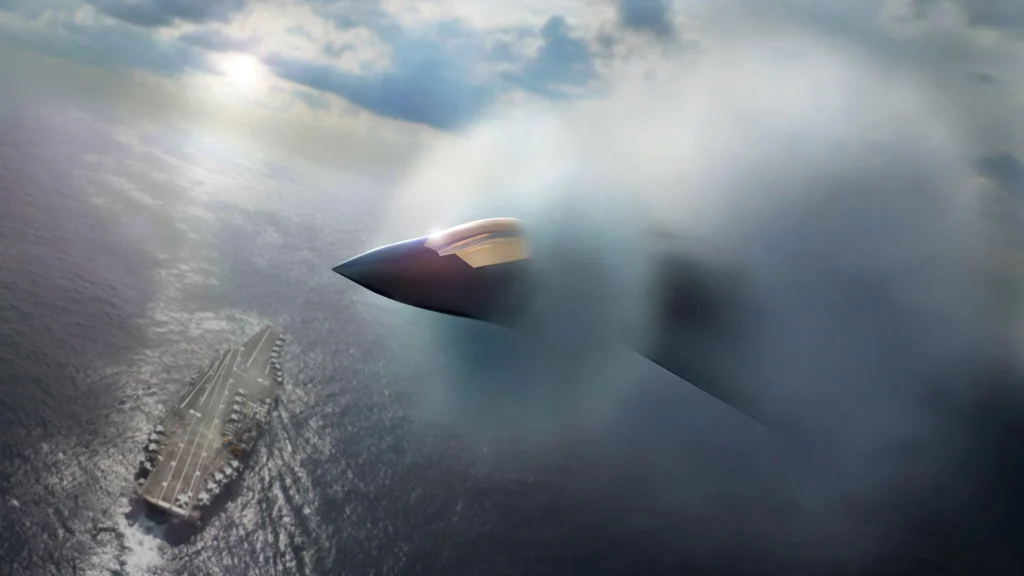
Boeing has released other concept art, too, although there’s no guarantee that these reflect the design on the table.
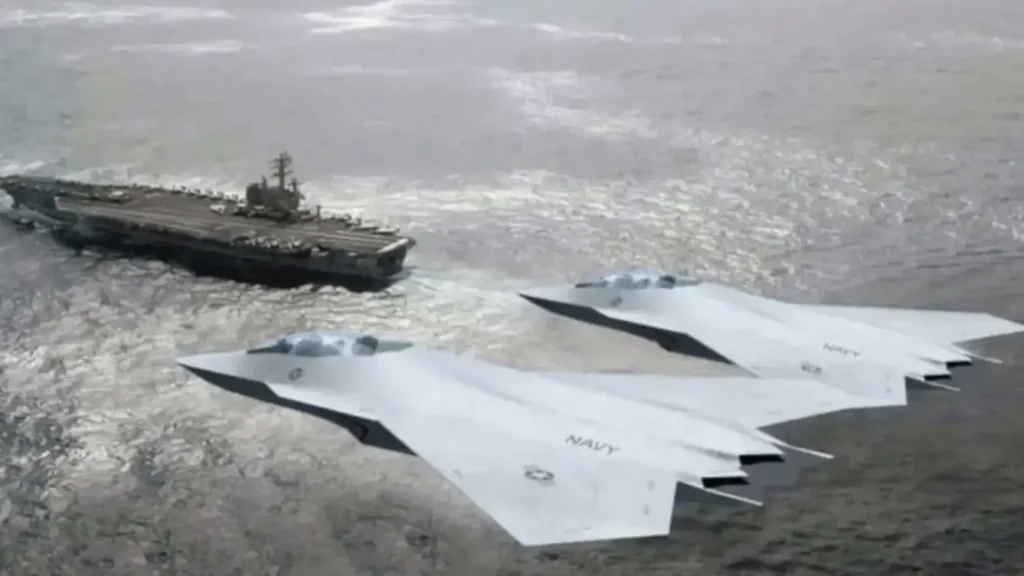
Based on the renders, Boeing’s concept shares a strong outward lineage with its F-47 work:
- A long, slender forward fuselage and crease lines similar to the F-47’s nose
- A blended wing-body arrangement
- A planform optimised for low observability from both frontal and low-angle radar perspectives
The overlap between Boeing’s F-47 and F/A-XX efforts is unavoidable. It may offer economies of scale in design tools and aerodynamics, though it also poses resourcing risks for the manufacturer.
What will the US Navy’s F/A-XX be capable of?
Most of the programme’s classified elements sit in the onboard systems rather than the airframe, but several key themes are clear.
Stealth and survivability
While technical details remain classified, the F/A-XX is widely expected to build on the F-35’s low-observable design with:
- Edge-aligned shaping with few discrete surfaces
- Broad-spectrum signature control, including infrared and electronic emissions
- Internal weapons carriage sized for long-range anti-ship and air-to-air missiles
Range and persistence
Pacific basing distances require far greater unrefuelled range than legacy fighters can provide. The design is expected to prioritise:
- A large internal fuel fraction
- Highly efficient variable-cycle powerplants
- Potential integration with uncrewed refuelling assets on or off the carrier
- Sensor fusion and open architecture

The aircraft is likely to include:
- A panoramic multispectral sensor suite
- Adaptive mission systems allowing rapid upgrades
- Deep integration with uncrewed wingmen, deck-launched drones and future networking standards
Weapons and mission roles
The jet is expected to replace both the air-to-air and strike mission sets of the Super Hornet, including:
- Long-range air superiority
- Maritime strike with future large-diameter weapons
- Stand-off missile carriage for counter-surface and counter-ship roles
- Electronic-attack features built into the airframe rather than via external pods
Why Boeing won the F/A-XX contract
Boeing, Lockheed Martin, and Northrop Grumman all submitted competing bids for the design of the sixth-generation stealth fighter. In March, Lockheed Martin was eliminated from the competition.
After more than 18 months of uncertainty, the Navy finally awarded the contract to Boeing on 29 September 2026. The decision came just before the end of the fiscal year, after Congress repeatedly pushed the Pentagon to move forward with the programme and preserve funding.
Boeing also won the Air Force’s F-47 fighter contract in 2025, making it the prime contractor on both of the Pentagon’s sixth-generation fighter programmes.

From selection to execution
The focus now shifts from source selection to execution. Boeing must prove it can deliver both the F-47 and F/A-XX simultaneously while meeting timelines for fielding next-generation air superiority capabilities.
Boeing is expected to deliver its final F/A-18s in 2027 and then shut down the production line. It is also moving to ramp up F-15EX Strike II production to a rate of 24-36 per year to meet new Air Force and export orders.
The Navy expects the F/A-XX to begin augmenting and eventually replacing F/A-18E/F Super Hornets and EA-18G Growlers during the 2030s, extending the range and survivability of future carrier air wings.