


Ukraine’s new Behemoth long-range drone turns to Shahed technology to strike Moscow

5 min read
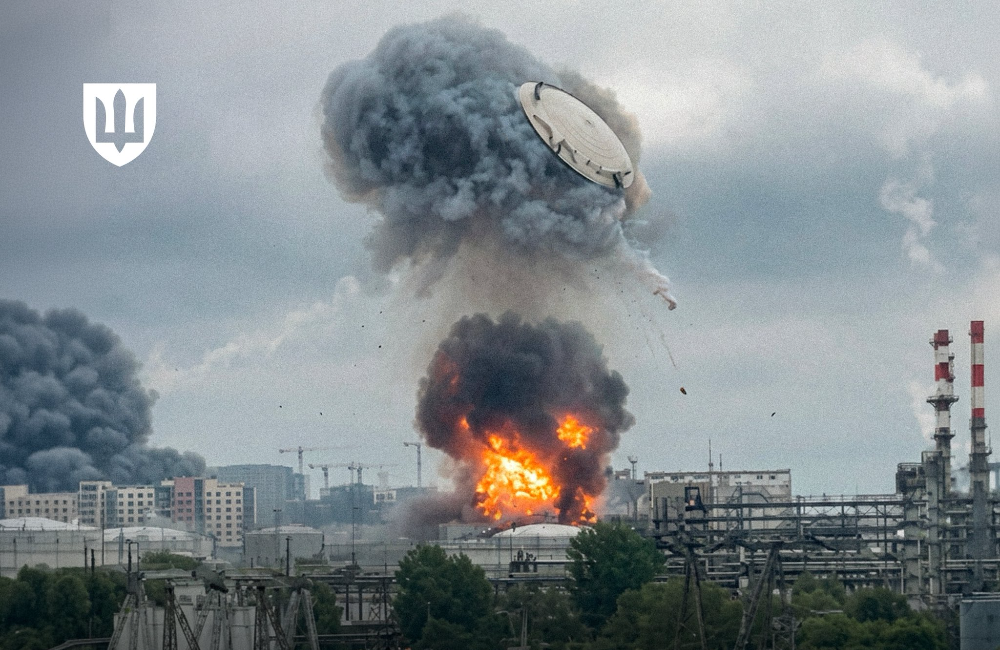
In yesterday’s impressive broad daylight attack on Moscow, Ukraine deployed what appears to be a deep strike variant of its new Behemoth Shahed-type drone. While Ukraine has developed various types of one-way attack drones, it is finally making Shahed-type drones.
Ukraine deploys Behemoth drone against Moscow
Ukraine launched a massive attack on Moscow using a large range of drones. This came the same day AGN reported Moscow was banning light aircraft and drones over city airspace.
Thanks to this footage, we can be almost certain that the Shahed-like drones seen attacking Moscow in large swarms today were the new Ukrainian Behemoth drones.
— Special Kherson Cat 🐈🇺🇦 (@bayraktar_1love) June 18, 2026
Behemoth features distinctive, pointy, wingtip extensions that set it apart from other Shahed-type UAVs. Those unique… https://t.co/mwpiej4rEC pic.twitter.com/fwb4VGXiF4
Thanks to a seemingly unlimited amount of videos taken by Moscow residents and promptly shared online, the world was greeted with one of the best documentations of any Ukrainian strike package.
Footage shows Ukraine’s famous FP-1 drones striking targets, hitting cranes, and being shot down. But also among the drones are the Bars cruise missile, the Morok strike drone, the AN-196 Lyuty, and the Shahed-looking UAVs that include the new Behemoth Shahed-type drone.
This is the first time Ukraine’s new Behemoth drone is known to have been used to strike Moscow, although its usage has dramatically ramped up in June. Behemoth is readily distinguishable by its distinctive wingtips.
On the 7th of June, Special Kherson Cat reposted footage claiming to show Ukraine’s CODE 9.2 unit striking the Chongar Bridge connecting Crimea with mainland Ukraine (the occupied land route to Russia).
A video showing the Behemoth drone by Culver Aerospace.
— DanielR (@DanielR_PhD) June 17, 2026
In a few days, I will release a story on this drone. pic.twitter.com/msNOi6PqXy
On the 17th of June, NOELREPORTS posted, “Ukraine’s 147th Artillery Brigade became the first newly formed artillery brigade to use Behemoth medium-range kamikaze drones, 7th Air Assault Corps said.
It adds, “Targets included an ammo depot in Staromykhailivka, a battalion command post in Selydove, and a troop gathering point near Kurakhove.”
Behemoth was first unveiled in May
Militarnyi first reported on the Behemoth in May 2026, saying the drone was presented at the Wild Drones event by representatives of GLEFA and Culver Aerospace. As of the time of writing, Culver Aerospace does not appear to have any information related to the Behemoth on its website.
The Armed Forces of Ukraine have received the Behemoth medium-strike drones.
— распад и неуважение (@VictorKvert2008) June 17, 2026
The first strikes using these drones were carried out against military targets in Donetsk: an ammunition depot in Staromykhailivka, a command post in Selydove, and a concentration of Russian fascists in… pic.twitter.com/DjSzhwM91p
Militarnyi said they spoke with the representatives. It said the drone belongs to the middle-strike class of drones with a combat range of up to 300 kilometres.
The distance from Ukrainian held-territory to Moscow is at least 450 kilometres, and considerably more if the drones had to fly circumventious routes around Russia’s air defence. It is unclear how these drones managed to fly all the way to Moscow; perhaps these drones had a reduced warhead.
🌉💥 The CODE 9.2 unit has released footage of today's strike on the Chongar Bridge.
— Special Kherson Cat 🐈🇺🇦 (@bayraktar_1love) June 7, 2026
The video shows FP-1/FP-2 drones striking the bridge. But according to the unit, Behemoth UAVs were also used during the operation. https://t.co/mRboc7C1Nx pic.twitter.com/Zw7ztPc1HA
Reporting on the unveiling of the Behemoth in May, Defender Media wrote, “The developers also presented the ‘Behemoth Deepstrike’ version, but additional technical specifications of this modification have not yet been released.”
Get the latest aerospace defence news here on AGN.
Behemoth drone’s reported capabilities
Behemoth can carry a 40 kg high-explosive fragmentation warhead on the nose section with a second 35 kg thermobaric warhead located behind it. It is described as having a wingspan of 2.28 metres, a length of 2.2 metres, and a height or thickness of 0.5 metres.
New footage confirms that an errant Russian surface to air missile was responsible for the tank roof toss at the Moscow Oil Refinery this morning. pic.twitter.com/H5kdsuO2pY
— OSINTtechnical (@Osinttechnical) June 18, 2026
Militaryni wrote, “The drone has already entered serial production and is being used by Ukraine’s Defense Forces. It supports fully autonomous, semi-automatic, and FPV control modes.”
The drone can fly at low altitudes, making it harder to detect and intercept.
The drone is reported to have a cruising speed of 170-180 km/h and a maximum speed of up to 200 km/h. Its launch is rocket booster-assisted and can be launched within 5 to 15 minutes.
The Kyiv Post reported in June 2026, “According to open sources, the Culver Aerospace-developed Behemot probably costs $35,000-50,000/launch.”
Russian forces are scrambling like rats after our FP-2 and Behemoth drones slammed the Henichesk road bridge at least three times. Satellite imagery confirms direct hits tearing up the deck, cutting their precious link between mainland Ukraine and the Arabat Spit.
— medoyid_ua (@LetsArmUKR) June 17, 2026
They're… pic.twitter.com/hUadZ6x6zm
The publication also noted that it is able to cause serious damage because it has been designed to carry a heavier warhead than Iran’s Shahed and that its warhead is designed specifically to penetrate hard targets like roadways or armoured aircraft shelters. This fits with Ukraine using it against bridges on the 7th.
Featured Image: Defense of Ukraine


